

Users no longer search for information online in a traditional way, and businesses need to embrace this reality. Undoubtedly, AI-generated summaries have smartly replaced conventional search results, in which users click links. This transformation is masterminded behind the emergence of a new concept: GEO, or Generative Engine Optimization.
However, what is GEO in simple terms, and why is it crucial in today’s digital era? This blog post will cover “What is GEO” and how you can use it to gain a competitive edge online.
What Do You Mean by GEO?

GEO (Generative Engine Optimization) is an advanced form of SEO in an AI-driven landscape. It not only helps websites appear in conventional Google results but also allows generative AI models such as ChatGPT, Gemini, and Perplexity to understand, cite, and use your content.
Unlike traditional SEO that prioritizes links, keywords, and rankings, GEO favors:
- Organizing information into clear, easy-to-extract fragments.
- Enhancing machine readability: hierarchical headings, lists, tables, and concrete data.
- Developing external authority, guaranteeing your brand becomes a reference source instead of a content publisher.
- Adjusting to various AI engines and understanding each one (Google Gemini, OpenAI, Perplexity, etc.) means interpreting information differently.
Simply put, GEO guarantees that when a user asks an AI a question, your content should fuel the answer.
Why is GEO Crucial?
There is no denying that SEO has influenced digital marketing for years; however, it has its own limitations. It typically depends on keyword optimization, backlink building, and meta tag optimization, which is time-consuming given the ever-evolving search algorithms.
How Does GEO Work?
When you want to rank your content for GEO or generative AI, you should focus on various parameters:
- Don’t underestimate the value of keyword research, as relevant keyword identification helps fulfill the search intent.
- Focus on creating top-notch content that is easy to understand and provides enough value and information. Use simple, easily understandable language to convey the main idea of the topic.
- Follow Semantic SEO best practices by optimizing your content for semantic search. For this purpose, prioritize the context and intent behind search queries.
- The content should be AI-friendly: structure it so it’s easy for AI to process, including clear headings, bullet points, and short paragraphs.
- Use schema markup to help search engines better understand and analyze your website’s content.
How Does GEO Differ from SEO?
| What Has Changed | Conventional SEO | GEO |
| Primary goal | To showcase content in top search positions | AI should mention or refer to in its answers |
| Success metrics | Rankings, clicks, traffic | Mentions, citations, share of voice |
| How do users discover you | Click through to your site | AI incorporates you in generated responses |
| Notable platforms | Google, Bing | Google AI Overviews and AI Mode, ChatGPT, Perplexity |
| How do you optimize content | keywords, site speed, title tags, content quality | Self-contained paragraphs, clear facts, structured data |
| What it takes to build credibility | Reviews, domain authority, backlinks, and author credentials | Positive or affirmative mentions across reputable communities and platforms |
What Factors Affect GEO Rankings?
Different factors influence GEO rankings, including:
Content Standard: You should write informative, engaging, and, above all, high-quality content so it is visible in search engine results.
Keyword Relevance: Identify specific queries and create content accordingly using relatable phrases and keywords. Doing so will help your content prominently display in search results.
User Experience: A positive user experience is crucial for SEO, comprising easy navigation, fast loading times, and more.
Backlinks: Focus on creating high-quality backlinks to enhance your site’s authority. Therefore, consistently acquire backlinks from top-notch websites.
Mobile-Friendliness: Optimize your site for mobile devices to capture mobile users’ attention.
AI-Friendliness: If you want your content to be accessible to AI algorithms, follow GEO principles.
Once you start to understand these factors and apply tactics appropriately, you are likely to improve your content for generative AI and boost your search engine rankings.
Important Strategies for GEO (Actual Implementation)
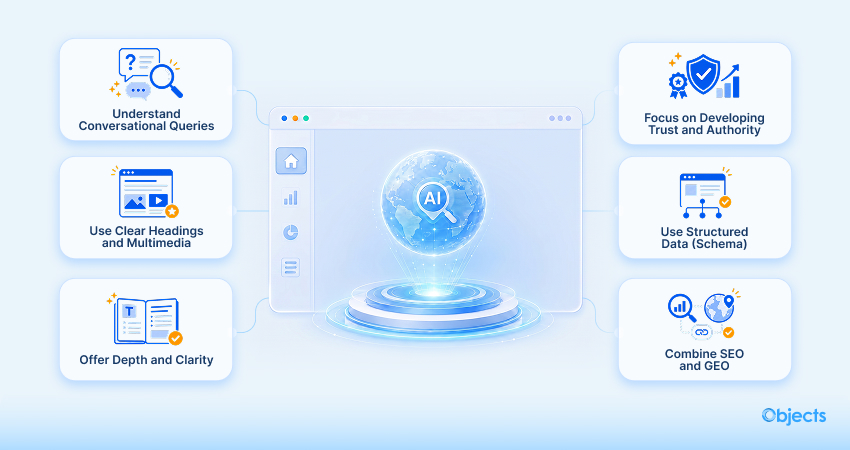
You should not overlook the importance of high-quality and optimized content. That’s because the content that is informative, relevant, and offers value to users holds the key to generative AI.
Thus, you should use a mix of tactics alongside technical SEO to achieve the desired results in the long run. These tactics are described below:
Understand Conversational Queries
As a digital marketing company, you must understand how your existing and potential customers interact with AI systems. Don’t depend on traditional keywords. Instead, consider researching conversational and question-based queries. For this purpose, you should go through Quora, Reddit, AnswerThePublic, and other services that help you discover real questions users ask.
Following such queries, you should create content around them and include headings that correspond to the user’s questions. This way, generative AI can identify your content as user-centric and value-driven.
Offer Depth and Clarity
Your content should delight users through clarity, depth, and comprehensiveness. AI systems prefer content that provides context and offers users firsthand knowledge and experience. Furthermore, your content should transform cumbersome ideas into easily understandable information through examples, bullet points, and lists.
Use Structured Data (Schema)
Consider applying structured data and schema markup. Using a schema, AI systems can easily identify your content type as a listicle, how-to guide, or FAQ. When you use JSON markup and reference citations, publication dates, and author information, you indicate to AI systems that your content is reliable, informative, value-driven, and organized.
Use Structured Data (Schema)
Consider applying structured data and schema markup. Using a schema, AI systems can easily identify your content type as a listicle, how-to guide, or FAQ. When you use JSON markup and reference citations, publication dates, and author information, you indicate to AI systems that your content is reliable, informative, value-driven, and organized.
Focus on Developing Trust and Authority
Follow Google’s E-E-A-T synopsis (Experience, Expertise, Authoritativeness, and Trustworthiness). Generative engines value expert opinions; you should add author bios and reference reputable sources and credible publications.
Do you know EEAT still influences SEO, AEO, and GEO? Yes, it impacts how your content is examined across all search formats.
Follow the Answer-First Approach and Styling
You should create content using the answer-first approach, directly answering user queries. Begin each section with an informative answer and offer a simple summary. Doing so will allow readers and AI systems to process your content without fuss. Use phrases like “You” and “We” often to make content human-oriented.
Use Clear Headings and Multimedia
Improve the content by using clear, descriptive headings. You should add headings (H1, H2, H3, etc.) and natural internal linking. Your website should have a clear sitemap that enables AI crawlers to access and interpret your pages.
You should include relevant images and videos to make your content visually attractive. This way, you can improve GEO performance, since AI engines are likely to extract visuals and tables when producing comparisons or summaries in response to user queries.
Combine SEO and GEO
Follow advanced GEO strategies and abide by traditional SEO tactics, too. SEO helps improve meta titles, meta descriptions, keyword placement, content structuring, etc. On the contrary, GEO prioritizes improving presence in AI-generated answers.
Therefore, perform additional useful activities, such as generating backlinks, optimizing on-page, and more, to enhance overall site authority and trust. GEO is an advanced version of SEO, so your aim is to improve search engine rankings, and AI systems should cite your content when a user asks a relevant question.
Google Confirmed “GEO is Still SEO” (Reddit)
On May 15, 2026, Google updated its Search Central documentation with a new guide titled “Optimizing your site for generative AI features on Google Search.” If any brand wants to improve its SEO, AEO, or GEO game, this update will be crucial, as it will enhance its visibility in the AI search era.

According to this update, Google has emphasized several points that businesses need to keep an eye on. These key points are mentioned below:
SEO Still Relevant and Crucial
Google has once again prioritized generative AI features in Search (AI Overviews and AI Mode). These features follow the same ranking and quality systems that power organic search.
Users don’t need to concentrate on a parallel algorithm or a separate AI index. The same systems that rank blue links also confirm what gets cited in AI responses.
Retrieval-augmented generation (RAG), also referred to as grounding. The AI doesn’t produce answers using its training data. It extracts relevant, up-to-date pages from the Search index and generates responses based on those pages. The clickable links you see in AI Overviews that RAG generates.
Technical Foundations are Key
Technical foundations remain valuable, which means pages must be indexed and eligible to appear with a snippet in AI features. Besides, the content should be crawlable.
Likewise, JavaScript SEO remains applicable; Google can render JavaScript, but users must follow the rules. Moreover, page experience and Core Web Vitals remain relevant. Semantic HTML is also handy, but doesn’t need to be applied perfectly.
Commodity vs Non-Commodity Content
Firsthand experience is key, as users need to focus on non-commodity rather than commodity content. Undoubtedly, generative AI can smartly produce commodity content.
But Google prefers the second form of content: non-commodity content, because it involves the human element. For instance, “ 9 Tips for First-Time Homebuyers”: common knowledge anyone could write about, and it belongs to commodity content.
Similarly, “Why We Waived the Inspection and Saved Money: A Look Inside the Sewer Line” is considered non-commodity content. That’s because it offers an experienced yet unique perspective to readers.
Images and Videos are Valuable
AI features value images, videos, and text. Therefore, users should continue to follow the video and image SEO best practices as they did previously.
Wrapping Up
We hope you enjoyed our blog post that explains the phrase “What is GEO”. GEO helps businesses focus on improving their brands or entities to appear in AI-powered outputs, rather than driving clicks via organic search rankings. Conversion rates from GEO traffic are higher because users are more likely to make informed, impactful decisions.
FAQs
1- Why is GEO the new SEO?
Generative Engine Optimization (GEO) is considered the “new SEO” because it shifts the focus from ranking in search results to being cited in AI-generated answers (e.g., Google’s AI Overviews, ChatGPT). As users worldwide adopt conversational AI for research in large numbers, GEO helps brands remain visible and impactful by enabling LLMs to detect and cite trustworthy content.
2- What is GEO in social media?
Generative Engine Optimization (GEO) is an advanced strategy that favors highly optimized, context-rich, and value-driven content that AI chatbots and generative search engines can easily discover, understand, and use when needed.
3- What is GEO vs SEO?
In simple terms, the main objective of GEO is to include the site or brand’s content in AI-generated answers. Likewise, the key aim of SEO is to improve visibility and get to the top of search results.
4- Is GEO helpful for all industries?
Yes, GEO supports all industries where users ask questions online. That’s because generative AI platforms help users explore related digital content across industries.
5- Can small businesses take advantage of GEO?
Small businesses can gain visibility when their content gets mentioned in AI summaries. GEO empowers them to compete on crucial factors like authority, clarity, and relevance, rather than on budget or backlink volume.
6- How can I begin optimizing for GEO?
You should start your journey by conducting thorough research. Similarly, you should analyze how AI tools answer users’ queries in your niche and industry. Don’t forget to perform competitor analysis to see if AI overviews or model-generated responses highlight them. Benefit from the extracted information and structure your content accordingly.