
The way netizens, readers, current, and potential customers search for information is evolving rapidly. AI search engines have begun to invade conventional organic search, and users get their answers directly on the search results page.
Traditional search engines will likely face tough competition from AI chatbots in the near future, as users find them easier to use and more powerful for exploring and explaining answers.
In plain terms, simply ranking #1 on Google is no longer enough.
“Generative AI solutions have turned out to be substitute answer engines,” compelling enterprises, small, and large businesses to reconsider or reassess their search marketing methods.
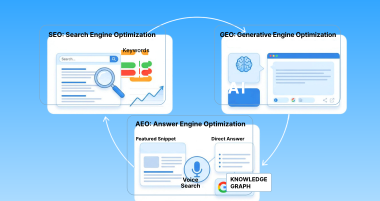
To stay viable and productive, companies, enterprises, and businesses must optimize their current strategies to incorporate or make full use of search engine optimization, answer engine optimization, and generative engine optimization.
This guide will analyze SEO vs AEO vs GEO in detail.
What is SEO?

SEO helps users optimize their websites to rank higher in conventional search engine results pages (SERPs) like Google and Bing. The goal is simple: drive more organic traffic to their websites by appearing at the top of search results for relevant queries.
What Does AEO Mean?

AEO, shortly called Answer Engine Optimization. This approach relies on content structuring so that search engines (and voice assistants, including Alexa, Siri, and Google Assistant) can pull out direct answers to user questions.
Aside from search engines, AEO provides informative answers in online communities and forums such as Quora, Reddit, and more. Instead of just aiming for a blue link in the SERP, AEO aims for those featured snippets, knowledge panel entries, AI engine citations, and voice responses that give users instant information. In other words, AEO is about becoming the answer.
How does AEO work? Search engines examine web content to explore concise, authoritative answers to common questions. If your page clearly answers a question, Google may showcase that answer at the top of the results (either in an AI Overview or a Featured Snippet), so users do not need to click through.
For example, ask Google “What is the capital of Japan?” and it will likely depict a snippet: “Tokyo,” usually extracted from a website like Wikipedia. AEO ensures your content features in those spots. We hope you now know the AEO meaning.
What is GEO?
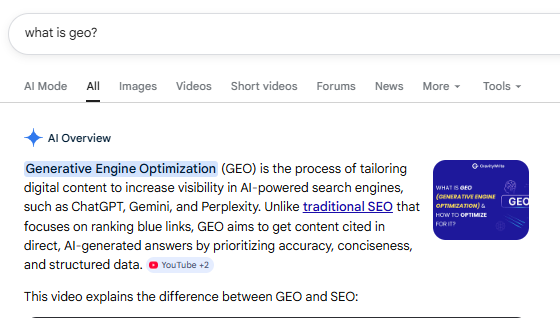
GEO, short for Generative Engine Optimization, is a relatively new concept that highlights the rise of AI-driven search tools.
Generative AI search engines (like ChatGPT and its web SearchGPT functionality, Perplexity.ai, Grok, Claude, and Google’s own offerings, AI Mode and AI Overviews) do not display a list of links; they produce conversational responses or answers by blending information from a wide range of sources.
GEO impacts these AI-generated answers, allowing your content to be included or cited. Here’s how GEO typically works: rather than ranking pages, an AI (such as Google’s AI Mode or ChatGPT) is trained on, or has access to, a vast index of web content.
When a user asks a query (say, “Provide me a comprehensive marketing plan for a new pizza shop”), the AI will extract from its knowledge to craft a custom answer on the fly. It can quote tips or facts from several websites, and some AI search implementations can cite sources.
Key Differences: SEO vs AEO vs GEO
| Category | Search Engine Optimization (SEO) | Answer Engine Optimization (AEO) | Generative Engine Optimization (GEO) |
| Key Goal | Rank web pages in conventional search engines to generate clicks | The content should be shown as direct answers (voice, snippets, knowledge boxes, forums, LLMs) | The content should be cited or used in AI-generated answers (e.g., Perplexity, ChatGPT, Google AI Mode) |
| Audience Interaction | Human users or netizens go through a list of ranked links | Netizens usually get instant answers (may not click through) | AI summarizes or answers user questions with synthesized info (may cite sources) |
| Search Medium | Yahoo, DuckDuckGo, Google, Bing, | Alexa, LLMs, Reddit, Quora, Google, Bing, Siri | ChatGPT, Google Search Generative Experience (SGE), Bing Chat, Perplexity.ai, Claude.ai |
| Ranking Mechanism | Algorithmic ranking based on technical SEO, links, and content, keywords | Structured data, question-answer relevance, and featured snippet algorithms | AI models prioritize relevance, clarity, authority, and freshness from indexed web content |
| Optimization Focus | Content depth, site speed, backlinks, keywords, and meta tags | Q&A formatting, structured data (schema), natural language, concise answers | Clear, authoritative writing; well-structured content; up-to-date facts; E-E-A-T alignment |
| Format of Content | In-depth landing pages, blogs, articles | FAQs, how-tos, short paragraphs, bulleted/numbered lists | Summaries, FAQs, natural language, citations, and well-labeled sections |
| Click Behavior | Click-through is the main objective | Zero-click searches are common (clicks may drop) | No click-through; goal is inclusion in AI response |
| Techniques and Tools | Link building keyword tools, Google Search Console | Voice search testing, People Also Ask data, FAQ Page/How To schema | Prompt testing, E-E-A-T improvement, AI auditing tools |
| Example Query Result | Best 10 links ranked by relevance | The featured box is provided at the top with a direct answer | AI-generated paragraph that may include quotes or ideas from your site |
| Measurement Metrics | CTR, bounce rate, rankings, organic traffic | Voice search, snippet visibility, presence, and impressions | AI visibility, inclusion in AI summaries, and citation frequency |
| Implications on Future | Stable, enhancing with AI incorporation | Enhancing significance as zero-click and voice search increase | Emerging field with increasing influence over how information is explored |
Optimizing for SEO
As you may be aware, SEO is the backbone of your online existence. Therefore, you should not underestimate its significance despite the emergence of new answer engines. That’s because you will continue relying on traditional SEO to make a mark in AEO or GEO.
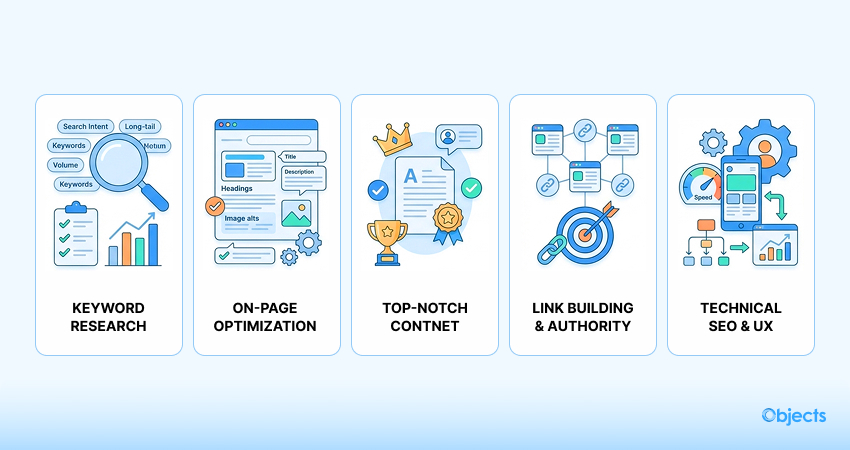
Keyword Research: You can benefit from keyword research tools that help explore relevant terms and queries in your niche. Furthermore, you should focus on high-volume head terms (e.g., “email marketing”) and more specific long-tail phrases (e.g., “how to enhance email marketing open rate for ecommerce”). The latter has less competition and denotes a much clearer intent. Once you understand your topics alongside keywords, you can develop content that directly addresses them.
On-Page Optimization: You must optimize content, including headers, meta descriptions, and titles, to align with user intent and target keywords. You should incorporate related terms and key phrases naturally throughout the content.
Top-Notch Content: Create high-performing content that ranks in search engines. It should be informative, user-friendly, and provide value to readers.
Link Building and Online Authority: You should aim to get backlinks from credible sites and services that ultimately boost your authority. Moreover, there is no harm in getting results-driven SEO services from a reputable SEO marketing company. When getting high-quality links, you can consider using this option.
Technical SEO and User Experience: Your site must meet all the technical requirements that search engines value. This includes fast page load speeds (users may leave slow sites), mobile-friendliness, and a logical site architecture with clear navigation. In addition, focus on creating and submitting an XML sitemap in Google Search Console to enhance indexing.
Optimizing for AEO
You must think about a question that can be answered appropriately to optimize for AEO (Answer Engine Optimization).
Detect Common Questions: Research the questions your target readers often ask in your area. You can use tools like People Also Ask, AnswerThePublic, and others to find such questions. Once you have identified questions, you can easily develop the basis of your AEO-centric content.
Use Question-Based Headings (Q&A format): Your content should include people’s actual questions as headings (especially H2s or H3s), and then you must answer them immediately. Suppose an FAQ page might have “Q: Do E-commerce Sites Depend on PPC and SEO?” as a header, followed by a concise answer.
This format signals to search engines that you answered a specific query, increasing the likelihood that your answer will be featured in a snippet or as a voice assistant result. It is a reality that content with question headings works well for LLMs, snippets, and voice search.
Optimizing for GEO
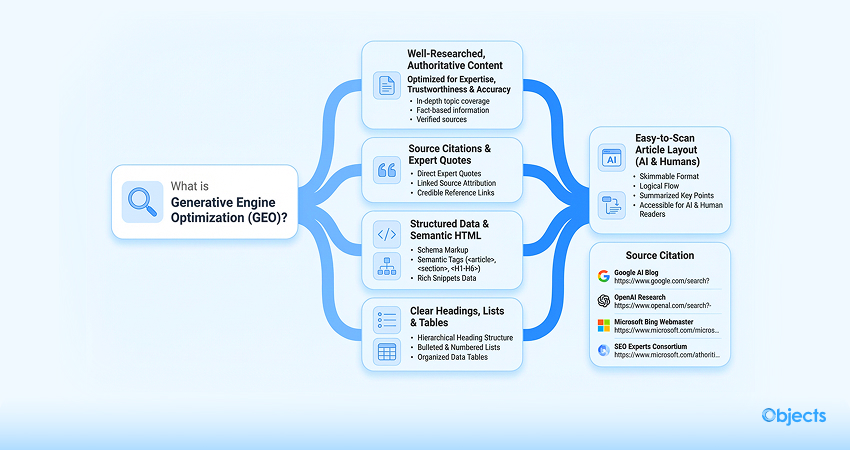
Generative Engine Optimization is a newer aspect, and its playbook still needs enhancement. However, you can use various simple tactics to improve the chances that AI systems will include and cite your content in their answers:
Well-Researched, Publishable Content: AI models tend to favor content that appears factual and authoritative. Ensure your content has evidence; cite statistics, link to reputable sources, and include quotes from experts where relevant.
Utilize Clear HTML and Structured Data: Structured data enables AI to parse content like AEO and SEO. Besides, clean, semantic HTML (correct application of lists, tables, headings, and clearly labeled sections) ensures that when an AI “skims” your page, it can instantly identify the crucial aspects of the information.
A well-panned blog or article with a simple content format (introduction, subheadings for each subtopic, and a conclusion) becomes easier for an AI to understand and grasp than a long, unbroken wall of text. You should assume that you tend to write for two audiences: machine readers and, obviously, humans.
Why Should You Prioritize SEO, AEO, and GEO?
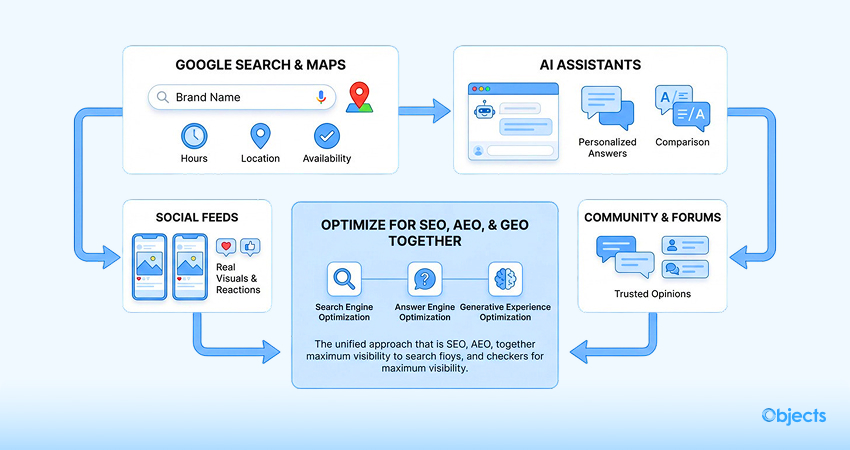
Why are all three still appropriate and decisive? Search no longer resides in a Google box. It lives now in your social feed, in a map app, in a conversation with AI, or in a comment on a Reddit thread. Netizens search in different ways that were unknown five years ago – and brands must ensure users can easily find them everywhere. In general, netizens take advantage of:
- Google and Maps to check hours, proximity, or availability.
- Gemini and ChatGPT to differentiate options or attain personalized answers.
- Instagram and TikTok to witness real reactions and real visuals.
- Reddit to identify and obtain what’s actually true — no filters, no fluff.
As per the above GEO vs AEO vs SEO analysis, brands that adapt to and embrace these changes in search behavior and technology will remain ahead of the competition, engaging customers wherever they search.
What is AIO in SEO?
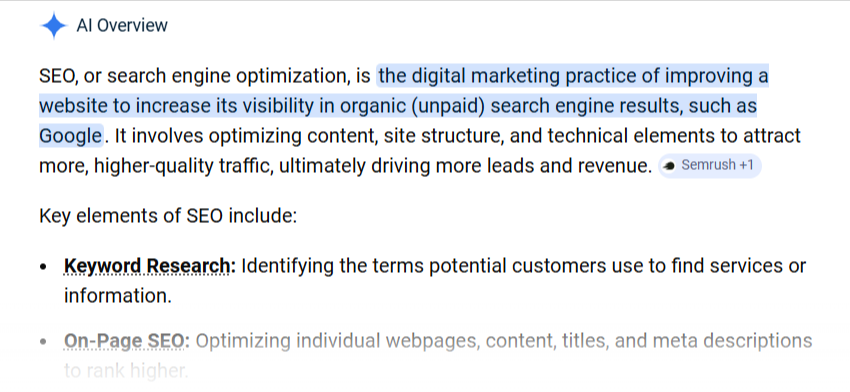
AIO in SEO, commonly called AI Optimization (or sometimes AI Overviews). It refers to the process of structuring website content so AI-powered engines like Gemini, ChatGPT, and Google’s AI Overviews can comprehend, cite, and present it accordingly.
What is the Difference Between SEO and GEO Optimization?
If you want to know the difference between SEO and GEO optimization, you have chosen the right place. SEO enables users to rank sites higher in prominent search engines such as Yahoo, Google, Bing, and more.
The other key objective of SEO is to generate clicks to the site. GEO, on the other hand, focuses on getting content cited or shown in summarized answers (Gemini, ChatGPT) and in AI-generated content.
Their targets are also different: the former prioritizes traditional SERPs, while the latter focuses on chatbots and AI engines that provide summarized answers.
Wrapping Up
We expect you will appreciate our SEO vs AEO vs GEO comparison guide. That said, the future of search will focus on answering users’ questions wherever they ask. Whether it’s a Google search box, an LLM, or an AI chatbot on a phone, your content should be there, ready to provide value.
Once you understand and optimize for SEO, AEO, and GEO, you not only benefit from the existing opportunities but also future-proof your digital existence for what’s to come.
It is surely a challenging yet highly rewarding time for search marketers: the rules of the game have expanded, but those who prioritize clarity, quality, and user-centric content will continue thriving through every algorithmic twist and turn of the coming years.



![Fix Your Connection Is Not Private Error in Chrome [2026]](https://objects.ws/wp-content/uploads/2026/10/Fix-Your-Chrome-Connection-Error.webp)