
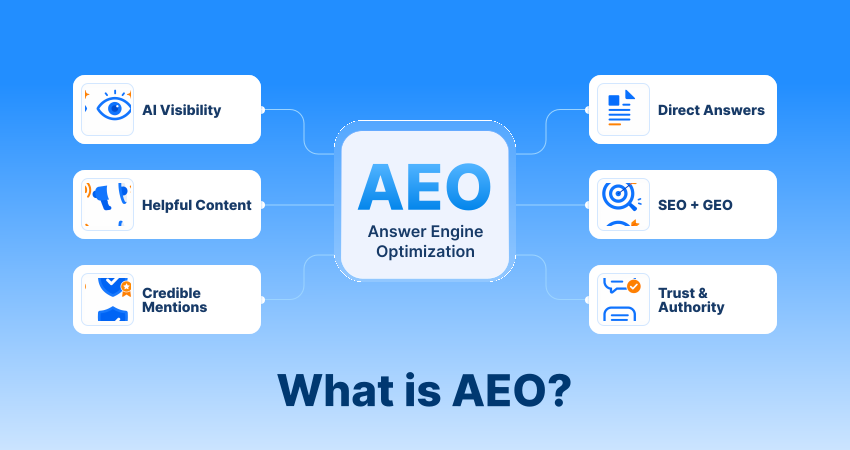
Search engines help businesses get their brands in front of the right audience at the right time. However, it’s not just users you’re optimizing for; you’re optimizing for AI, too. Well, what is AEO then? You’ll know in a while.
Famous AI platforms like ChatGPT, Perplexity, and Google’s AI Mode don’t work like traditional search engines. They retrieve, examine, and produce relevant, precise answers. Rather than sending users to a ranked list of results, they send a single response, and your brand is mentioned in that answer, or it isn’t.
In this agentic search, AI acts as an intermediary, tracks what users have done, compiles information to provide an answer, and even makes decisions on users’ behalf (such as purchasing a product).
This blog post will explain the phrase “What is AEO?” by analyzing answer engine optimization in detail.
What Do You Mean by AEO?
Answer engine optimization (AEO) is a delicate combination of marketing practices that help enhance your brand’s visibility in AI-generated answers — such as ChatGPT responses and Google’s AI Mode.
Here is an example of how a brand gets a mention in an AI answer in Google AI mode:
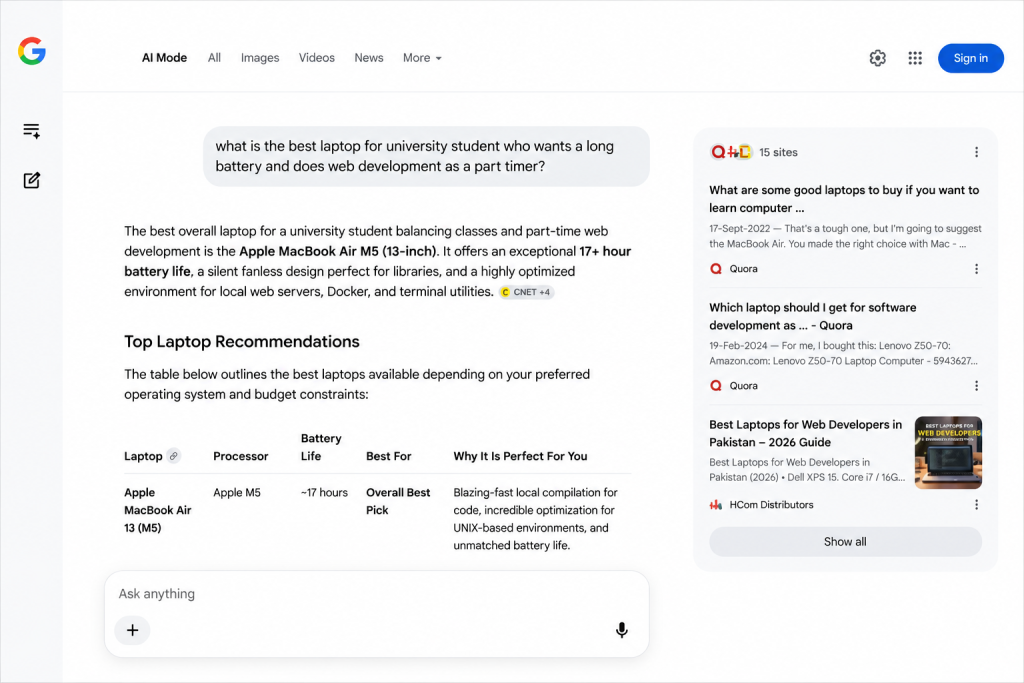
Additionally, ranking in organic Google search doesn’t guarantee that your content will also appear in AI Mode or other AI systems.
So, beyond the best SEO tips and practices, crucial AEO techniques are:
- Attaining positive mentions in news articles, podcasts, blogs, and other credible publications.
- Publishing helpful, unique, and AI-friendly content.
Various techniques used in conventional search engine optimization (SEO) also help with AEO, but they differ in a few ways.
Why is AEO Crucial?
Answer engine optimization is handy since it helps businesses align their content strategies with users’ expectations for immediate, direct information. As users have started turning to voice assistants, smart devices, and AI-powered search features that provide them with answers up front, ensuring your answers fit these formats has become critical.
If you have not optimized your content for AEO, you risk becoming invisible in these rapidly expanding channels, even if your traditional SEO is robust and up to date. In this situation, you should be able to differentiate SEO, AEO, and GEO.
Doing so will help you make the most of conventional search and these advanced, answer-centric platforms.
According to Justin Ahrens, author at PRINT Magazine,
- SEO is about being found.
- AEO is about being selected as the answer.
- GEO is about being incorporated into generated answers.
Ahrens also said that without SEO, you may not be discoverable. Without AEO, you may not be extractable. And, without GEO, you may not be reusable inside generated answers.
Coming back to the point, the core goal of AEO is to make your brand the source of truth when users ask direct questions, maximizing your visibility and building trust and authority.
When an answer engine regularly displays your content as the best response, it validates you as a knowledgeable leader in your domain. This helps capture the attention of users who want quick solutions or factual information without having to browse various websites.
What Factors Affect AEO Rankings?
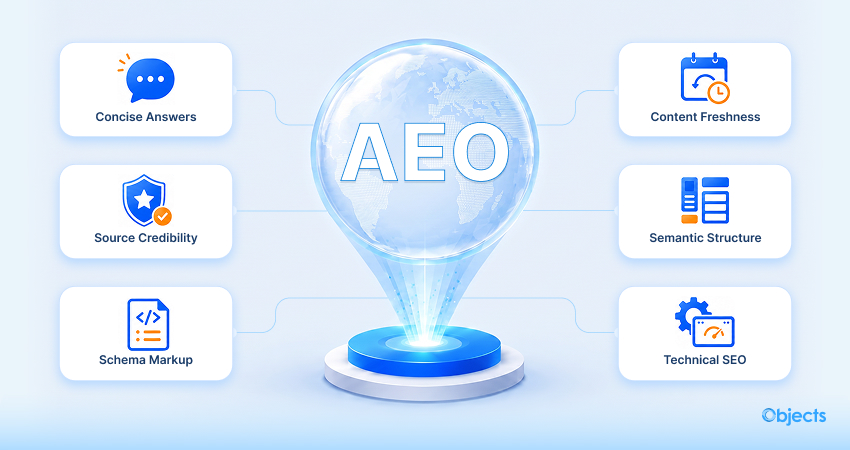
Three key pillars drive Answer Engine Optimization (AEO) rankings for AI search tools: Entities, Context, and Credibility. Therefore, the main factors influencing AEO rankings revolve around these pillars. These factors include:
- Explicit, Concise Answers: AI systems prefer content that directly and concisely answers the user’s question (in 40–50 words) before providing them with deeper examples or context.
- E-E-A-T and Source Credibility: AI values authoritative information, so use clear author bios, cite reputable sources, publish original data, and secure backlinks from trustworthy, notable websites.
- Structured Data (Schema Markup): You should take advantage of precise schemas (e.g., FAQ, HowTo, and Product), which enable AI models to interpret, extract, and contextualize your content effortlessly.
- Content Freshness & Recency: AI engines strongly favor recency or freshness. This applies specifically to time-sensitive queries. Benefit from visible “Last Updated” tags, updated data, and recent statistics to ensure static evergreen pages do not decline in rankings.
- Semantic Chunking & Formatting: A logical structure with simple, informative headings (H1, H2), bulleted lists, and short paragraphs helps AI systems retrieve information more effectively.
- Technical Optimization: Standard technical SEO—such as fast load times, mobile-friendliness, and crawlability—ensures that AI crawlers can successfully access and read your website.
Difference Between SEO, AEO and ASO

AEO helps achieve visibility in AI-generated answers. As you may be aware, agentic search optimization (ASO) is a broader sphere that encompasses not only answer inclusion but also how your brand appears in agent-driven actions. As for SEO, it helps you gain visibility in traditional search results.
Undoubtedly, SEO, AEO, and ASO follow multiple best practices, but there are a few crucial differences:
| Category | SEO | AEO | ASO |
Main Goal | To rank content in traditional search engine results pages (SERPs) | To cite content or mention content in AI-generated answers (e.g., Google AI Overviews and ChatGPT) | Be present across the full AI search lifecycle (answers and actions) |
| Search Environment | Regularly updated list of ranked links | Dynamic, real-time generated responses | Multi-step agent workflows (answers, recommendations, actions) |
| Optimization Focus | Backlinks, technical SEO, and keyword targeting | Brand mentions, targeting question-based queries, and backing up claims with proof | Everything in AEO and optimizing for agent decisions (APIs, structured data, product availability, trust signals) |
| Primary Platforms | Google Search, Bing Search, etc. | Google AI Mode, Bing Chat, Perplexity, ChatGPT, etc. | AI agents and ecosystems (e.g., ChatGPT, Google AI Mode, Perplexity, shopping/booking agents) |
| Success Metrics | Rankings, click-through rate, and organic traffic | AI citations and brand mentions | Citations, mentions, inclusion in agent decisions, and actions taken (purchases, bookings, etc.) |
How Can We Integrate AEO with Traditional SEO Strategies

Integrating AEO with traditional SEO methods helps your content perform more effectively across search results and emerging AI-driven answer formats. For multiple businesses, this means building a strong SEO foundation while creating user-friendly, value-driven content.
The more your content shows up in search results, the more authoritative and trustworthy Google and AI answer engines consider your site to be.
Your main focus is to ensure your content is accessible to AI algorithms without affecting its appeal to human readers. For that reason, build your pages around natural, question-based headings and offer direct, short responses at the top of each section. Likewise, using structured data that helps search engines explain crucial information is recommended.
Your language should be clear, your sentences concise, and you should reinforce credibility by citing authoritative sources such as research institutions or credible websites.
How to Start with Answer Engine Optimization?
To begin applying AEO on your website, you must analyze your current content and highlight how it aligns with AEO best practices. You can follow some steps to start optimizing your content, including:
- Review top responses: Think about what users in your niche may ask, and invest time in identifying key topics and queries. Once you do this, examine which sites appear in AI responses and look for trends.
- Create content optimized for answer engines: After understanding the landscape, you can start enhancing your content by structuring it clearly, adding expert commentary, and using descriptors and language. You must format your web pages to make them scannable.
- Disseminate your content: To help AI systems easily recognize your content, mention it on websites and industry publications that AI algorithms value. Therefore, you should contact relevant community platforms and industry publications to achieve your objective. If you maintain a good reputation, you may be able to promote your content more easily.
- Measure and iterate: Monitor your brand’s AI visibility to see what works and what needs fine-tuning on your end. Once you recognize areas for improvement, refining your strategy to maximize outcomes becomes doable.
What AEO Practically Influences?
AEO smartly introduces a new layer of visibility that nicely complements traditional SEO but operates under a different set of rules. It’s more about shaping the outcome rather than driving the click. That’s how AEO works and creates a difference.
The answers users typically view are mostly the first ones, and they carry on only that impression. The brands that appear in the answer not only amplify visibility but also shape perception.
This is precisely the role for which AEO has been built. It not only helps users detect your content but also shapes what they see, how they perceive it, and what they trust.
Wrapping Up
We hope you enjoy our blog post explaining the phrase “What is AEO” in detail. In simple words, AEO decides where and how your brand appears. It is not limited to search results.
It should also appear inside the answers netizens usually read, hear, and act on. It comprises brand mentions, direct citations, and information that elicits a response without explicit attribution.
FAQs
How long does it take for the AEO impact to show?
Answer Engine Optimization (AEO) impact usually appears within 10 to 90 days, with full authority and measurable traffic building over 2 to 6 months.
How do I measure AEO success?
If you want to measure your AEO success, monitor brand mentions and citations in AI answers. Additionally, check whether your content appears in chat responses, snippets, and AI overviews. The main logic behind measuring AEO success revolves around how accurately and how often your brand is mentioned.
Does schema markup help with AEO?
You cannot deny the importance of schema markup for Answer Engine Optimization (AEO). It mainly works as a translator, providing AI models and search engines with explicit, machine-readable labels to make your content easier to recognize, process, and cite.
What industries benefit from AEO most?
Different industries can make full use of AEO, including healthcare, legal, financial services, B2B, education and training, consulting and advisory, and more.
What types of content work best for AEO?
Your content should clearly and directly answer any query. Therefore, create simple, concise definitions, how-tos, comparisons, step-by-step tutorial guides, and detailed explainers. Moreover, focus on matching the user’s intent. Hence, your content can be an FAQ, a short answer, or a numbered list. Don’t write too long and generic answers.
What is Enterprise AEO?
Enterprise AEO (Answer Engine Optimization) helps you structure the digital content of a large organization. As a result, AI-powered platforms such as ChatGPT, Gemini, and Perplexity can discover, rely on, and cite the brand as a direct answer to a user’s question.