
Digital products fail for many reasons. One of the obvious ones? Fragmented development teams and a lack of ownership, alongside supervision and management. Fortunately, a strong full-stack developer can resolve that issue.
They cover both the front and back ends of your stack, work across systems, and let your build move without the friction of managing multiple roles simultaneously. It’s no surprise that companies tend to lean into these versatile hires, especially as demand for efficient product delivery continues to rise.
This blog post will help you find the answer, “What is a full-stack developer?” who actually fits your project, from defining your needs and budget to vetting technical skills and cultural fit.
What is Full-Stack Development?
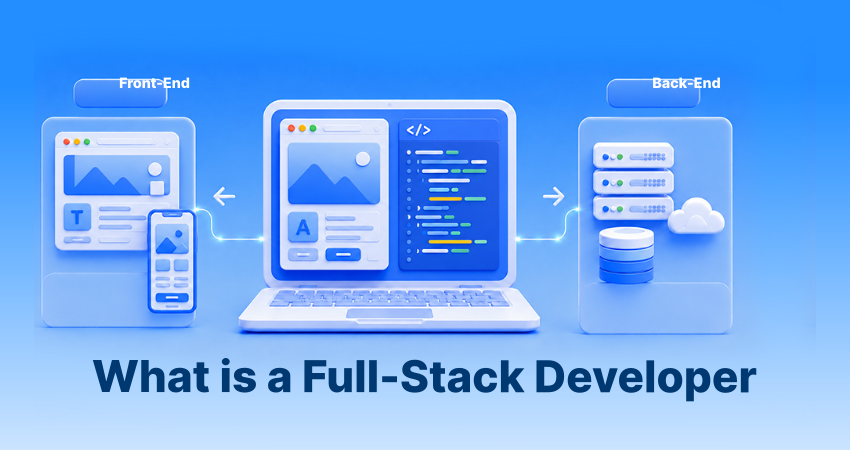
Full-stack development involves building both the frontend and backend of an application. As you may be aware, an application comprises a frontend (user-facing) component and a backend (database and logic) component. The frontend includes the user interface and code for user interactions with the application.
As for the backend, it consists of all the code needed for the app to run, including integrations with other applications and data systems, as well as data processing.
Software developers need different skills, tools, and knowledge of software for frontend and backend development. However, full-stack development offers a delicate balance of these disciplines. Furthermore, it helps teams develop applications from scratch and deliver them in an integrated, cohesive manner.
A full-stack application typically comprises both the frontend and the backend.
What is a Full Stack Developer?
A full-stack developer has expertise in both front-end and back-end web development. These developers can smartly create all layers of a web application, from the user experience (front-end) and user interface to the server, database, and application logic (back-end).
As far as the front-end goes, they know how to leverage technologies such as HTML, CSS, and JavaScript to develop visually appealing, impactful interfaces that users can interact with directly.
Regarding the back-end, they are proficient in server-side languages such as Python, Java, Ruby, Node.js, and Ava, which they use to manage data manipulation and server-side logic.
What are the Duties and Responsibilities of a Full-Stack Developer?
As for duties and responsibilities, a full-stack developer’s role can vary depending on project requirements and the organization’s needs. That said, they need to perform a few common tasks and responsibilities, including:
- Developing and Maintaining Web Applications: Full-stack developers help design, develop, and maintain web applications from ideation to full-fledged creation. They need to write clean, efficient, and sustainable code for the application’s front-end and back-end components.
- Front-End Development: Full-stack developers are responsible for handling the client-side of applications, including design and user interface development. These user interfaces must be attractive, intuitive, and responsive. Besides, they use HTML, CSS, JavaScript, and notable frameworks such as Angular and React to craft engaging user experiences.
- Back-End Development: In addition to front-end development, full-stack developers manage databases and handle server-side programming. They use various languages, such as Java, Ruby, Python, and Node.js, to create and manage server-side logic. When storing and retrieving data, they use MySQL, MongoDB, and other databases.
- Integration and Testing: Full-stack developers integrate front-end and back-end components to boost seamless communication between the server and the client. They perform key activities, such as comprehensive testing and debugging, enabling them to recognize issues proactively. Hence, they can effectively rectify application issues, making them reliable and stable.
- Collaboration and Communication: Full-stack developers coordinate with developers, product managers, web designers, devOps engineers, and other cross-functional teams to comprehend projects’ scope and specifics. Once they understand them, they can easily provide clients with appropriate technical solutions. In this situation, effective communication is a must for full-stack developers.
Types of Full-Stack Developers
Before exploring various types of full-stack developers, you must know that each developer has their unique expertise and skills that differentiate them from others.
Here are a few types, including:
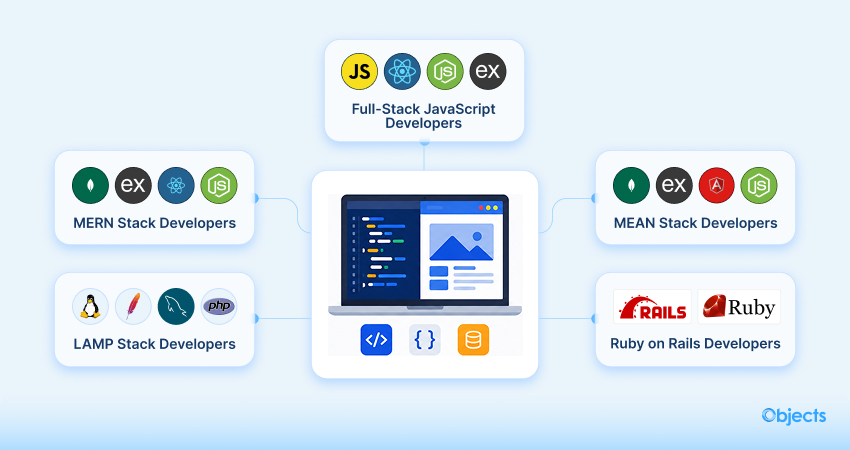
- Full-Stack JavaScript Developers: Full-stack JavaScript developers are proficient in using JavaScript for both front-end and back-end development. They can leverage front-end frameworks such as React, Angular, or Vue.js, and back-end frameworks such as Express.js or Nest.js, to create responsive, dynamic web applications in JavaScript.
- LAMP Stack Developers: LAMP stack developers know how to use the LAMP stack, which consists of Apache (a web server), MySQL (a relational database management system), Linux (an operating system), and PHP (a server-side scripting language). They have proficiency in leveraging these technologies to develop scalable, impactful web applications.
- MEAN Stack Developers: MEAN stack developers specialize in using the MEAN stack, which includes MongoDB (a NoSQL database), Express.js (a web application framework for Node.js), Angular (a front-end framework), and Node.js (a server-side JavaScript runtime). They leverage these technologies to build high-performance and scalable web applications.
- MERN Stack Developers: MERN stack developers efficiently use the MERN stack, which comprises Express.js (a web application framework for Node.js), React (a front-end library for building user interfaces), MongoDB (a NoSQL database), and Node.js (a server-side JavaScript runtime). They know what it takes to develop responsive, user-friendly, and interactive web applications with this technology stack.
- Ruby on Rails Developers: Ruby on Rails developers are proficient in maximizing the Ruby on Rails framework to create web applications. As you know, Ruby on Rails is a leading web application framework written in Ruby. These developers can expertly build efficient, manageable, and scalable applications with this framework.
How to Hire a Full-Stack Developer?
To hire the right full-stack programmer, it’s crucial to assess a candidate’s technical and communication skills, as well as relevant industry experience. Furthermore, you must consider the fit for your specific industry, company, and project.
In this scenario, you should follow a rigorous screening process to ensure that every potential full-stack developer you hire has the desired experience and skills. In the end, you need to hire the right full-stack developers for your existing or potential project.
When to Hire Full-stack Programmers
When You Just Begin
Usually, solopreneurs, entrepreneurs, small business owners, and others start a web development project by hiring a sole developer. In this situation, they prefer to hire an experienced full-stack developer. That’s because they can make full use of their expertise and build a basic software architecture from scratch, consolidating all application components in a single place.
Create and expand your in-house team along these lines, gradually adding specialized developers as needed. This approach is specifically ideal for new businesses launching new projects.
However, you should always have one developer who can supervise the entire software development process and coordinate work progress across all areas.
When You Need a Technical Lead
It’s a great alternative to bring a full-stack coder into your current team if you don’t have a tech lead. Software development is like sailing: without a captain, it will end up at a random, unwanted destination.
Hence, one individual must be responsible for project management in this situation. That experienced resource will assign all tasks and manage the entire development team. The potential technical lead must be familiar with multiple full-stack development concepts and related attributes.
As a result, they can maximize each team member’s productivity by helping them focus on crucial tasks rather than unnecessary ones.
When Your Budget is Limited
The most budget-friendly or cheap option when you have a budget constraint is to hire a generalist developer. There is a strong likelihood that development won’t go as fast as you have planned, or that you won’t have a team of skilled developers dedicated to certain parts. Nevertheless, your project will continue to progress steadily.
This way, you can minimize communication overhead among developers, since a few professionals are involved.
When You Need a Chief Technical Officer (CTO) or a Co-founder
If you start a business as a non-technical person, you need to onboard a CTO or a technical co-founder. As you might know, it’s advisable to create a minimum viable product when starting a business.
Therefore, you need the expertise of a CTO or a technical co-founder in this scenario. They will monitor all technical aspects of the projects and key operations, drawing on their knowledge, skills, and experience.
Glossary of Full-Stack Developer Terms
Full-stack development encompasses various terms, including APIs, AngularJS, Bootstrap, Flask, Frameworks, the MEAN Stack, PHP, Python, and more.
- AngularJS: An open-source web application framework managed by Google.
- API: A software that enables two applications to share information, commonly referred to as an application programming interface.
- Bootstrap: An open-source library that consists of front-end tools to develop apps and websites.
- Flask: It is primarily a micro web application framework developed in Python.
- Framework: A layered structure that provides a foundation for creating software applications.
- MEAN Stack: An open-source, free JavaScript software stack that helps create websites and apps.
- Open-source software (OSS): A software that includes source code, which is modifiable, distributable, or mergeable into other projects.
- PHP: It is a short abbreviation of hypertext preprocessor, which is mainly a server-side (back-end) scripting language and suits web development.
- Python: It is commonly known as a general-purpose, high-level programming language.
- Stack: A set of tools and technologies that developers use to complete their tasks.
Wrapping Up
We hope you now know the query, “What is a full-stack developer?” They play a massive role in all aspects of software development, from server-side database management to user experience. Moreover, full-stack developers are adept at using front-end and back-end languages and technologies, as well as web design and database management.
FAQs
Will AI replace Full-Stack?
AI will not replace full-stack developers. That said, it could significantly influence the role of full-stack developers. As a result, their productivity will increase, benefiting businesses and users alike. AI can help developers simplify and revolutionize their tasks, such as coding, testing, debugging, and more.
What are Full-Stack developers’ skills?
Crucial skills needed for full-stack developers are API development, database management, version control (Git), and deployment (Docker, AWS). They also need soft skills like problem-solving, communication, and adaptability.
Can a Full-Stack developer create an App?
A full-stack developer can easily develop an app from scratch. They can benefit from front-end and back-end development and smartly manage each stage of the app creation process, including initial design, planning, UX design, quality assurance, product launch, and maintenance.
How can I become a full-stack developer?
You can become a full-stack developer by earning a degree in computer science or a related field, researching the skills employers need, strengthening your coding skills, building and maintaining a portfolio, and learning technical interview questions.