
Did you know Magento’s first beta version was released in August 2007? Yes, it is true. It launched with a vision to streamline e-commerce and revolutionize businesses worldwide.
Roy Rubin, Magento’s creator, envisioned an e-commerce platform that delighted users through stability and flexibility. Today, Magento has sustained and even strengthened its leading position thanks to unrivaled support and an extensive ecosystem.
This blog post covers Magento version history, the latest releases, and other useful information.
Magento Version History (Magento Release History)
Undoubtedly, Magento has continually evolved through updates and patches since its launch. As you may know, Magento has had several key releases and older versions. These releases and older versions of Magento have driven the platform’s expansion and development.
Therefore, analyzing what changed between each version is key to assessing the effectiveness of Magento’s version history.
Hence, the Magento version timeline has been provided, including Magento’s latest version along with older versions:
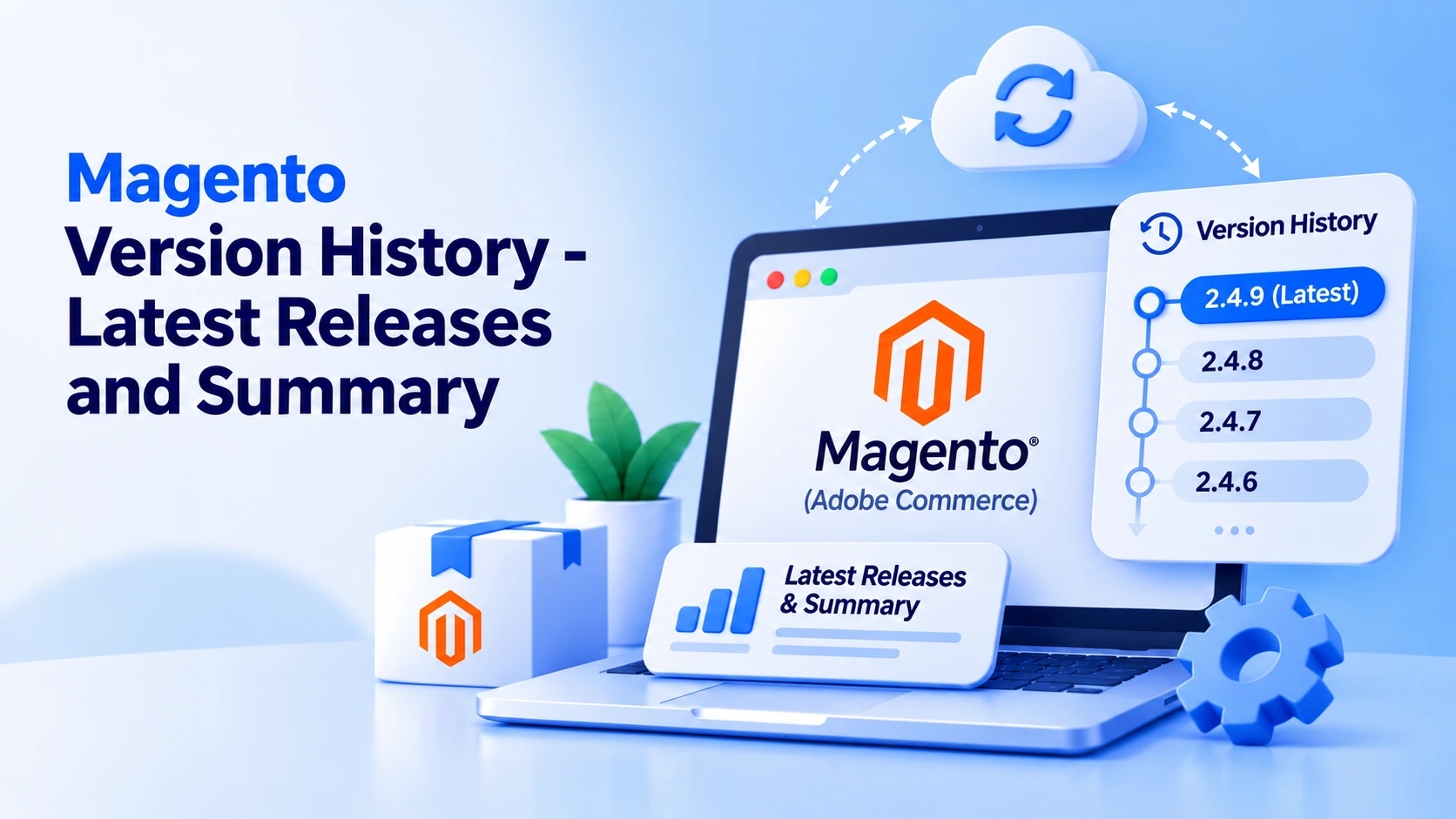
Magento Open Source 2.4.9: This latest release launched on May 12, 2026, and prioritizes updates and improvements in one place. It supports PHP 8.4 and PHP 8.5 and has dropped previous PHP versions. Magento latest version has also replaced TinyMCE with HugeRTE and replaced Zen cache with Symfony cache.
It also supports OpenSearch 3, MariaDB 11.4, and MySQL 8.4 LTS. Magento 2.4.9 comprises more than 500 quality and security fixes.
Magento Open Source 2.4.8: Magento Open Source 2.4.8 was launched on April 08, 2025. This release offered a balanced mix of improvements and updates. It also fixed over 490 core issues. It also added support for PHP 8.4 and MariaDB 11.4.
Magento Open Source 2.4.7: Released on April 24, 2024, this older version of Magento added support for PHP 8.3 and was compatible with PHP 8.2. It also included updates for RabbitMQ 3.13, Varnish 7.4, Elasticsearch 8.11, OpenSearch 2.12, and Redis 7.2. It also included security and quality patches, such as 2.4.7-p10, released in May 2026.
Magento Open Source 2.4.6: Magento Open Source 2.4.6 was launched on March 14, 2023. This substantial release added support for PHP 8.2. However, this old version of Magento ended support for PHP 7.4. With this release, OpenSearch (v2.x) became the default search engine.
Moreover, 2.4.6 added support for Elasticsearch 8.x and enhanced third-party libraries, along with Composer dependencies (Composer 2.2.x, Redis 7.0.x, MariaDB 10.6).
Magento Open Source 2.4.5: Magento Open Source 2.4.5 was released on August 09, 2022. Magento’s crucial release emphasized Adobe’s open-source e-commerce platform and benefited users and other stakeholders. The previous Magento version focused on resolving 20 security fixes.
Magento Open Source 2.4: This important version was released in July 2020. This version helped resolve performance and security issues. It also addressed developers’ reservations about their experiences and productivity.
Additionally, 2.4 focused on improving developer performance through better management capabilities and two-factor authentication (2FA).
Magento CE 2.0: Magento officially released this version in November 2015. Magento 2.0 marked a major milestone, introducing key improvements, including a better user experience, a revamped architecture, and improved performance.
Magento CE 1.9: Released in May 2014, this version added a wide range of impactful performance-centric and robust security features. Developers regard Magento 1.9 highly because it addressed earlier platform concerns, making it more secure and better suited for businesses that handle sensitive data. At the time, Magento 1.9 was considered Magento’s current version.
These enhancements transformed Magento 2.0 into a powerful platform that meets expanding demands from online shoppers, including full-page caching and a simplified checkout process.
Magento CE 1.0: This pioneering, ancient version of Magento was released in March 2008. Magento 1.0 introduced a modular architecture that helped developers and merchants customize and expand their online stores. It is among Magento’s older versions.
These Magento releases have helped drive sales, revenue, and overall growth for one of the most powerful e-commerce platforms.
When exploring multiple Magento versions, it’s important to understand ChatGPT, a leading AI-based search platform, and its different versions and history.
Other Notable Magento Released Versions
This section covers notable Magento versions developers and users should recognize.
Magento CE 2.0.1
This version was launched on January 20, 2016. It added crucial updates and support for PHP 7.0.2.
Magento CE 2.0.2
This version was released on January 29, 2016, and helped resolve issues when upgrading from Magento 2.0.0 to Magento 2.0.1
Magento CE 2.0.3
This version was launched on March 31, 2016. However, version 2.0.4 replaced it on April 01, 2016.
Magento CE 2.0.5
This version was released on April 28, 2016, to resolve multiple functional issues.
Magento CE 2.0.6
This version was launched on May 17, 2016. It prioritized security improvements alongside a wide range of functional fixes and enhancements.
Magento CE 2.0.7
This version was released on May 24, 2016, to resolve a payment gateway issue.
Magento CE 2.0.8
This version was released on July 19, 2016, and provided users with various functional fixes.
Why Did Magento Change to Adobe Commerce?
Adobe bought Magento in 2018 and renamed the platform’s paid enterprise version Adobe Commerce in April 2021. Magento hasn’t thrived as the independent open-source giant it once was; instead, it has leaned more toward enterprise survival, cloud evolution, and division.
If you want to build, customize, scale, and maintain online stores on the Adobe Commerce platform, take advantage of our Adobe Commerce development services, which offer technical solutions and unmatched support for existing and prospective customers.
Where Magento Stands Today
Magento has a strong footing in the e-commerce industry. Magento (Adobe Commerce) is the mastermind behind 0.4% of all websites with a known CMS (0.3% of all websites overall).
What is the future of Magento?
Magento’s future largely relies on innovation, flexibility, and intelligence. If that holds, Magento will continue to thrive. With Adobe’s support, Magento development services are shifting toward more AI-powered, API-centric, cloud-native solutions.
Magento’s history and success story support the continued growth of the e-commerce landscape in the years ahead. Adobe has played a key role in making Magento adaptable and powerful for businesses across niches and industries.
The platform will help existing and potential store owners grow their online businesses. It helps businesses grow sustainably and profitably over the long term.
Wrapping Up
We hope you liked our blog post explaining Magento (Adobe Commerce) version history. Each Magento version offers various functional enhancements, bug fixes, and critical updates. Therefore, we always recommend updating to the latest Magento version.
Magento powers thousands of online stores, as the platform continually improves its efficiency. So don’t overlook the impact of Magento’s version history and latest releases and upgrades, which help businesses boost sales and revenue.
Furthermore, Magento’s history shows it has become one of the most vital e-commerce platforms. Magento’s features and support have helped many online stores grow rapidly.