
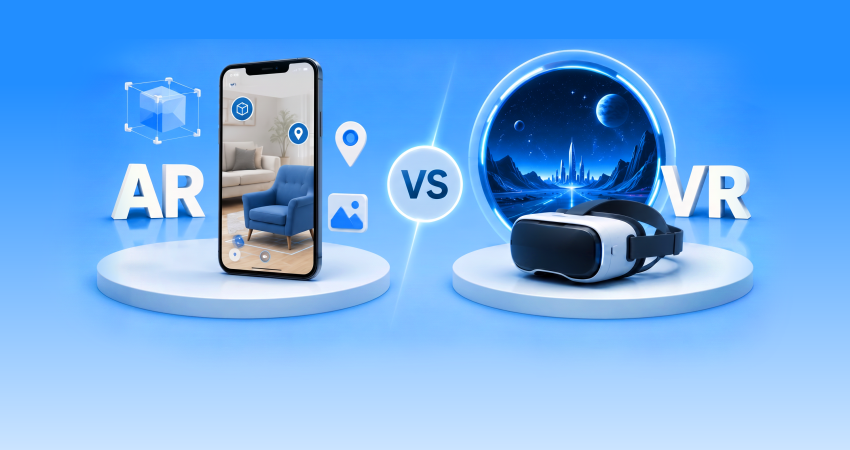
Are you ready to dive into the exciting worlds of augmented reality (AR) vs. virtual reality (VR)? These two technologies have gained popularity in recent years, with their immersive experiences captivating audiences across various industries. But what exactly are AR and VR? What is the difference between AR and VR? And which one is better suited for your needs?
Let’s explore these questions as we discover the difference between AR and VR. Get ready to be transported into a world where anything is possible!
What is Augmented Reality (AR)?
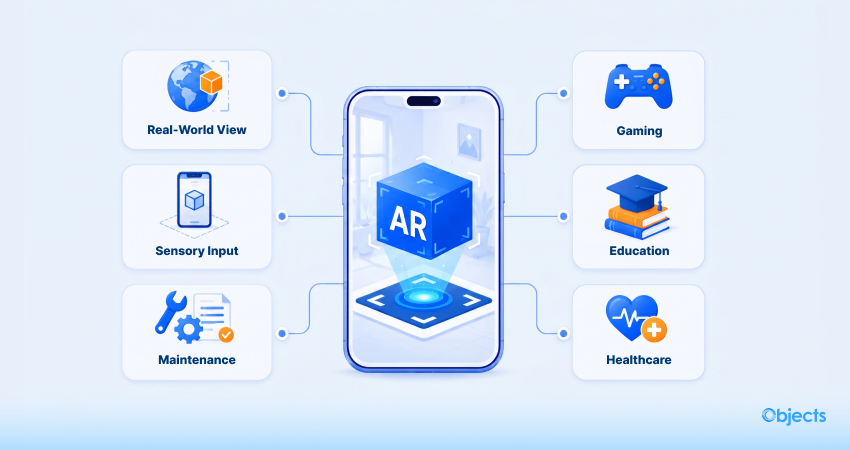
Augmented reality (AR) is a live, direct or indirect view of a real-world environment whose elements are “augmented” by computer-generated sensory input, such as graphics or sound. It relates to a broader concept called mediated reality, in which a computer modifies a person’s view of reality. Consequently, technology works by improving how one perceives reality.
The first augmenting medium was cinema. The term “augmented reality” was first coined in 1992 by Boeing researcher Thomas Caudell. Since then, the technology has been used in various fields, such as the military, aerospace, and entertainment industries. AR is used extensively in maintenance and repair procedures as it provides instructions overlaid on the equipment being repaired.
Moreover, it has been employed in several video games and mobile app development, including Google Glass, Pokémon Go, and Snapchat filters. However, its potential goes far beyond gaming and fun applications; augmented reality can be used in education, training, healthcare, and many other areas to provide an immersive experience that can be very helpful and even lifesaving.
How is Augmented Reality used in Business?
AR can be used in several ways to help businesses. For example, it can be used for training and simulations, product visualization, marketing and advertising, and even workplace safety.
One area where AR is particularly useful is in training and simulations. This is because AR can provide a realistic simulation of a real-world environment without expensive physical equipment or facilities. This can be extremely helpful for businesses that must train their employees in a safe and controlled environment.
Product visualization is another common use for AR in business. This allows companies to give their customers a realistic view of their products’ appearance in the real world. This can be helpful for both marketing and sales purposes.
Finally, AR can also be used to improve workplace safety. By overlaying digital information on top of the real world, AR can help workers avoid potential hazards and stay safe while on the job.
What is Virtual Reality (VR)?
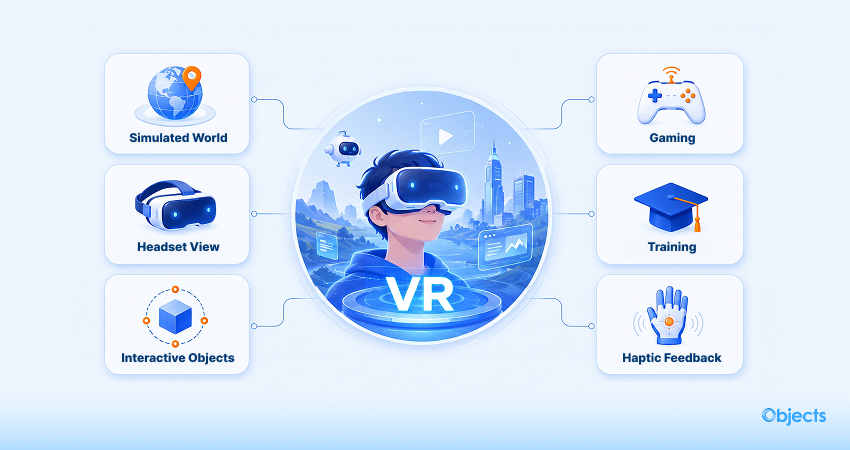
Virtual reality (VR) is a simulated experience that can be similar to or completely different from the real world. Applications of virtual reality include entertainment (e.g., video games) and education (e.g., medical or military training). Other potential uses include shopping, architecture, engineering, and design.
Using virtual reality technology, a user may often “see about” the created environment, move around, and interact with virtual objects or features. The illusion may also be produced in specialized spaces with several huge displays in addition to the VR headsets that typically include a head-mounted display with a tiny screen in front of the eyes.
Although audio and visual feedback are frequently included in virtual reality, other forms of sensory feedback, such as haptic feedback through gloves or other body suits, may also be possible.
How is Virtual Reality used in Business?
Virtual reality is an entirely immersive experience where users can interact with their surroundings. This technology has a wide range of applications, including business. Businesses can use virtual reality to create realistic simulations for training employees or customers. Additionally, companies can use virtual reality to create an immersive environment for marketing purposes. For example, businesses can allow potential customers to experience their products or services before purchasing.
Virtual Reality vs. Augmented Reality: The Differences
It is essential to understand what’s the differences between augmented reality and virtual reality to know when to use each technology. AR is a technology that overlays digital information in the real world, while VR creates a completely simulated environment.
There are several key differences between AR and VR:

Industries Using AR and VR
As we move into the future, likely, both augmented reality (AR) and virtual reality (VR) will become more commonplace and integrated into our everyday lives. While there are still many limitations to both technologies, it’s exciting to think about all the future potential uses for AR and VR. Here are just a few examples of how AR and VR might be used in the future:
In Education
Imagine being able to take a virtual field trip inside a computer-generated simulation of ancient Rome or walk through a 3D model of the human body. AR and VR could provide immersive, hands-on learning experiences far more engaging than traditional methods.
In Healthcare
Surgeons could use VR to rehearse complex procedures before performing them on real patients. Doctors could also use AR to view X-rays or MRI scans while treating patients.
In Retail
Customers could try on clothes virtually before buying them or see how furniture would look inside their homes before making a purchase.
In Entertainment
We could experience movies and video games in entirely new ways with AR and VR. For example, you could become a character in your favorite film or explore fantastical worlds that are impossible in real life.
These are just a few examples of how AR and VR might be used in the future; the possibilities are endless! As these technologies continue to develop, we can only imagine all the fantastic ways they’ll be used.
Examples Of AR and VR Applications in Business

There are a number of ways that businesses are using AR and VR technology to improve their operations. Here are a few examples:
Enhancing Customer Experience
Businesses are using AR and VR to create more immersive and interactive customer experiences. For example, IKEA has developed an app that allows users to place furniture virtually in their homes before making a purchase. This helps customers to visualize how the furniture will look in their space and make better-informed buying decisions.
Training Employees
AR and VR can be used to provide employees with realistic training experiences for dangerous or complex tasks. For example, Walmart uses VR to train its employees to deal with potential workplace hazards, such as spills or active shooters. This type of training can help employees be better prepared to handle real-life situations.
Improving Communication
AR and VR can be used to improve communication among geographically dispersed team members. For example, Google’s Hangouts Meet app allows users to have a virtual meeting where they can see and hear each other as if they were in the same room. This can help remote teams collaborate more effectively.
Creating New Products
Businesses use AR and VR technology to create new products that didn’t exist before. For example, Nike has developed an app allowing users to design custom shoes. This will enable customers to get exactly what they want while ensuring that Nike doesn’t have any unsold inventory at their warehouse.
Beyond AR vs. VR

As immersive technologies evolve, experiences are moving beyond the traditional AR vs. VR battle. Mixed Reality (MR) combines the best of both worlds, allowing digital elements not just to overlay the real world, but to interact with it.
Users can engage with both digital and physical objects, and the environment itself influences how these elements behave.
To Compare AR vs. VR vs. MR:
- AR (Augmented Reality): A digital robot appears in front of a real person, but they don’t interact.
- MR (Mixed Reality): The digital robot can shake hands with the person, blending digital and physical interaction.
- VR (Virtual Reality): The user enters a fully digital environment in which both the robot and the user’s avatar exist entirely in virtual space.
MR creates experiences that go beyond simple overlays or fully virtual worlds, enabling dynamic, interactive, and context-aware environments.
Here is a video that shows how the physical and digital worlds blend to create an MR experience.
Augmented Reality vs. Virtual Reality: The Verdict
Augmented and virtual reality are relatively new technologies offering a wide range of potential applications. Although the two concepts sound similar, there are actually quite a few differences between them.
While AR allows users to interact with digital content in the real world, VR completely immerses users in an artificial environment. Both can be used differently, depending on what people need or want from their experience. Ultimately, it is up to each user to decide which technology best suits their needs and preferences.