
AI is no longer a myth; it is a powerful reality that attests to the importance of technological advancement. We cannot imagine living our lives without it. Thanks to AI, we have access to many incredible tools and solutions that make our lives more productive.
Furthermore, the platforms we use and search on are the brainchild of AI. In this scenario, planning the use and application of AI this year becomes crucial.
Therefore, you must know how to leverage AI and make informed, influential decisions that can significantly transform your business and offer a clear competitive edge in the market.
This guide will cover 101+ AI statistics, key trends, and other relevant information.
Snapshot of Top AI Statistics (2026)
Multiple companies and sectors have taken advantage of the AI revolution, including:
- Corporate AI investment is projected to reach $581.7 billion in 2025.
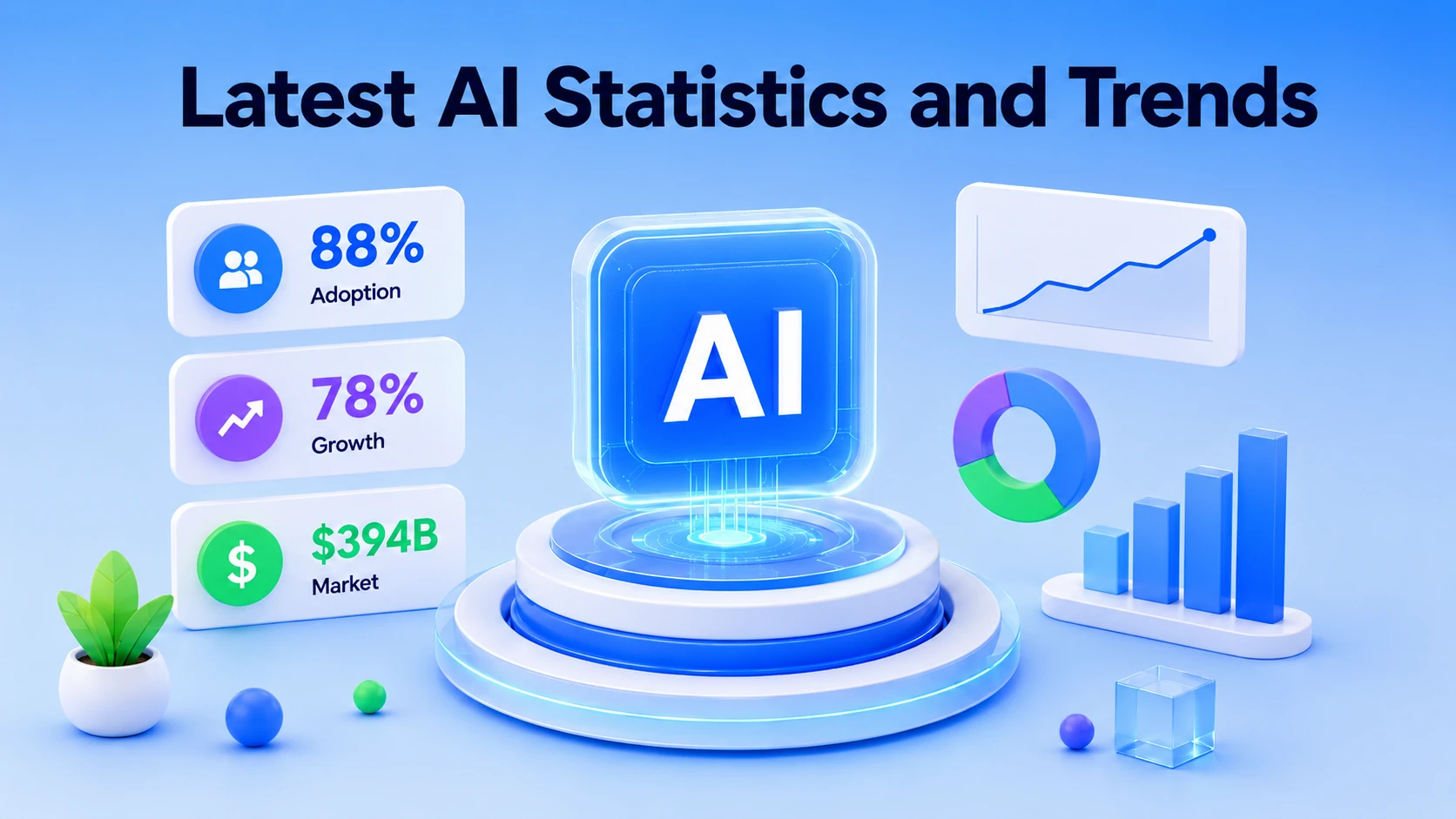
- Organizational AI adoption progressed 88% in 2025.
- Generative AI adoption reached an outstanding figure of 53% globally in three years.
- 97% of employees personally used AI in the past year.
- AI will potentially contribute $15.7 trillion to the global economy by 2030.
- Workers with AI skills earn 56% more than peers without those skills.
- Two in three report using an AI tool or application in the last twelve months (66% average across 21 countries).
- AI search traffic grew 527% year-over-year.
AI Adoption Statistics
Most large companies use AI. A few companies have integrated AI into their work; others still run isolated pilots. This difference has largely affected their ROI.
Enterprise AI adoption
- Organizational AI adoption reached 88% in 2025.
- 77% of companies have used or explored AI in their businesses. AI is a leading priority for some companies in 2026 and beyond.
- 20.2% of firms have reportedly used AI in 2025, up from 14.2% in 2024 and 8.7% in 2023.
- The enterprise-size gap remains wide: 52% of large firms vs. 17.4% of small firms use AI.
- 34% of companies now rely on AI to “deeply transform” their business.
Consumer AI Adoption
- 66% of adults across 21 countries utilized an AI tool in the last year, up 18% from 2024 and 28% from 2023.
- Generative AI reached 53% global adoption in three years, faster than PCs and the internet at the same stage.
- ChatGPT now has 700 million weekly active users, making it the fifth most-visited website globally, with over 5 billion monthly visits.
- 55% of Americans say they regularly use AI. 44% think they don’t use AI.
- 77% of devices being used have some form of AI. Only a third of consumers assume that they use AI platforms, while actual usage is 77%.
- More than one-third of individuals across the OECD used generative AI tools in 2025. The largest divide is based on age (usage rates are higher among ages 16 to 24), while the gender gap in AI use is relatively small, at 4.2 percentage points.
Global Generative AI Market Size
The global Generative AI market will reach US$394.66bn in 2026. This market will continue to grow at a yearly rate of 12.60% from 2026 to 2032 (CAGR 2026-2032), increasing market volume to US$804.33bn by 2032.
Generative AI Statistics
Generative AI has captured the attention of companies across industries and niches worldwide. Likewise, users have adopted generative AI platforms in large numbers, a testament to their global success.
GenAI Usage and Productivity
- According to 87% of leaders, AI super-users are at least 5X more productive than the workforce that has not adopted AI.
- AI super-users save nearly 9 hours per week, 4.5 times more than the 2 hours a week reported by AI laggards.
- Nearly all (96%) organizations that have invested in AI have achieved some productivity gains, with 57% reporting significant gains.
- Companies with $10 million or more in AI budgets are 71% likely to report significant productivity gains, compared to 52% for companies with smaller budgets.
- Anthropic’s Economic Index found a 12x speedup for prompts requiring a college degree, while only a 9x speedup for prompts requiring a high school education.
- About 49% of jobs have seen at least a quarter of their tasks performed using Claude.
- 66% of companies have reported productivity or efficiency gains from AI.
GenAI Challenges
- Only 29% of organizations see substantial ROI from generative AI, and only 23% from AI agents.
- 75% of executives have revealed that their company’s AI strategy is “more for show” instead of actual internal guidance.
- 67% of executives believe their company has already suffered a data leak or security breach due to the use of unapproved AI tools.
- 48% of executives call AI adoption a “massive disappointment,” up from 34% last year.
- 79% of organizations experience challenges in adopting AI, a double-digit increase from 2025.
- One-in-eight (12%) CEOs say AI has provided them with both cost and revenue benefits. Overall, 33% report gains in either costs or revenue, while 56% say they have not experienced any substantial financial benefit.
Agentic AI Statistics
It would not be wrong to say that AI agents are the biggest gains of 2026. Unlike a chatbot or a copilot, an agent reasons, follows an action plan, and then executes tasks on its own.
Businesses have accelerated deployment, but they haven’t kept pace with governance. This gap has caused uncertainty in this category.
- 97% of executives say their company deployed AI agents in the past year. 52% of employees have already benefited from them.
- The agentic AI market is expected to surge to $10.86 billion in 2026, up from $7.55 billion in 2025.
- The agentic AI market could reach $93.2 billion by 2032, growing at a 44.6% CAGR.
- 74% of companies plan to implement agentic AI within two years. Only 21% report having a mature model for governance of autonomous agents.
- 40% of enterprise applications will include integrated task-specific AI agents by the end of 2026, up from less than 5% in 2024.
- 40% of agentic AI projects will be canceled by 2027 due to escalating costs and unclear business ROI.
- CEOs have committed over 30% of their 2026 AI investment to agentic AI.
- AI agents could perform tasks that occupy 44% of U.S. work hours at current capability levels.
- 75% of executives expect AI agents to be part of their company’s C-suite within the next five years.
- 36% of executives don’t follow a formal plan for supervising AI agents. 35% admit they couldn’t immediately shut down a rogue agent.
If your business, or you, plan to experiment with AI agents, you must build oversight processes before you scale.
AI Jobs and Workforce Statistics
AI tends to create more jobs for professionals from different walks of life than it displaces. But bear in mind that the nature of work is changing at a brisk pace. Workers who adapt their skills are already earning more and getting promoted faster than those who do not.
Job Displacement vs. Creation
- The World Economic Forum projects that 170 million (14%) new roles will be created and 92 million (8%) will be displaced by 2030, a net gain of 78 million (7%) positions.
- Job disruption will affect 22% of all jobs by 2030.
- AI could replace the equivalent of 300 million full-time jobs, according to Goldman Sachs.
- 66% of enterprises have reduced entry-level hiring as they deploy AI.
- Through 2026, 20% of organizations will use AI to flatten their organizational structures, eliminating more than half of current middle-management positions.
- 40% of employers anticipate reducing their workforce where AI agents automate tasks. 70% expect to hire staff with new skills, and 50% plan to transition staff from declining to growing roles.
AI Skills and Wages
- Workers with advanced AI skills earn 56% more than peers in the same roles without those skills.
- 39% of workers’ existing skill sets can be expected to transform or become outdated over the 2025-2030 period.
- Over 90% of global enterprises will experience a critical AI skills shortage by 2026.
- 77% of employers plan to enhance their workers’ skill set to work more effectively alongside AI.
- 80% of the engineering workforce will depend on upskilling through 2027 to keep pace with generative AI.
- AI super-users were 3x more likely to have received a promotion or a pay raise in the past year.
- 92% of the C-suite admit they are actively cultivating a new class of “AI elite” employees. 60% plan to lay off those who do not adopt AI.
Most In-Demand AI Jobs
- Fastest-growing job postings for freshers include AI engineer, Marketing coordinator, Recruitment assistant, Legal specialist, Human resources operations specialist, and Business development representative, among others.
- AI is expected to improve employee productivity by 40%. 60% of business owners believe AI will increase their productivity.
- About two-thirds of employers plan to hire talent with specific AI skills.
AI in Business Statistics
Most businesses have started using AI in some form, even if they do not always label it. The question is whether it’s actually working. The data tells a mixed story: clear wins in specific use cases but frustration when organizations try to apply it broadly without a clear plan.
Business Adoption and Use Cases
- The most common uses for AI in business are customer service (56%), cybersecurity and fraud management (51%), digital personal assistants (47%), customer relationship management (46%), and inventory management (40%).
- 98% of U.S. small businesses are using an AI-enabled tool.
- 35% of all companies worldwide report using AI in their business.
- The most common reason businesses do not use AI is finance and cost (51%). 35% worry they lack the technical skills.
- The manufacturing sector will likely see the greatest benefit from AI, with a projected gain of $3.8 trillion by 2035.
AI ROI and Executive Sentiment
- More than 90% of companies plan to continue investing in AI even without near-term ROI. Nearly all CEOs believe that AI agents will produce measurable returns in 2026.
- 50% of CEOs believe their jobs are on the line if AI does not pay off.
- Nearly 75% of CEOs say they are their organization’s main decision-maker on AI, double last year’s share.
- 78% of leaders now see AI as more beneficial to revenue growth than cost reduction, up from 65% in 2024.
- Companies that apply AI widely across products, services, and customer experiences achieve nearly 4 percentage points higher profit margins than non-adopters.
- Industrial AI deployments at scale have achieved 30% to 50% productivity gains and up to 35% reductions in maintenance costs.
AI for Small Businesses
If you own a small business, AI should be included in your toolkit, even if you do not think of the specific tools as “AI”. From the email spam filter to the chatbot that answers customer questions on your site, AI is integrated into the products you use.
- The top ways consumers use AI are: responding to people via text or email (45%), answering financial questions (43%), and planning travel itineraries (38%).
- Nearly two-thirds of business owners think AI will improve their customer relationships.
- 97% of business owners think using ChatGPT will help their businesses.
AI in Healthcare Statistics
Healthcare is one of the most important, fastest-growing sectors for AI. Physician adoption has nearly doubled in a single year, and AI-generated medical reports have outperformed human-written ones in accuracy.
- The global AI in healthcare market is projected to increase from USD 51.20 billion in 2026 to approximately USD 613.81 billion by 2034, a CAGR of 36.83%.
- 66% of physicians used AI in their practice in 2024, up from 38% in 2023.
- AI-generated operative reports achieved 87.3% accuracy, outperforming surgeon-written reports at 72.8%.
- Over 340 FDA-approved AI tools are being used in clinical settings, primarily for diagnosing strokes, brain tumors, and breast cancer.
- The average ROI for AI in healthcare is $3.20 for every $1 invested, with typical returns seen within 14 months.
- Microsoft’s Diagnostic Orchestrator solved complex medical cases with 85.5% accuracy, far above the 20% average for experienced physicians.
AI in Education Statistics
- Students have adopted AI rapidly. Parents and educators are trying to follow them,
- 4 out of 5 university students use GenAI.
- 9 in 10 students want to learn more about AI in school.
- 87% of educators have not obtained any AI training as part of their professional development.
- 54% of parents think AI can lead to a positive effect on their child’s education.
- 80% of parents have concerns about the harmful effects of AI in education. Top concerns are privacy/data and accuracy and reliability of AI-generated content.
- U.S. adults with higher levels of education and income demonstrate greater awareness of AI: 53% of postgraduates versus 14% of those with a high school education or less.
- 75% of students 16 and older across OECD countries used GenAI tools in 2025.
Consumer AI Usage Statistics
People have begun using AI daily, often without thinking of it as AI. Moreover, it helps them perform many tasks, such as writing, travel planning, search summaries, shopping assistance, and more.
Undoubtedly, their trust in AI has grown to some extent, and the way netizens and other users find information has changed, as has the way businesses are explored online.
- About 2 out of 3 people (67%) would rely on ChatGPT rather than Google.
- Nearly 35% of Gen Z people in the U.S. use AI chatbots to find information.
- 78% of people polled think the benefits of generative AI far outweigh the risks.
- 65% of consumers trust businesses using AI. 14% do not. 21% are neutral.
- 54% of consumers think written content will improve with AI technology.
- Workplace AI usage by type: email spam filters (78.5%) and chatbots for customer service (62.2%).
AI and Search Statistics
If you have a website or produce content, this section is crucial for you. As you may be aware, AI Overviews now reach two billion monthly users. AI search traffic grew 527% year-over-year. The way netizens discover information is changing, and the sites that recognize this shift early can adapt in time.
- Google AI Overviews now reach 2 billion monthly users across more than 200 countries.
- AI search traffic grew 527% year-over-year. Some sites (especially SaaS) have reported that over 1% of total sessions are coming from platforms like ChatGPT, Perplexity, and Copilot.
- AI search traffic could surpass traditional search traffic by 2028.
- About 60% of searches on traditional search engines result in no clicks.
- Only 8% of users click a traditional link when an AI summary appears. Without a summary, the rate nearly doubles to 15%.
- The average LLM visitor is worth 4.4 times as much as a conventional organic search visitor.
- AI referral visits have a 27% lower bounce rate than non-AI traffic for retail sites. These visits are 38% longer and contain more page views.
- 50% of ChatGPT’s cited links denote business and service websites.
- ChatGPT users click an average of 1.4 external links per visit, compared to 0.6 from Google.
- Nearly 70% of businesses have reported achieving higher ROI from using AI in SEO.
While developing a content strategy for your business, you should not overlook AI-generated search results, as it can help you attract meaningful traffic to your site. More importantly, well-researched, precise, and valuable content helps you promote your business, as AI platforms can cite your content and showcase it in AI overviews.
AI Trust and Regulation Statistics
Public confidence in AI needs to grow. Currently, public trust in AI is not up to the mark, and people have given mixed responses. Most people have seen the benefits, but some have also expressed their reservations. concerns.
Public Trust in AI
- 50% of consumers view AI optimistically.
- 80% of people are concerned about AI being used for cyberattacks. 78% are concerned about identity theft. 74% are concerned about deceptive political ads.
- 42.1% of users report experiencing inaccurate or misleading content in AI Overviews.
- 80% of Gen Z trust AI more than their managers to provide performance feedback and career advice.
- 29% of employees admit to sabotaging their company’s AI strategy. Among Gen Z workers, the figure jumps to 44%.
- 73% of CEOs report stress or anxiety about their company’s AI strategy. 61% fear losing their job if they fail to lead the AI transition.
AI Regulation
- 85% of respondents endorse a national effort to make AI safe and secure.
- Only 8% (4/50) of Member States have issued health-specific AI guidelines to address ethical implications
- 58% of respondents indicated that advancing science, medicine, and other fields through AI innovation was crucial, compared with 41% who prioritized protecting industries that may be affected by AI.
- 50% of organizations will need “AI-free” skills assessments by 2026, responding to concerns about critical-thinking atrophy from GenAI use.
Top AI Trends to Look For in 2026
As we move forward into 2026, AI isn’t a technological revolution anymore. It’s now becoming the basis for how industries evolve and societies function. From workplaces to hospitals, from global trade to sustainability, AI continually influences the world.
Here are the top AI trends that will create an impact this year:
Rise of Agentic AI in Daily Life
Among the major AI trends in 2026, agentic AI has all the right ingredients to change everyday interactions. In 2025, it was the industry’s hot topic for all the right reasons, but its impact will be felt in 2026 and beyond.
Picture a smarter ChatGPT that can not only produce required information but also manage day-to-day tasks. It can help you in multiple activities such as booking trips, managing groceries, or operating smart home devices.
From a professional perspective, agentic AI will go beyond being an assistant. It has begun coordinating systems projects, communicating with external partners, and driving long-term objectives across systems. In practice, agentic AI serves as an autonomous teammate rather than a mere assistant.
The AI-Driven Shift in Workplace Dynamics
According to AI trends 2026, artificial intelligence has transformed people’s work practices and collaboration. As a result, predictive analytics, automation, and intelligent tools have played a key role in enhancing workflows. They have also enabled employees to focus on more valuable work.
The BCG’s “AI at Work” report reveals that 72% of respondents have begun using generative artificial intelligence tools like ChatGPT and Copilot to improve productivity.
Decisive Role of AI Agents in Healthcare
Among the AI trends for 2026, healthcare is one of the most promising areas for adopting agentic AI. Previous systems managed specific functions, such as symptom analysis or treatment recommendations.
Next-generation AI agents will potentially handle the entire patient journey and deliver the best possible solutions. They will schedule diagnoses, review medical histories, plan treatments, and schedule aftercare follow-ups.
These intelligent assistants will give patients a more comprehensive picture of their health by linking lifestyle, medication, and risk factor measurements. In short, AI in healthcare will play a crucial role because of the global shortage of healthcare professionals and rising costs.
Physical AI Leverages Digital and Real Worlds
Physical AI is one of the most crucial trends in AI in 2026. In reality, it is a delicate combination of IoT technologies, smart infrastructure, AI, and robotics. Through this integration, machines can perceive and analyze the world around them and interact in the physical world. It comprises applications from warehouse robots and delivery drones to surgical assistants and traffic systems.
Once you integrate intelligence into physical systems, physical AI will make industries efficient, flexible, and safer. This will benefit industries that were previously too complex or costly to automate.
AI Influences Cybersecurity Offense and Defense
One of the AI trends in 2026 that needs attention is cybersecurity, both as a risk and an opportunity. Cyberattacks increased by 21% in 2025, and AI-driven technologies are continually introducing new attack vectors.
Agentic AI is a near-perfect example in this case. Tools like ReaperAI can help examine networks autonomously, detect weaknesses, and execute complex cyberattacks without human intervention.
As Malwarebytes CEO Marcin Kleczynski has said, today’s threats prioritize volume. They are nearly impossible to detect and exploit new forms of deception.
AI-powered defense systems, in turn, have evolved as well, and AI trends in 2026 have emerged to nullify them. As a result, security agents will not only respond but also highlight and eliminate threats.
In 2026, this shift from reactive protection to adaptive, self-learning defense marks a new era in the fight against ransomware, data theft, and phishing.
Top AI Tools According to Use Cases
Here are the top AI tools based on primary use cases:
1. Coding & Development
- Cursor: Cursor is developers’ first choice for “vibe coding” and AI-assisted pair programming within their local environment.
- Claude Code: An impactful, agentic CLI tool for managing multi-file projects, debugging, and complex refactoring.
2. Research & Knowledge Management
- Perplexity AI: The preferred yet reliable search engine for citation-heavy research and staying up to date.
- NotebookLM: It can smartly ingest your personal documents, PDFs, or research notes to produce summaries and audio overviews.
3. Writing & Productivity
- ChatGPT: The pioneer generative AI platform that favors versatile daily use, complex reasoning, and general file analysis.
- Claude: Anthropic’s flagship model is widely famous and accepted among users for advanced reasoning, document structuring, and professional writing.
- Notion AI & Grammarly: Crucial for organizing knowledge bases, strengthening team copy, and fixing grammar on the go.
4. Image, Video & Audio Creation
- Midjourney: Ideal for producing visually striking, painterly, and photorealistic AI art.
- Veo: Google’s leading text-to-video model, renowned for cinematic clips, high photorealism, and ambient audio generation.
- ElevenLabs: The go-to voice AI platform for text-to-speech, voice cloning, and top-notch AI dubbing.
5. Presentations & Workflow Automation
- Gamma AI: It helps create perfectly formatted and designed slide decks, webpages, and documents using a single prompt.
- Zapier AI: It is one of the best platforms for developing automated workflows that connect various web apps without coding.
The Bottom Line on AI Statistics and Trends in 2026
We hope you enjoyed our extensive guide highlighting AI statistics and trends you should not overlook in 2026. You may not be aware that most of your employees have used AI, directly or indirectly, to enhance their productivity. This is the truth you should accept sooner; the better for you.
Luckily, you don’t need a lot of bucks in your pocket to start benefiting from AI. Start small and take baby steps to see what AI can deliver. Your competitors have already leveraged AI to revolutionize their products and services.
It is high time you pay attention to the perks and benefits AI offers its followers worldwide.
FAQs
Should small businesses invest in AI in 2026?
Businesses, whether small or large, must invest in AI in 2026 and beyond to gain a competitive advantage. API-accessible models, low-code platforms, and SaaS tools with built-in AI capabilities indicate that businesses of all sizes can revolutionize workflows, personalize customer experiences, and enhance decision-making without a dedicated ML team.
The question for small businesses is not whether they should adopt AI, but which use cases offer the fastest payback for their specific operational bottlenecks.
What industry will boom in 2026?
The industries that will experience substantial growth this year include AI (Artificial Intelligence), Healthcare Biotechnology, AI and Cloud Computing, Data Centers and Energy Infrastructure, Cybersecurity, and more.
How many enterprise apps will include AI agents by 2026?
Gartner indicates that 40% of enterprise applications will comprise integrated, task-specific AI agents by the end of 2026, up from less than 5% in 2025. Both Gartner and Forrester highlight 2026 as the breakthrough year for multi-agent systems, in which specialized agents collaborate under centralized coordination to manage complex enterprise workflows.
How big is the AI talent shortage in 2026?
The AI talent shortage is substantial and cannot be overlooked in 2026. The demand for AI professionals far exceeds qualified supply, with a ratio of over 3.2 to 1, and over 90% of global enterprises report critical AI skill gaps.
What jobs are safest from AI?
The jobs safest from AI are those that depend on manual dexterity, operate in unpredictable physical environments, or need deep emotional intelligence. Various secure fields include clinical healthcare, skilled trades, mental health and social work, and more.