

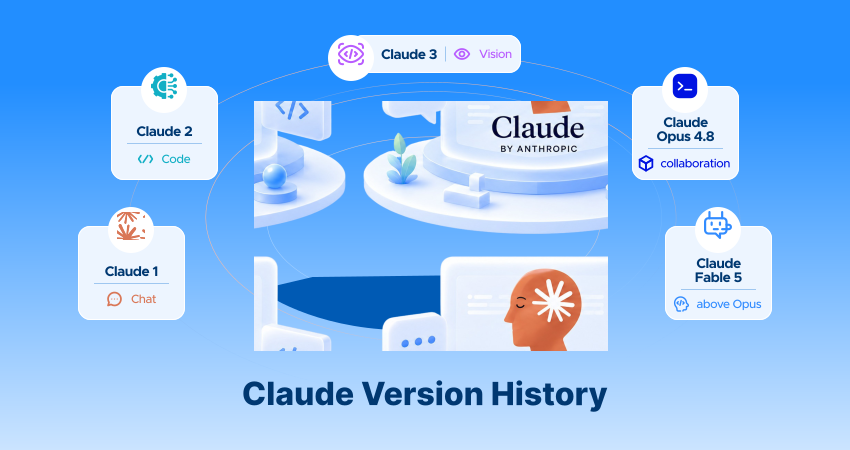
Claude has become one of the most sought-after agentic AI models, which means its effectiveness lies beyond the usual search-based platform. Anthropic’s Claude began as a chat model and has evolved into a large family of AI systems capable of performing numerous tasks, including operating desktops, writing code, and more.
This blog post delves into Claude version history, different models, alongside their release dates and key features, all in one place.
Snapshot of Claude Models
| Model | Release Date | Salient Features |
| Claude 1 | March 12, 2023 | The first public Claude assistant, built on Constitutional AI |
| Claude 2 | July 11, 2023 | Impactful reasoning, longer responses, API access |
| Claude 2.1 | November 21, 2023 | 200K context window, system prompts, early tool use |
| Claude 3 (Opus, Sonnet) | March 4, 2024 | The three-tier family and native vision |
| Claude 3 Haiku | March 13, 2024 | A fast, low-latency tier |
| Claude 3.5 Sonnet | June 21, 2024 | Artifacts and a major coding leap |
| Claude 3.5 Haiku + upgraded 3.5 Sonnet | October 22, 2024Computer use | Computer use |
| Claude 3.7 Sonnet | February 24, 2025 | Hybrid reasoning / extended thinking (and Claude Code) |
| Claude Opus 4 & Sonnet 4 | May 22, 2025 | The agentic Claude 4 generation |
| Claude Opus 4.1 | August 5, 2025 | Sharper coding and agent precision |
| Claude Sonnet 4.5 | September 29, 2025 | Agent and computer-use upgrade |
| Claude Haiku 4.5 | October 16, 2025 | Fast, low-cost 4.5-generation model |
| Claude Opus 4.5 | November 24, 2025 | High-intelligence coding and long-running work |
| Claude Opus 4.6 | February 5, 2026 | Stronger planning and 1M context in beta |
| Claude Sonnet 4.6 | February 17, 2026 | Broad upgrade across coding, agents, and design |
| Claude Opus 4.7 | April 16, 2026 | Advanced software engineering and high-res vision |
| Claude Opus 4.8 | May 28, 2026 | More reliable long-running collaboration |
| Claude Fable 5 & Mythos 5 | June 9, 2026 | The new Mythos-class tier above Opus |
| Claude Fable 5.1 & Mythos 5.1 | September 01, 2026 | New advanced models with different levels of safeguards |
Claude Version History: Claude 1 and Claude 2 (2023)
What is Claude?
Claude is a family of powerful, advanced, and impactful conversational AI assistants developed by Anthropic. Anthropic is an artificial intelligence research company and a brainchild of former OpenAI researchers.
Anthropic began in 2021 as an AI safety organization. The company started researching “Constitutional AI,” in which a model is trained to follow certain rules rather than relying on human feedback. This notion led to the evolution of its first product.
What is Claude 1?

The Claude version history reveals that Claude 1 was introduced on March 14, 2023. Anthropic launched it as the first public assistant. Users can use Claude 1 to interact, write, and perform other tasks such as Q&A, coding, and more.
What is Claude 2?

Claude 2 was officially released on July 11, 2023, and it focused on several aspects simultaneously, including an extensive content window, detailed responses, robust reasoning, and API access.
What is Claude 2.1?
According to Claude release history, Claude 2 was introduced on November 21, 2023, and focused on facilitating companies through system prompts, a 200,000-token context window, lower hallucination rates, etc.
Not to forget that both Claude and ChatGPT primarily operate as agentic AI models. Hence, you cannot perceive them as merely search-based platforms.
What is Claude 3?

Claude 3 was released on March 4, 2024, and dominated by the introduction of a three-tier family revolving around several bargains, including:
- Haiku for speed and affordability
- Sonnet for offering a delicate combination of efficiency and intelligence
- Opus for challenging, humongous activities
Claude 3 allowed models to understand documents, charts, images, and other resources. It also paved the way for native vision, which was a massive breakthrough.
Claude Version History (Claude 3.5 and 3.7: Artifacts, Computer Use, and Reasoning)

The Claude AI version history unveils that Claude 3.5 Sonnet was launched on June 21, 2024, and comprised Artifacts, which primarily serve as the interactive side panel for apps, code, and documents. It further revolutionized Claude, making it a standout feature.
Claude 3.5 Haiku, along with Claude 3.5 Sonnet (an improved version), was released on October 22, 2024, introducing computer use. It helped control a desktop by clicking, typing, and shifting the cursor.
The Claude update history suggests that Claude 3.7 Sonnet was released on February 24, 2025. Sonnet entered the market as a hybrid reasoning model with scalable thinking modes. Claude Code, an agentic command-line coding tool of Anthropic, was also launched on February 24, 2025.
Claude 4: The Agentic Age (2025)

According to Claude’s version history, Claude 4 entered the market on May 22, 2024, with Claude Opus 4 and Claude Sonnet 4. Through these models, Anthropic shifted its prioritization to AI agents and long-horizon work.
Similarly, other updated versions were also launched, such as Claude Opus 4.1, Claude Sonnet 4.5, Claude Haiku 4.5, and Claude Opus 4.5.
If we discuss Claude Opus 4.1, it was launched on August 5, 2025. The model helped enhance coding and agentic performance.
Likewise, Claude Sonnet 5 was launched on September 29, 2025, with a focus on improving coding, computer use, and agents. Claude Haiku 4.5 was released on October 16, 2025, to facilitate coding, reasoning, and computer use tasks.
The Claude update history indicates that Claude Opus 4.5 stormed the market on November 24, 2025, and leveraged spreadsheets, long-running chats, and high-intelligence coding.
Claude Version History: Claude 4.6 to 4.8 (2026)
The Claude release history shows that Anthropic has released multiple agentic AI models in 2026, from Claude Opus 4.6 to Claude Opus 4.8. The firm has smartly utilized its models to design and build the upcoming AI agentic models:
- Claude Opus 4.6 was released on February 5, 2026, and introduced capabilities such as code review, debugging, and robust planning, along with a 1-million-token context window in beta and trustworthy long-running agents.
- Claude Sonnet 4.6 entered the market on February 17, 2026, with the objective of revolutionizing agent planning, design, coding, long-context reasoning, and more.
- Claude Opus 4.7 was launched on April 16, 2026, with a focus on complex multi-step workflows, high-resolution vision, and advanced software engineering.
- Claude Opus 4.8 was released on May 28, 2026, and helped optimize agentic tasks, coding, and long-running collaboration.
Claude Version History: Claude 5 and the Mythos Class (2026)

As per the Claude AI version history, Claude Fable 5, a Mythos-class model, is publicly accessible. It helps simplify cumbersome coding, vision, long-horizon agent work, and knowledge work, etc. Fable 5 also includes protection that routes sensitive requests in domains such as chemistry, biology, and cybersecurity to Claude Opus 4.8.
Claude Mythois 5 was introduced on June 9, 2026, with limited access. It allows users to conduct deep reasoning, top-tier cybersecurity defense, and autonomous multi-step tasks. This four-tier structure rests above Opus, Sonnet, and Haiku, forming the prevailing Claude family.
Claude Fable 5.1 and Claude Mythos 5.1
Anthropic released Claude Fable 5.1 and Claude Mythos 5.1 on September 01, 2026. These models follow the same underlying AI model and possess identical technical specifications. For instance, they offer a 1 million token context window. They also cost $10 per million input tokens and $50 per million output tokens.
The public and developers can access Fable 5.1 through the API and leading cloud platforms. However, Mythos 5.1 is available only to select companies and researchers in fields like life sciences and cybersecurity through trusted access programs.
Claude Version History: Claude Pricing Plans
| Plan | Price | Billing Interval | Usage Capacity | Best For |
| Free | $0 | N/A | Limited | Occasional use |
| Pro | $20/month $200/year | Monthly or annual | Standard | Regular use |
| Max 5x | $100 | Monthly | 5x Pro capacity per session | Suit regular users who want to work with Claude to perform tasks |
| Max 20x | $200 | Monthly | 20x Pro capacity per session | Suit users who wish to collaborate with Claude for many tasks regularly |
The above plans are for individual users.
What is the Team Plan?
Claude’s Team plan suits companies that want to use a version of Claude where 5+ people can interact within a single workspace. This plan offers companies admin control and centralized billing.
What is the Enterprise Plan?
The Enterprise plan serves well for companies that prefer scalable AI, compliance controls, and security for their teams. It comprises the Team plan as well as security and compliance features. Companies can use Enterprise in two ways: Self-serve and Sales-assisted.
Self-serve helps firms buy online directly without contacting sales. Whereas, companies need to contact the sales team to obtain dedicated support and advanced options if they are willing to consider using a sales-assisted plan.
Wrapping Up
We expect you to appreciate our blog post, which provides a comprehensive overview of Claude version history. The version history of Claude is a testament to how contemporary AI approaches and impacts have unfolded over time.
The company Anthropic began its journey with a 9K-context chat model and evolved into a four-tier family with million-token context windows, stronger reasoning, vision, and agentic autonomy.
FAQs
When was Claude introduced?
Anthropic’s first public AI assistant, Claude 1, was released on March 14, 2023.
When was Artifacts launched?
Claude Artifacts, a notable feature, entered the market on June 21, 2024, along with Claude 3.5 Sonnet.
Which is the latest Claude model?
Currently, the latest Claude models are Claude Fable 5.1 and Claude Mythos 5.1. These models are suited to coding and knowledge work.
What is the Mythos class?
The Mythos class is a model tier launched alongside Claude Fable 5 and Claude Mythos 5. Claude Fable 5 primarily works as a public version, whereas Mythos 5 applies to trusted-access programs.
When was Claude Code released?
Claude Code was released as a research preview on February 24, 2025, with Claude 3.7 Sonnet. It mainly operates as Anthropic’s agentic coding tool.
What are the different Claude tiers?
There are different Claude tiers available, including Mythos (Fable 5), Opus (Opus 4.8), Sonnet (Sonnet 4.6), and Haiku (Haiku 4.5).