

The business world is vast and ever-changing. You could argue that while businesses themselves are the major force, customers are what drive them practically. Being organized in managing customers and ensuring they’re satisfied are the ultimate keys to success.
This is where Salesforce’s role is handy. It is a super-smart tool that helps businesses of all sizes, regardless of niche or domain, closely monitor their customers and keep them happy and convinced at all times. If you don’t know the answer to the query, “What is Salesforce?”, don’t worry.
This simple guide will explain the query “What is Salesforce?” and describe its benefits, functions, and other aspects.
What is Salesforce?
As a leading, impactful CRM platform, Salesforce has revolutionized how businesses handle and enhance customer relationships. In addition, the platform has evolved from conventional software to advanced software that provides cloud-based solutions to businesses across niches and industries.
What makes their platform ecosystem unique is that it unites sales, marketing, analytics, and services, all in one place, offering businesses a comprehensive overview of customer interactions.
What Does Salesforce Do?
Salesforce offers businesses, large or small, cloud-based solutions that simplify operations, analyze data, and automate workflows, thereby enhancing customer relationships. Salesforce enables businesses to connect sales with marketing, IT, commerce, and service on a single platform.
Hence, teams can improve their collaboration and delight customers through consistent, powerful experiences.
We hope you now know what Salesforce CRM is and how it shapes the performance of any business, large or small.
Why Is Salesforce So Popular?
Salesforce’s popularity and acceptance stem from its scalability, user-friendly interface, customizable features, and continuous innovation. Different reasons suggest why Salesforce is an indispensable solution:
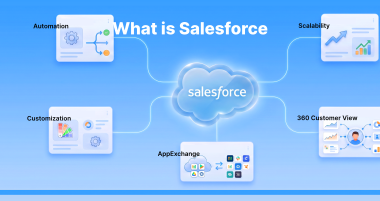
- Automation: Salesforce offers powerful features that can automate workflows and even make smart suggestions. This helps businesses work smoothly and smartly.
- It grows and evolves: Regardless of the size of the business, Salesforce can scale with it and adapt to whatever changes come its way.
- It is highly customizable: Businesses can adjust Salesforce features and settings to use the platform exactly as they need.
- It helps with seeing the big picture: The platform lets you observe a customer from a 360-degree angle.
- AppExchange: You can benefit from Salesforce’s “marketplace” that empowers businesses to search for and install third-party applications or services from other developers to broaden the platform’s functionality. This huge ecosystem of apps has a multitude of customization options.
What are the main functions of Salesforce?
Salesforce’s functions aren’t limited to managing contacts and customer information. The platform comprises capabilities that impact every aspect of business operations and customer engagement.
Moreover, these functions are integrated, enabling comprehensive solutions that evolve and adjust to meet customized business requirements while sustaining best practices and standardization.
What are Salesforce Cloud Services?
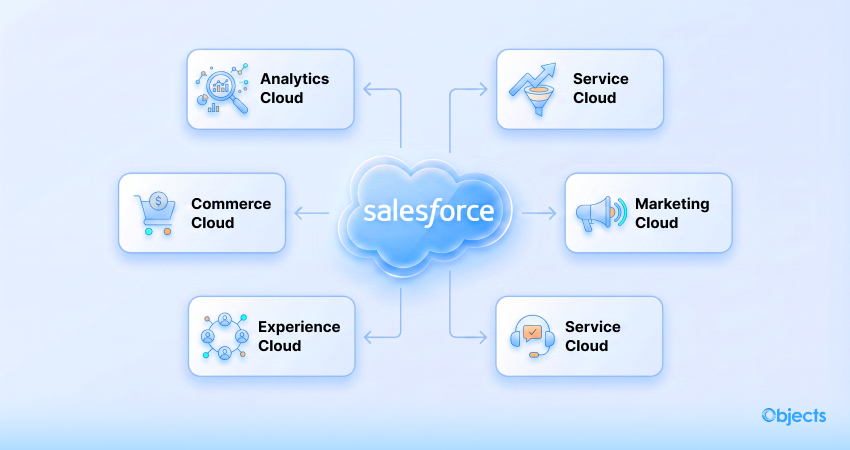
“Clouds” in Salesforce can refer to a wide range of cloud-based services designed to meet various business requirements and provide access to unique or specialized functionality. Each cloud has a distinct role tailored to specific industries or business types.
Here are the different Salesforce cloud services you must know about:
Sales Cloud: Helps businesses sell their products by monitoring customer information – like who they are and what they purchase. As you may be aware, it manages sales processes and helps businesses drive sales with tools for lead conversion, sales forecasting, opportunity tracking, and other purposes. This way, sales teams can close deals without fuss.
Marketing Cloud: Helps send emails and ads to existing and potential customers, ensuring they receive the right messages at the appropriate time. Marketers can run personalized marketing campaigns across multiple channels, thereby improving customer engagement.
Service Cloud: For businesses with a customer-facing support center, it enables them to answer customer questions and provide them with timely solutions. Thus, they can make their customers happy and satisfied, increasing the likelihood of future returns.
It can significantly improve customer service and support by providing tools for case management, omni-channel support, and knowledge sharing.
Experience Cloud: Every business now largely relies on its website to help partners, internal workers, and customers find the products they want. This helps create branded online communities and portals for employees, partners, and customers.
Commerce Cloud: Businesses that sell goods online or use e-commerce are the platform’s key users. It allows them to delight customers with customized, engaged, and secure buying experiences across several platforms.
Analytics Cloud: Salesforce delivers CRM Analytics (formerly Einstein), the first near-perfect AI solution for CRM. It primarily serves as a comprehensive set of AI technologies built on Analytics Cloud. This tool offers advanced visualization and analytics capabilities that help users gain valuable insights from data sourced from external sources, including Salesforce. Once businesses start using CRM Analytics, they can make data-oriented decisions.
What is the importance of Salesforce consulting services?
Salesforce consulting services are handy because they enable CRM investment, ensure a tailored application, and drive business growth through data optimization, automation, and expert strategy. These services help reduce risks and improve user adoption through training and platform customization to specific industry needs.
If you don’t know what Salesforce consulting services are, we’ve got you covered. Salesforce consulting services empower businesses to get the most from their Salesforce platform. Consultants closely monitor processes, propose valid solutions, and ensure smooth adoption.
How Does Salesforce Help Businesses?
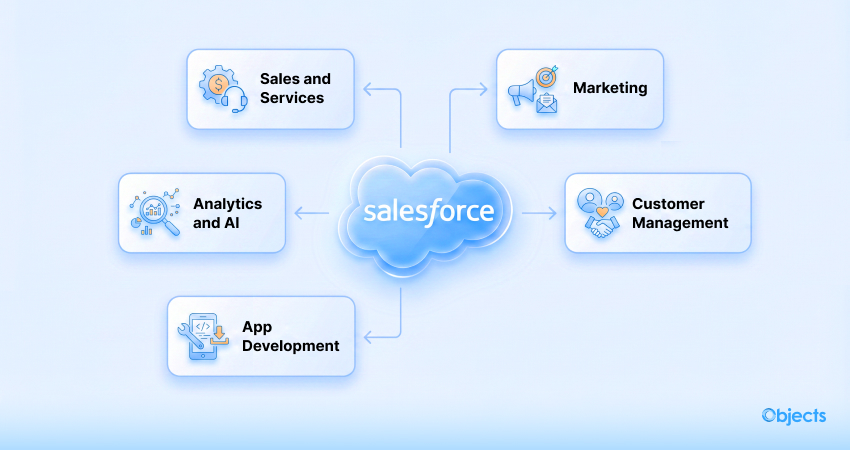
Salesforce empowers businesses with a platform that streamlines and revolutionizes sales, service, marketing, analytics, and customer management by centralizing and consolidating disparate data sources and workflows.
Sales and Services
The platform simplifies lead management, pipeline forecasting, and opportunity tracking, and streamlines quote generation and order processing. Service teams make full use of omnichannel support, case management, and knowledge bases to reduce resolution times and, to a certain extent, increase customer satisfaction.
Marketing
Salesforce enables smooth campaign management, lead nurturing, and personalization at scale. Marketing teams can design customer journeys, trigger automated responses based on behavior, and measure campaign effectiveness with integrated analytics.
Analytics and AI
CRM Analytics provides recommendations, automated decision-making, and predictive insights to all platform functions. Advanced analytics tools ensure real-time reporting and deliver customizable dashboards and deep-dive analysis, turning raw data into strategic intelligence.
Customer Management
Salesforce maintains a unified database of customer records, including history, preferences, and interactions, accessible across business units and departments. This comprehensive record of customer data empowers companies and enterprises to make informed, practical decisions and provide personalized engagement and proactive service.
App development
The Lightning Platform helps businesses develop custom applications with limited coding. This way, businesses can scale Salesforce functionality effectively to meet and even exceed specific industry or organizational needs. Low-code/no-code tools democratize development, enabling business users to build solutions that seamlessly integrate with prevailing Salesforce data and processes.
How Does Salesforce CRM Work?
A detailed examination of Salesforce’s operational framework reveals why it has become a major force behind the digital transformation initiatives across niches and industries. Since it operates entirely in the cloud, it provides both flexibility and structure, enabling businesses to adapt rapidly to changing customer needs and business requirements.
Cloud Architecture
Salesforce relies on a multi-tenant cloud infrastructure in which different companies share computing resources while ensuring complete data isolation. This architecture assures guaranteed uptime, automatic scaling, and seamless updates without negatively affecting business operations.
Data model
The platform uses a relational database with custom objects and standards that depict business entities such as contacts, accounts, and opportunities. Relationships between objects yield delicate yet significant data models that capture real-world business processes while ensuring referential integrity.
Configuration vs. Customization
Salesforce prioritizes declarative configuration using visual tools over code-based customization. This approach helps accelerate deployment, reduces maintenance complexity, ensures compatibility with platform updates, and provides extensive customization when needed.
Workflows & Automations
Process automation tools like Flow Builder and Process Builder enable the implementation of complex business logic without programming. These tools mastermind multi-step processes, integrate with external systems, and guarantee consistent execution of business rules throughout the organization.
Wrapping Up
We hope you now understand what Salesforce is and how it can improve your business across sales, marketing, service, and other areas. The good thing is that Salesforce has helped a variety of businesses worldwide, regardless of niche or industry.
From basic CRM needs to enterprise-wide digital transformation, Salesforce offers a range of scalable solutions that grow with evolving business requirements. As a result, Salesforce has become a guiding force for companies that prioritize customer success and competitive differentiation.
Salesforce’s comprehensive platform approach helps companies, enterprises, and other organizations adapt quickly to changing market demands and maintain a higher benchmark of operational efficiency.
FAQs
Is Salesforce easy to learn?
Salesforce is easily accessible to new users thanks to its point-and-click tools, though its learning curve varies by role, ranging from moderate to steep. Thus, beginners can learn the basics in 1–2 weeks, while potential administrators can take 2-4 months. Developers can face a challenging curve lasting 6 to 12 months.
Is Salesforce an ERP or SAP?
Salesforce doesn’t work as SAP or an ERP. Salesforce is a reliable, results-driven customer relationship management (CRM) software platform that integrates with enterprise resource planning (ERP) systems. That said, SAP is an ERP system that can work with Salesforce to simplify and transform end-to-end business processes.
Is SQL and Salesforce the same?
No, SQL and Salesforce are not identical. SQL (Structured Query Language) is an impressive programming language for managing relational databases. As for Salesforce, it primarily operates as a CRM platform that uses its customized language.
What are the four types of CRM?
The four crucial types of CRMs are analytical, collaborative, operational, and strategic. Each type prioritizes a different attribute of customer interaction management.