
Traffic is coming in. Your ads are running, your SEO is picking up, people are landing on your product pages, but the orders still don’t match the visits. If you’ve refreshed your Shopify Analytics dashboard one too many times hoping the number magically climbs, you already know how frustrating a low Shopify conversion rate feels.
Here’s the good news: a low conversion rate almost never comes down to bad products. It comes down to specific, fixable friction points between “browsing” and “buying.” In this blog, we’ll address the most common reasons Shopify stores underperform, and exactly what to do to increase Shopify stores’ CR.
What Counts as a “Good” Shopify Conversion Rate?
Shopify-specific benchmarks put the average conversion rate at roughly 1.4%, based on a study of 2,800 Shopify sites. A rate above 3.2% puts a store in the top 20%, and above 4.7% puts it in the top 10%. But a “good” Shopify conversion rate is always relative; it depends heavily on your industry, price point, and traffic mix. So, don’t panic if your number doesn’t match a stranger’s screenshot.
- Higher-priced or considered purchases (electronics, luxury) naturally convert lower
- Returning customers convert far higher than first-time visitors
- Email and organic traffic typically outconvert paid social by a wide margin
- Mobile conversion rates are usually lower than desktop across the board
Average Shopify Store Conversion Rates by Niche/Industry
| Niche | Typical Shopify Conversion Rate Range |
| Food & Beverage | 2.0% – 6.0% |
| Beauty & Personal Care | 2.5% – 4.9% |
| Gifts & Specialty | 4.5% – 5.0% |
| Health & Wellness / Supplements | 2.0% – 3.5% |
| Pet Supplies | 1.6% – 2.6% |
| Fashion & Apparel | 1.3% – 3.1% |
| Electronics & Tech | 1.4% – 2.3% |
| Jewelry & Accessories | 0.8% – 1.9% |
| Home & Furniture | 0.4% – 2.2% |
| Luxury & Premium | 1.0% – 1.5% |
These ranges can still vary depending on your pricing points and many other factors; we will discuss and suggest fixes. Treat these as reference points rather than exact targets. The goal is to compare your store against its own niche, not to chase a single universal number.
6 Fixes to Improve Your Shopify Conversion Rate
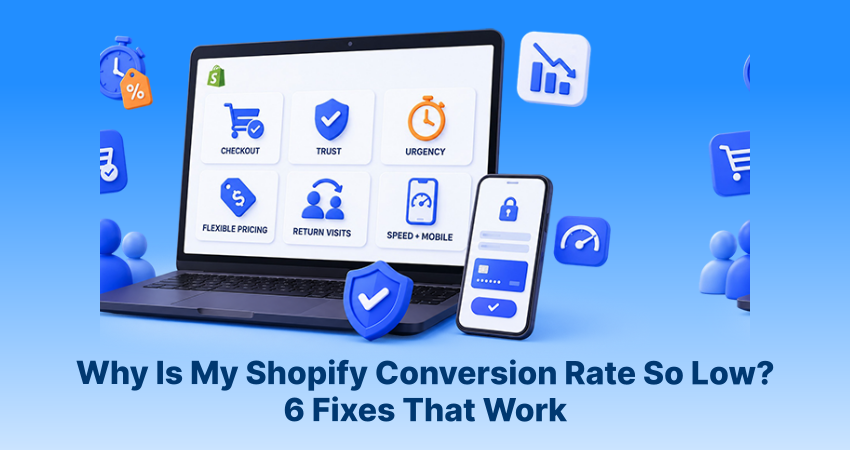
1. Simplify Your Checkout Process
If your checkout demands an account, hides the shipping cost, or takes six pages to complete, you’re losing bulk buyers. And shoppers who were already sold on the product. Every extra click is a opportunity for someone to reconsider.
Here’s the simplest fix to this cause:
- Offer guest checkout as the default, not an afterthought
- Show shipping costs and taxes early, not as a surprise at the end
- Reduce form fields to only what’s essential for fulfillment
- Enable one-click payment options like Shop Pay or Apple Pay
2. Build Trust With First-Time Visitors
New visitors to your Shopify eCommerce store are cautious by nature. If your store doesn’t quickly answer “is this legit?”, they’ll close the tab rather than risk their card details. Trust signals do a lot of quiet, unglamorous conversion work.
Here’s what actually works:
- Display reviews and ratings prominently on product pages
- Add secure checkout badges and clear return/refund policies
- Show real donation or cause transparency if your brand supports one. The best Shopify donation app makes your cause visible at checkout instead of buried in an About page
- Feature real customer photos or testimonials where possible
3. Create Urgency With Timely Offers
A visitor who isn’t ready to buy today often just… doesn’t. Without a nudge, “I’ll come back later” quietly becomes “I forgot this existed.”
Here’s how to fix it:
- Use exit-intent popups to attract users one last time before they leave. Popup & Disclaimer Shopify app handles this along with scheduled flash-sale banners and other disclaimers
- Run limited-time offers with visible countdowns
- Gamify the discount instead of just stating it. Shopify spin the wheel popup app converts hesitant browsers into buyers through a small, fun incentive spin and win games
- Rotate offers so returning visitors don’t see the same static banner every time
4. Offer Flexible Pricing for Different Buyer Types
A single fixed price works fine for casual retail shoppers, but it quietly repels bulk buyers, wholesalers, and price-sensitive customers who would’ve bought under slightly different terms.
- Offer volume-based discounts for bulk or multivariant orders. Choose a Smart Variant Table app that lets B2B buyers select quantities and variants without friction
- Bundled products discounts convert better and boost your order’s AOV. And now bundle and variant table creation are achievable through one Shopify app: Smart Variant Table
- Let B2B customers request custom quotes instead of forcing retail pricing on them. You can get this B2B Request Quote & Hide Price app to automate your Shopify b2b pricing tasks end-to-end
- Test flexible or pay-what-you-want pricing for clearance stock. You can get the best Shopify Pay What You Want app: Offer Your Price. It is built specifically for this
5. Give Visitors a Way to Come Back
Not every visitor shops on their first visit. And if you give them no way to save their interest, that traffic is gone for good instead of just delayed.
- Add a product wishlist option in your Shopify store so undecided shoppers can save products instead of abandoning them entirely. We recommend the Shopify Smart Product Wishlist app for the wishlist feature. It’s super easy to run, manage, and also shows you which products get saved most, which doubles as demand data
- Introduce a Shopify store loyalty program that rewards points for browsing, sign-ups, and purchases using myCred Loyalty Points & Reward app. It turns one-time visitors into repeat customers
- Send a follow-up email or retargeting ad for wishlist or cart activity
- Make account creation optional but attractive, with a small incentive to sign up
6. Improve Your Site Speed and Mobile Experience
None of the above matters if your store is slow to load or clunky on a phone. Mobile conversion rates typically run 40-60% lower than desktop across industries. Yet smartphones account for over 70% of ecommerce traffic in 2026, making mobile performance optimization one of the highest-leverage fixes.
- Audit your installed apps and remove ones that slow down page load
- Compress and lazy-load product images
- Test your full checkout flow on an actual phone, not just a browser resize
- Make sure buttons, forms, and popups are actually usable with a thumb, not just visible
If auditing and fixing this yourself feels like more than you have time for, our Shopify development services can handle the speed and mobile optimization for you.
How to Track If These Shopify CRO Fixes Are Working
Once you’ve made changes, resist the urge to check results after two days. Conversion data needs time and volume to mean anything.
- Use Shopify Analytics > Reports > Behavior to track conversion rate over a 30-day window minimum
- Opt for heatmap or session recording tools to see where visitors actually drop off, like Microsoft Clarity
- Run one change at a time where possible, so you know what’s actually moving the number
- Compare against your own historical baseline, not someone else’s Shopify conversion rate benchmark
Final Thoughts
A website with a low conversion rate rarely has one single cause. And it rarely has one single fix either. It’s usually a handful of small leaks to fix the CRO of Shopify eCommerce sites. It can be a slow mobile page, a missing trust badge, or even pricing that doesn’t flex for your best buyers.
Analyze and fix the biggest leak first, measure it, then move to the next one. That’s how Shopify conversion rate actually improves: one compounding win at a time, not one overnight miracle.
FAQs
What is a good Shopify conversion rate in 2026?
Anywhere between 2% and 3% is considered solid for most Shopify stores. The top 20% of stores convert above 3.2%, and the top 10% exceed 4.7%. The right number for your store depends on your industry and average order value.
How long does it take to see improvements in my Shopify store conversion rate?
Most fixes need at least 30 days of consistent traffic to show a reliable trend, since conversion data is noisy over short windows. Give each change enough time and volume before deciding whether it worked.
Do Shopify apps really help increase conversion rates?
Yes, when you choose the best Shopify apps, they solve a specific bottleneck rather than being installed just to have more features. A pop-up app reduces exit-intent friction, a wishlist app reduces indecision, and a quote app reduces rigid B2B pricing. The key is matching the app to the actual leak in your funnel.