

Java is one of the most fascinating and influential languages today. The extensive Java version history is a testament to its sustained popularity over the past many years. Java is a prominent object-oriented programming language with features that resemble C++, though simpler and more advanced. One striking feature of Java is that it is free to use and runs on all platforms.
This blog post will highlight the Java version history, the JDK, Java SE, and its future.
Java Version History Timelines
Java has been on the market since the mid-1990s and has revolutionized software development, including mobile app development. The first version of Java was officially released in 1996.
Similarly, its latest version was introduced in March 2026. The platform has enabled developers to streamline web development tasks, making them powerful yet results-driven for the past three decades.
The Java Version list below comprises an overview of all Java SE versions, from their origins to the latest.
| Java SE Version | Version Number | Release Date |
| JDK 1.0 (Oak) | 1.0 | January 1996 |
| JDK 1.1 | 1.1 | February 1997 |
| J2SE (1.2) Playground | 1.2 | December 1998 |
| J2SE (1.3) Kestrel | 1.3 | May 2000 |
| J2SE 1.4 (Merlin) | 1.4 | February 2002 |
| J2SE 5.0 (Tiger) | 1.5 | September 2004 |
| Java SE 8 | 1.8 | March 2014 |
| Java SE 9 | 9 | September 21, 2017 |
| Java SE 10 | 10 | March 20, 2018 |
| Java SE 11 | 11 | September 25th, 2018 |
| Java SE 12 | 12 | March 19, 2019 |
| Java SE 13 | 13 | September 17, 2019 |
| Java SE 14 | 14 | March 17, 2020 |
| Java SE 15 | 15 | September 15, 2020 |
| Java SE 16 | 16 | March 16, 2021 |
| Java SE 17 | 17 | September 14, 2021 |
| Java SE 18 | 18 | March 22, 2022 |
| Java SE 19 | 19 | September 20, 2022 |
| Java SE 20 | 20 | March 21, 2023 |
| Java SE 21 | 21 | September 19, 2023 |
| Java SE 22 | 22 | March 19, 2024 |
| Java SE 23 | 23 | September 17, 2024 |
| Java SE 24 | 24 | March 18, 2025 |
| Java SE 25 | 25 | September 16, 2025 |
| Java SE 26 | 26 | March 17, 2026 |
History of Java (Helpful Description)
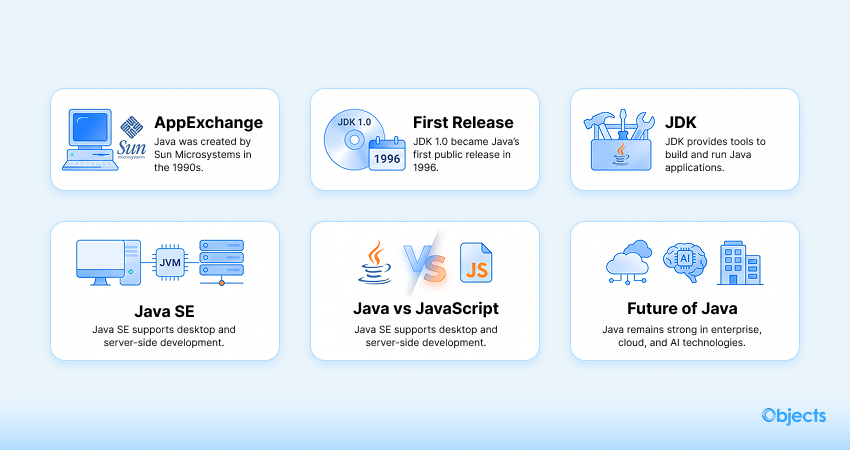
Java is a powerful server-side programming language that emerged in the 1990s. As you may be aware, Sun Microsystems, which powers Java, introduced the platform to address the needs and demands of a huge audience.
The first public version, commonly referred to as JDK (Java Development Kit) 1.0. There is no denying that Java has evolved into a breathtaking platform through successive versions and improvements over the past few years.
As a result, users and other stakeholders benefited from a multitude of exciting language features and improved libraries. In addition, they explored the history of the Java language to see how it has evolved over time.
What is JDK, and Why is It Used?
JDK, short for Java Development Kit, is a development environment for building applications, applets, and components in Java. As for the JDK, it comprises key tools for testing and developing programs that run on the Java platform and are written in Java.
What Do You Mean by Java SE?
In fact, Java SE (Java Standard Edition, formerly called J2SE) comprises programs, libraries, and tools that enable developers and users, both experienced and new, to craft and configure Java applications on servers and desktops. Further, developers have used Java SE to develop desktop apps that primarily run and depend on the JVM (Java Virtual Machine).
What is JavaScript, and Does It Correlate with Java?
JavaScript is a leading scripting language that makes sites interactive and appealing to both new and existing users. It functions directly in web browsers (client-side) to affect webpage elements. Moreover, users can run on servers using technologies such as Node.js.
Despite similar names, Java and JavaScript have distinct developers, use cases, and technical designs. That said, they work as object-oriented programming languages.
At Objects, our JavaScript development team leverages the language’s ever-growing capabilities to build everything from responsive websites and data visualizations to VR and AI-powered applications. Our JavaScript development services enable businesses, large or small, to deliver efficient, top-notch, and influential solutions.
Why Does Java Have Various Versions?
Apart from Java, most programming languages release several versions when required. Each version of Java and other languages includes new features and improvements over previous versions. All these versions help remove errors and bugs and update features from previous versions.
What Next If We Use Old Java Versions?
Users on older versions of Java cannot access the latest features and improvements. Thus, you should avoid using software that runs primarily on older Java versions; otherwise, you may face critical issues, such as a lack of security patches.
If you use older versions of Java for any reason, update them as soon as possible, as they may not fulfill your diverse development needs.
What Do You Know About Java Syntax?
Java syntax is a set of rules and grammar that govern how Java programs are written and designed. This way, the Java compiler can smartly understand the code and run it correctly.
What Do You Know About Java Compiler?
A Java compiler typically operates as a program that interprets Java source code into a transitional format, known as Java Bytecode. Basically, the Java compiler allows developers to write Java source code. Likewise, the JVM (Java Virtual Machine) helps developers run bytecode smoothly.
Contributions of Java Version History to Different Technologies
In general, the Java version history helps us examine the effectiveness and contributions of this remarkable programming language across software and backend development, big data and analytics, mobile technologies, the Internet of Things (IoT), embedded systems, AI, machine learning, and more.
Is There a Future for Java?
Undoubtedly, we regularly witness new programming languages every few months and years. As for Java, the notable programming language has all the right ingredients to automate and revolutionize enterprise development, financial applications, cloud systems, and humongous backend architectures.
Being a Java developer today and beyond offers a lucrative career option.
Wrapping Up
The six-month release cycle is a prominent determinant of Java’s version history. The arrival of multiple new features and smaller enhancements, along with opportunities for bug fixes, continues to expand the Java landscape, making it more engaging.
A thorough overview of several Java versions can easily enhance our understanding of the enhancements.
The next substantial aspect in this case is the need for programmers to stay up to date with recent Java improvements. The new features in the latest Java releases, as well as the support details from the version history, can help you make the most of Java.
FAQs
1- Has Java 26 been released?
Oracle launched Java 26 on March 17, 2026. This latest release offers immediate enhancements, including improvements to AI-powered services, faster cloud-native application startup times, and enhanced G1 GC throughput.
2- What are the 4 versions of Java?
The four platforms of the Java programming language are: Java Platform, Standard Edition (Java SE), Java Platform, Enterprise Edition (Java EE), and Java Platform, Micro Edition (Java ME).
3- What are the 8 variables in Java?
The 8 primitive variable types are byte, short, int, long, float, double, char, and boolean.
4- Is Java 8 Outdated?
Java 8 is now outdated and a legacy technology for new development, despite developers still using it in production (roughly 29-50% of applications).
5- Which is the no 1 coding language?
The success of a coding language largely depends on factors such as market share, developer adoption, and growth. etc. Currently, Python and JavaScript are two leading languages.