Anthropic launched Fable 5.1 on September 01, 2026. OpenAI launched GPT-6 Astra on September 03, 2026. Interestingly, both AI models cost the same for developers but suit different tasks.
This blog post analyzes GPT-6 Astra vs. Claude Fable 5.1 for pricing, coding and agentic work, reasoning, and computer use. It also explains practical use cases that highlight the performance of Astra 6 and Fable 5.1.
What is ChatGPT-6 Astra?
OpenAI created GPT-6 Astra, an advanced AI model released in September 2026. The model primarily functions as a frontier reasoning model, designed to work like an autonomous computer operator and handle professional and technical tasks.
What is Claude Fable 5.1?
Claude Fable 5.1 is Anthropic’s frontier model, suitable for enterprise knowledge work, ambitious coding, and long-horizon agents. If you don’t know versions of Claude other than Fable 5.1, read our exclusive Claude’s version history guide.
ChatGPT 6 Astra vs Claude Fable 5.1 Pricing
On pricing, both models offer the same rates. However, the only difference is caching and long context. If these models use the same number of tokens for an identical task, users will pay the same amount.
| Rate | ChatGPT 6 Astra | Claude Fable 5.1 |
|---|---|---|
| Input, per 1M tokens | $10.00 | $10.00 |
| Output, per 1M tokens | $50.00 | $50.00 |
| Cached input read, per 1M tokens | $1.00 | $0.25 |
| Cache write (5 minutes), per 1M tokens | $12.50 | $12.50 |
| Batch discount | 50% | 50% |
| Rates above 272K input tokens | $20.00 input / $2.00 cached input / $75.00 output | No surcharge |
In short, GPT-6 Astra and Claude Fable 5.1 both follow identical base list prices. That said, real-world costs largely rely on workload and caching.
Coding and Agentic Workflows
For coding and agentic workflows, GPT-6 Astra is the better option. On Terminal-Bench 4.0, which examines software engineering, system configuration, and data analysis, OpenAI reports 57.7% for Astra and 55.8% for Fable 5.1.
The gulf increases on DeepSWE v1.1. That’s because Astra shows 74.1% against 67.4%. Astra almost completely closes the gap on FrontierCode 1.1 Main, where 53.3% against 50.9% falls within the range already occupied by Claude Fable 5 (53.5%) and Claude Opus 5 (53.4%).
Artificial Analysis places Fable 5.1 in Claude Code at 70. Remember, that is the highest score on its Coding Agent Index, and Astra sits nicely in Codex at 67. This levels with Claude Opus 5 and Claude Fable 5.
Astra wins the published coding rows by a small margin and turns the efficiency argument outright in its favor. On the other hand, Fable 5.1 holds the only independent coding-agent score that clears both.
Reasoning and Scientific Work
When we analyze Astra 6 and Claude Fable 5.1 on reasoning and scientific work, the former favors scientific and mathematical tasks. Astra 6 scored 97.6% in math and science work.
Whereas Fable 5.1 scored 87.8% on FrontierMath Tier 4 v2. Astra 6 performed at 96.0%, and Fable 5.1 scored 93.7% on GPQA Diamond. On Terminal-Bench Science 0.1, Astra 6 scored 64.6%, and Fable 5.1 performed at 52.6%.
Fable 5.1 shone during Humanity’s Last Exam with tools; it performed at 65.0% against Astra 6.0, which scored 57.2%. Artificial Analysis supports that outcome independently. That’s because Fable 5.1 scored 66 on its intelligence index against Astra, which scored 61.
If you want to conduct a graduate-level math or science activity, Astra can help. If it belongs to the hard-reasoning Humanity’s Last Exam category, Fable 5.1 is the right choice.
Computer Use and Professional Artifacts
On computer use and professional artifacts, Astra 6 is superior. According to OpenAI, Astra scored 72.6% on OSWorld 2.0’s offline set compared to 70.2% for Claude Opus 5, and 92.7% on ScreenSpot-Pro compared to 87.3% for Fable 5.
The artifact numbers are relatively simple: 95.9% on BenchCAD against 84.3%, and 41.4% against 31.4% on AutomationBench. Astra is a better option for users who prefer real software and want to create slides or CAD output.
Choose ChatGPT Astra 6
Consider selecting GPT-6 Astra if your users prefer real software. It also suits professional artifacts, including slides, CAD output, and spreadsheets. Therefore, ChatGPT 6 Astra is a smart choice for artifacts. Astra 6 also favors science and math work.
If you use Codex, Astra should be your default choice, since its context notes primarily work as a strong Codex feature. We recommend reading ChatGPT’s version history to understand its strengths and get the most out of GPT-6 Astra.
Choose Claude Fable 5.1
You work in Claude code, because Fable 5.1 is Anthropic’s most efficient AI model. Fable 5.1 also seems like a wise choice for long requests because the model doesn’t charge extra for long context. Additionally, you prefer the best independent reasoning score and are ready to pay for it.
ChatGPT-6 Astra vs Claude Fable 5.1 Real Use Cases
This section discusses real use cases from Nate Herk, owner of the online community AI Automation Society. Herk is primarily an AI educator, entrepreneur, and creator who encourages people to use AI to work more effectively and build better businesses.
You can browse its official YouTube channel: Nate Herk | AI Automation.
Now we describe different use cases that Herk experimented with to see which model worked better in reality.
Experiment 1: A Branded Consulting Presentation
In the first experiment, Herk gave both models the same assignment: create a McKinsey-level presentation about the state of small and medium businesses for his fictional consulting brand. It needed to fit the branding and target audience.
Astra started asking questions related to the presentation. Meanwhile, Fable began working on the prompt accordingly. Herk was interested in how both models presented the information. Astra presented the information in a presentation style, but it looked casual.
Another issue was that the presentation wasn’t extensive and relied on only a few visuals. Fable 5.1, by contrast, created a professional, detailed, engaging, and informative presentation on the topic. It suggested that the presentation could have been used as a document for someone who wanted to learn.
Based on the above description, Herk declared Fable 5.1 the clear winner based on the output received.
Experiment 2: Sales Copywriting
This experiment focused on sales copywriting, where Herk assigned both models to create a sales page for their certification program. The models were supposed to analyze the new students, their thoughts, and what factors they would consider if the program suited them.
Astra produced a short output in terms of word count. It wrote around 1300 words. Fable 5.1 produced around 2800 words in return. Moreover, the latter answered various queries about the teacher: how it works, tuition fees, enrollment, certification, and whether it would suit someone who manages their own agency.
So, Fable’s version was far more suitable and looked more appropriate than Astra’s one. Astra’s version was high-level, but Fable’s attention to detail ensured students were better informed about what they would get when they sign up for the program.
Thus, Fable 5.1 won this experiment.
Experiment 3: Organizing My Tax Information
This experiment focused on financial information, and both GPT-6 Astra and Fable 5.1 created workbooks covering the first two quarters of the year. Fable comprised projections, payments, inputs, sources, and conditional decision logic.
Astra, by contrast, started by asking different questions first. As a result, the model produced more customized answers based on the input it received. Astra 6 provided a detailed workbook with a clear starting point, a forecast, payments, monthly results, source checks, and a transaction ledger. Interestingly, the layout was attractive and easy to read.
Astra worked better throughout this experiment and asked questions; based on the answers, it tried to reduce the output. Overall, Astra 6 offered a favorable experience. Hence, Astra 6 outshone Fable 5.1 in this experiment, as the deliverable was appropriate and it managed the context equally well.
Experiment 4: Auditing My Subscriptions
In this experiment, Herk assigned both models to examine email accounts for upcoming payments, price increases, duplicates, and anything that might need to be canceled. That meant going through potentially years of messages.
Fable 5.1 streamlined active subscriptions by current price, billing date, account, and monthly equivalent. It also highlighted price jumps, seat increases, unpaid items, duplicate subscriptions, and larger contractor payments. However, to his surprise, its All Charges tab was empty.
Astra 6 comprises annualized spending, recurring baseline, other bills, payment history, and items that required further examination. It also highlighted tier changes, price increases, term changes, expiring discounts, and overlapping seats or tools.
Astra’s output included payment history, which mattered when the job was to audit the underlying charges. Thus, Astra again defeated Fable 5.1 on the subscriptions front.
Experiment 5: Finding Problems Across Meetings
This experiment evaluated leadership meetings alongside team conversations. Both models were tasked with detecting pain points and suggesting one much-needed automation.
To Herk’s surprise, Astra reviewed 79 meetings, and Fable reviewed 58 meetings. Fable produced output that prioritized customer-success workflow. Moreover, it included crucial aspects like delivery, acquisition, and work, alongside attendance, mastery checks, unanswered questions, and missing submissions.
However, Astra’s version was more practical and focused on ownership. It also suggested recommendations regarding personal intervention needed to move users through the customer journey. Based on this output, GPT-6 Astra was a clear winner in this test.
Experiment 6: An AIS Live Event Recap
This experiment focused on delivering an enticing 60-second recap to market future events and happenings. For this purpose, Herk provided both models with a folder over 150GB, including recordings and resources from our July AIS Live event.
Fable 5.1 and Astra 6 were needed to understand the event, explore key moments, and create a story around it. Animations and music also strengthened the video’s impact. Astra leveraged live speaker clips amazingly well, and Fable did its part by framing the next event in October.
That said, both versions had some issues that need a fair bit of polishing to become premium versions. Astra 6 inspired Herk, as it took less time and money to complete. On the other hand, Fable took more time and money to produce.
These experiments demonstrate GPT-6 Astra’s effectiveness over Claude Fable 5.1. However, the results vary from person to person depending on the use cases they follow and how they implement them.
GPT-6 Astra vs Claude Fable 5.1 Reddit
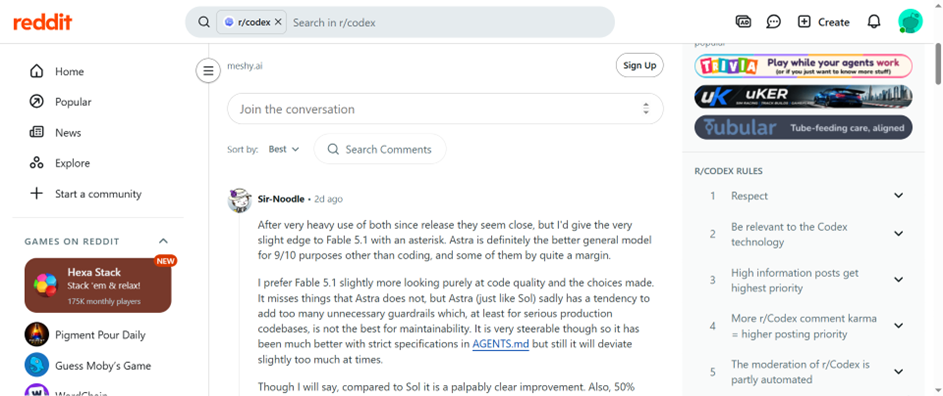
Different users have evaluated the performance of Astra 6 vs. Fable 5.1 for coding on Reddit. Some users found the latter better for coding.
However, they suggested Astra 6 is a better option overall for tasks like image creation, website design, 3D game development, transforming a YouTube video into a fascinating learning guide, and more.
Wrapping Up
We expect you’ll appreciate our analysis of GPT-6 Astra 6 vs Claude Fable 5.1. As for GPT-6 Astra’s performance, it’s high-class and results-driven. It also delivers strong results for tasks like image creation, website design, YouTube video optimization, and more. Moreover, it suits agents that click through software, do math, or develop client-ready artifacts.
Fable 5.1 is also a favorable option because it does the job for users. They can rely on it when performing multiple tasks like coding, reasoning, scientific work, web development, etc.
We recommend subscribing to both AI generative models. That’s because Fable and Astra can deliver the desired results based on users’ own use cases and practical experience. Results may vary, but they don’t disappoint users, and that’s a major point in favor of Astra 6 and Fable 5.1.
FAQs
Is Fable 5.1 suitable for image creation?
Fable 5.1 doesn’t look like a great option for image creation and optimization. Astra 6 seems like a strong alternative, as it has performed much better than Claude in the past.
Is Claude Fable 5.1 useful for long documents and analysis?
Yes, Fable 5.1 does an incredible job producing reports from long, detailed documents. The model can create branded reports that align with companies’ missions and goals.
Where can I access GPT-6 Astra and Claude Fable 5.1?
You can access GPT-6 Astra in ChatGPT (Plus, Pro, Business, and Enterprise plans), through the OpenAI API, and in Codex. Enterprise administrators must enable it, as access is off by default at launch.
Claude Fable 5.1 runs on the Claude web, mobile, and desktop apps, the Claude API, and Claude Code. It also requires 30-day data retention.
Can Fable 5.1 help me recreate a reference website?
With Fable 5.1, you can easily recreate a reference site. The model helps users recreate custom experiences based on audiences’ needs.
Who are the Big 4 of AI?
The “Big 4” of artificial intelligence refers to the four leading generative AI model families: OpenAI (ChatGPT), Anthropic (Claude), Google (Gemini), and Meta (Llama).
Can Fable 5.1 or Astra 6 help me create a reel with motion graphics?
According to Nate Herk, an AI tutor, he experimented with both models and asked them to create a reel with motion design. Astra 6 did an excellent job in this test; it looked more professional, with 3D elements, shadows, and stronger depth.
Astra 6 and Fable 5.1 can help users create reels incorporating motion graphics, but the output may vary.