
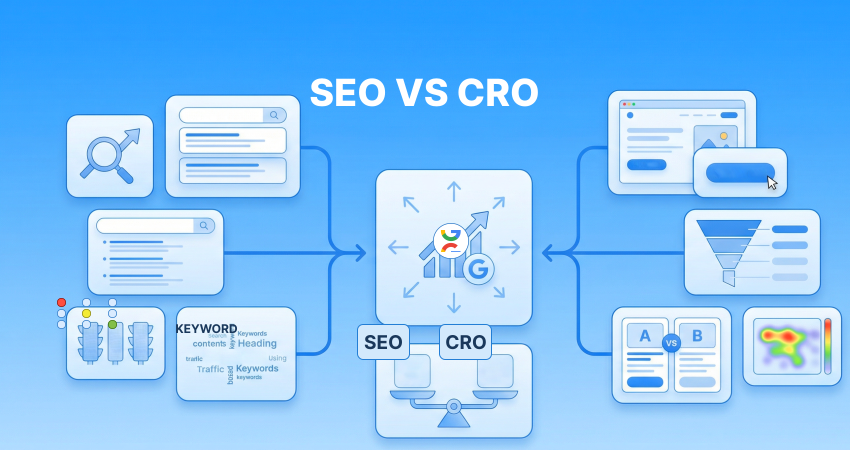
Netizens often assume search engine optimization (SEO) and conversion rate optimization (CRO) are two completely distinct tactics. But are they? You will be astonished by how closely SEO and CRO correlate and how they work together to drive results.
In this digital era, SEO and CRO should go hand in hand. Do you want to learn SEO vs. CRO and why they both need a spot in your marketing plan? Keep reading.
However, let us begin with the basics.
SEO vs. CRO? Know the Difference
SEO focuses on increasing website visibility and driving organic traffic, while CRO focuses on converting that traffic into leads and customers. Balancing both can significantly improve your website’s performance, helping you attract qualified visitors and turn them into loyal customers.
What is SEO?
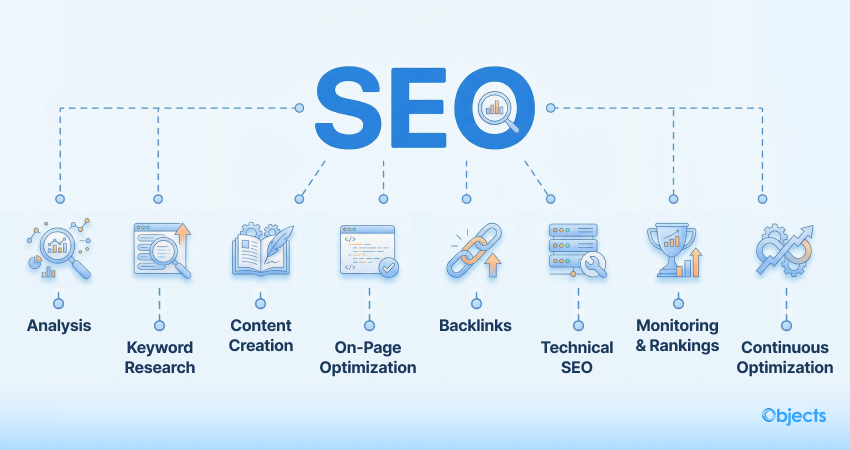
SEO, formally called Search Engine Optimization. This field involves applying strategies, both online and offline, to enhance your website’s visibility in search results. With keywords and a user’s search intent playing a large role, SEO has a big impact on whether your site shows up and on which page when users write or say a search query.
No business worldwide wants to be on Page 10, or even Page 2, of Google search results. This is where an SEO strategy plays a critical role.
Optimizing for Search
SEO is not static; it’s a dynamic process in which the rules are constantly updated to match a search user’s intent better. Moreover, you should pay close attention to various aspects of the content. While these aspects help generate organic traffic, they also serve as a bridge to your overall CRO tactics and efforts.
- Title Tags: The clickable blue anchor text shown in a search result.
- Meta Descriptions: The webpage description appears directly below the title tag in search results.
- Body Content: The on-page copy that users can find on the landing page.
- Term Frequency (TF-IDF): The frequency at which a keyword is shown on a page (Term Frequency), and how often a keyword is shown across all pages (Inverse Document Frequency).
- Linking Anchor Text: The clickable text that allows users to visit an external or internal web page.
Furthermore, the technical SEO aspects that can assist you in boosting your organic visibility include:
- Site Speed: How fast your site loads when served to a site visitor or a user. If your site loads slowly, you increase the chances of visitors bouncing. Per Google, 5 seconds can likely increase the bounce rate by 90%.
- Rich Snippets: Search results that offer additional yet crucial information when compared to a usual or an expected search result.
- Site Security (SSL Security/HTTPS): How safe your new or old website is, whether an SSL certificate has protected it, and whether it is HTTPS instead of HTTP.
A secure site provides users with a sense of security, and search engines alike, and users will be inclined to purchase a product or provide personal information on an HTTPS site than on an HTTP site.
While these attributes help search engines understand your web pages and match that understanding to the right query, if your main focus is SEO alone, you may drive qualified traffic to landing pages that need optimization.
Fortunately, you can get impactful search engine optimization services to boost your organic visibility on leading search engines like Google.
What is the use of driving traffic to a site that does not let its customers take desired actions?
For instance, searchers who look for transactional queries like “buy baseball bats” and “purchase baseballs” want to take the next step once they click a result in the SERP.
If they see listings without the CTAs or keyphrases for purchasing baseball bats, they may not click the listing or return to the search bar and start another query.
What is CRO?
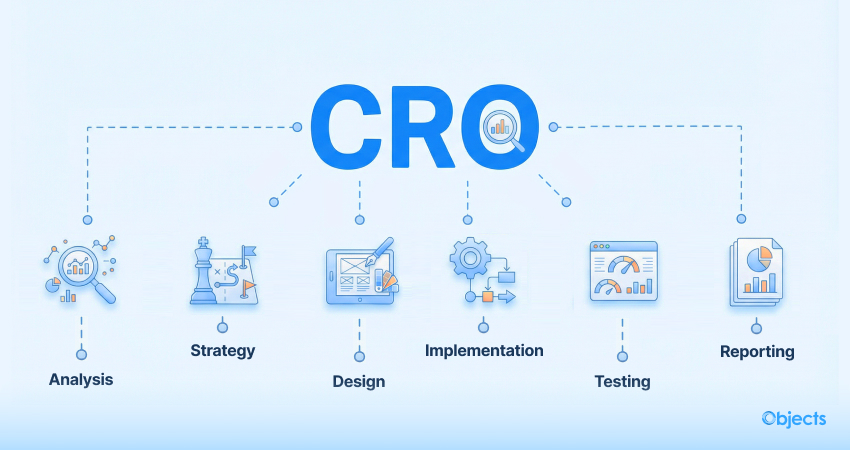
CRO, formally called Conversion Rate Optimization. It focuses on the tactics used on your website (forms, buttons, newsletters, shopping carts, etc.) to generate new leads and transform them into customers. The key objective of CRO is to regularly increase the percentage of website visitors who become customers or take any desired action on a webpage.
Optimizing for Conversions
While SEO focuses on generating more traffic to your site, CRO focuses on ensuring that traffic is converted into paying customers or that visitors complete a specific action on your website.
CRO focuses on messaging, user intent, user experience, and the overall appearance of your website to nurture visitors via the funnel.
So, if the searcher from the above explanation wants to purchase a baseball bat and lands on a page about the history of baseball bats, they won’t take an action on that page. The ideal landing should be the baseball bats category page, or likely a sales landing page showcasing or marketing any deals on bats.
However, if the said searcher visits the baseball category page, what they do next highlights the importance of conversion rate optimization.
When optimizing for conversions, several marketing tactics can help you identify exactly what needs work.
- A/B Testing: One of the most helpful CRO strategies for achieving the highest possible RO, A/B testing helps develop multiple versions of a landing page and serves each to a different set of users. The page that helps generate the most conversions is your winner. Some A/B Testing tools include:
- VMO
- Optimizely
- Crazy Egg
Heat Maps: You can benefit from tools like CrazyEgg to obtain an in-depth analysis of the “hot spots” on a page. As a result, you can discover the best places to leave a call to action, including a contact form, Buy Now button, or an email opt-in.
Call to Action: Many small and large businesses don’t include a clear call to action on their site pages, leaving users unsure how to complete the process.
Analyzing the traffic to your website through a channel, you can clearly understand how each channel performs. Targeting is available for paid channels such as Display and PPC. Still, for organic traffic, you let in every potential customer from the street with no concrete idea of their aims or purposes.
Relationship Between SEO and CRO
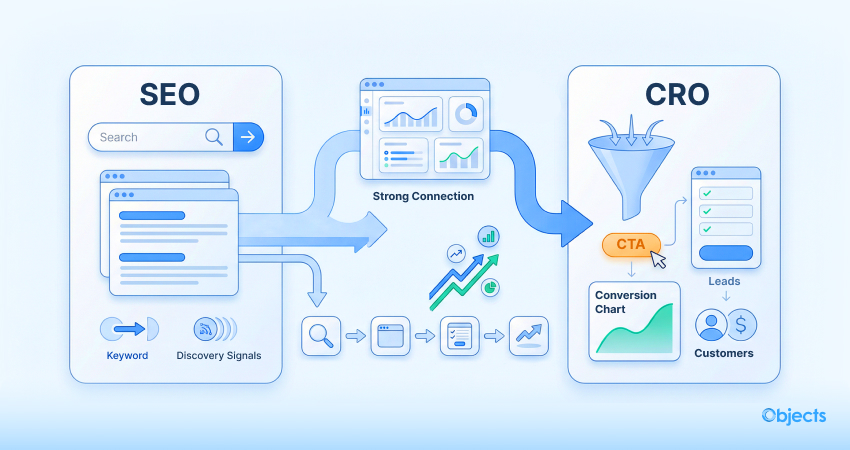
SEO helps websites get much-needed organic traffic, and CRO (Conversion Rate Optimization) prioritizes its importance and ensures that it remains useful and doesn’t go unnoticed.
Interestingly, SEO and CRO both focus on user intent, but SEO helps users explore your content, while CRO encourages them to take action after visiting the site.
When they work in tandem, they offer invaluable combined data that enhances decision-making, sharpens strategies, and improves business results.
SEO brings in site visitors in massive numbers by showing up for relevant queries, whereas CRO highlights what these visitors bring to your business. In short, they both let you maximize the impact of your content and user flows based on real behavior.
How to Align SEO and CRO to Boost Growth

SEO and CRO provide a better solution when you use them to solve the same problem. This means your targets aren’t dissimilar, and your target audiences aren’t different. You can closely examine the following tactics to help you align SEO and conversion optimization and achieve the desired connected outcomes.
Unify Goals and Metrics Across Teams
The Challenge: SEO teams typically prioritize higher rankings, CTRs (click-through rates), and backlinks. Moreover, CRO teams value session duration, conversion metrics (e.g., purchases and form submissions), bounce rates, and revenue metrics (e.g., CLV and AOV).
The Strategy: Identify shared KPIs that capture the full customer journey. Consider different signals, including:
- Organic traffic influences revenues.
- Conversion rates categorised by acquisition channel.
- Time on site and page-to-page movement.
Lead quality, revenue, bounce rate, and other shared KPIs can enhance collaboration, and CRO tools can help businesses nurture these data points. As a result, it becomes simple to adjust metrics across functions.
The Impact: Adjusted or aligned metrics help improve SEO and CRO teams’ performance by simplifying their tasks. It helps them dedicate more time to enhancing shared results or deliverables.
Avoid SEO Disruptions During A/B Testing
The Challenge: While performing an A/B testing activity, ensure you conduct it correctly. Otherwise, it can negatively affect your SEO through inconsistent indexing, duplicate content, JavaScript delays, and more. All these issues can conflict with search bots.
The Strategy: SEO and CRO teams should take the following measures to protect their SEO efforts:
- Reduce layout shift or flicker that can negatively influence CWV (core web vitals) scores.
- Abide by best practices for JavaScript frameworks that ensure pages don’t obscure content from bots.
- Apply canonical tags to refer search engines to the original page versions.
The Impact: When applied properly, testing does not hamper your rankings since pages remain indexable, fast, and clean. Luckily, CRO and SEO teams do not need to choose between search visibility and performance data.
Wrapping Up
We hope you enjoyed our blog post analyzing SEO vs. CRO. You should not underestimate the importance of SEO and conversion rate optimization in increasing site traffic and converting leads into new customers, thereby ultimately increasing sales.
Therefore, you must optimize your site to find its right place in Google and transform site visitors into regular clients.
In this situation, the conversion funnel, alongside CRO and SEO, enables businesses to reach the right target audiences with optimized, targeted content and to provide clear direction for subsequent steps.
SEO vs. CRO – FAQs
1- What are the 4 key types of SEO?
The four crucial types of SEO are On-Page, which focuses on website content; Off-Page, which builds authority through external signals; Technical, which ensures speed and site crawlability; and Local, which targets nearby customers through location-based signals like Google Business Profiles, all working closely for comprehensive search engine visibility.
2- Is SEO an IT skill?
Technical SEO skills are specialized abilities and knowledge related to a website’s backend functionality. These skills play a handy role in ensuring that search engines can crawl, index, and eventually rank a website effectively.
3- What are the three C’s of SEO?
The 3 C’s of SEO are Content, Code (or Crawlability), and Credibility (or Connections), which help establish the foundational pillars of SEO by focusing on user value, technical accessibility, and trustworthiness for search engines.
Content is proportional to value, while code ensures search engines can access it, and credibility builds authority through reputation and backlinks.