
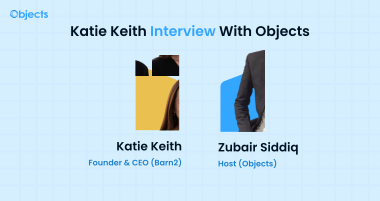
We recently connected with Katie Keith, FOUNDER and CEO of Barn2 Plugins, whose evolution from technical author to successful WordPress plugin entrepreneur offers valuable insights for anyone building in the digital product space.
Since founding Barn2 as a web design agency in 2009, Katie has navigated the challenging pivot to plugin development in 2016, transforming the company into a thriving business with a distributed team of 17 people and a portfolio of popular WordPress and WooCommerce plugins.
Now, she’s embarking on an ambitious new chapter by expanding into Shopify app development while maintaining her role as co-host of WP Product Talk podcast.
In our conversation, we explored her strategic decision to diversify beyond WordPress, the surprising similarities and differences between the WordPress and Shopify ecosystems, her consistent #ShopifyDiary series on X that documents this journey in real-time, and how she balances the demands of running a growing company with family life and community involvement.
Q&A Session
Q1. How long have you been working in the tech industry, and what was your journey in building Barn2?
I’ve always worked in roles with some kind of tech element. After graduating in 2002, my first job was as a technical author writing help pages for a software company. My next few roles all involved managing and maintaining company websites, which is how I got into web development. In 2009, I started Barn2 as a web design agency, and in 2016 we pivoted to focus fully on WordPress and WooCommerce plugins. That’s when things really took off.
Q2. As a successful owner of WordPress plugins and WooCommerce extensions, what inspired you to venture into building Shopify apps?
Mainly to future-proof the business. I didn’t want us to be reliant on a single platform. WordPress and WooCommerce are still our core focus, but expanding into Shopify means we’re building a more stable, diversified company for the long term.
Q3. How does the Shopify app development ecosystem differ from the WordPress plugin industry?
In some ways, they’re very similar. With both, you’re building on top of someone else’s platform and limited by their APIs, hooks, and filters. I initially assumed we’d need to hire a whole new team of developers, but it turns out we can use many of the same technologies for both. Our existing developers have picked up Shopify quickly and actually enjoy working in that environment.
Q4. Do you find the Shopify community to be as vibrant and energetic as the WordPress community?
Yes, surprisingly so. I wrongly assumed it would be more closed because it’s not open source, but that hasn’t been the case at all. Other app founders have been incredibly generous with their advice and support. I’ve had Shopify agencies offer free calls just to help me understand what merchants need. The events I’ve attended in Paris and Toronto have been every bit as friendly and welcoming as WordCamps.
Q5. Your #ShopifyDiary posts on X are a great source of inspiration and insight for new Shopify app developers and business owners. How do you maintain such consistency in posting them?
It’s become a habit. Whenever I do something related to Shopify, I write a diary entry about it – which is most days. If I have several updates, I’ll schedule them so they’re spaced out. I’ll admit I got a bit disheartened at one point because those posts get less engagement than my other tweets, but when I surveyed my followers, most said they find them really valuable. I’ve also been invited to give a talk next year on “365 days of the Shopify Diary,” which helps keep me motivated to see it through.
Q6. Are you currently focused solely on building Shopify apps, or do you also plan to take on custom development work?
We’re not doing any custom development and haven’t for years. The new products we’re building are all Shopify apps, but we’re also continuing to invest heavily in our existing WordPress plugins. They still make up 99.9% of our revenue, so they’re far from an afterthought.
Q7. Do you believe your journey could inspire other WordPress plugin owners to start their own Shopify businesses?
It already is. Quite a few people in the WordPress product space have told me they’re watching what we’re doing with interest and considering doing the same. I’ve co-created a Slack group for WordPress founders who are exploring Shopify so we can share what we’re learning and support each other.
Q8. How are you leveraging AI across your WordPress and Shopify businesses? Have you implemented AI or automation at any level in your workflows?
We mostly use AI internally – for content, automation, and productivity – rather than building it directly into our products. I don’t want to add AI just for the sake of it. The main exception is in our WooCommerce Product Options plugin, where we’re developing an AI assistant that helps users create complex price formulas. You just describe what you want, and the AI builds the formula for you.
Q9. What is your role at WP Product Talk, and what makes it stand out from other WordPress podcasts?
I’m one of four rotating hosts. WP Product Talk is unique because it’s 100% focused on helping WordPress product makers grow their businesses. We bring in guests from across the ecosystem – plugin founders, marketers, investors – and have honest, practical discussions about what’s working and what’s not. It’s more like a group chat for people who build products, rather than a traditional interview show.
Q10. As a mother, CEO of Barn2, podcast host, and an active member of both the WordPress and Shopify communities, how do you manage to maintain a healthy work-life balance?
It sometimes feels like I’m working all the time, but when I check my timesheets, it averages around 30 hours a week. I take days off regularly to do things with my family or go hiking with friends, then catch up in the evenings or weekends if needed. It’s a flexible rhythm that works for me. I do have a tendency to take on too much myself, though – even with a team of 17 and a few freelancers. I’m trying to get better at delegating. Hiring a Marketing Specialist recently was a big step in that direction.
The Reality of Platform Expansion
Katie’s journey demonstrates that successful diversification doesn’t mean abandoning what works; her WordPress plugins still generate 99.9% of Barn2’s revenue even as she builds toward a multi-platform future.
As she continues developing Shopify apps, sharing lessons through her #ShopifyDiary posts, co-hosting WP Product Talk, and gradually improving her delegation skills with a growing team, her commitment to building a sustainable, future-proof business remains clear.
Whether you’re a WordPress product maker curious about expanding to new platforms or simply interested in the realities of managing a technical product company, Katie’s candid insights offer a roadmap grounded in practical experience.
To follow Katie’s ongoing Shopify journey and connect with her work across both ecosystems, visit her on X at @KatieKeithBarn2 or explore Barn2’s plugins at barn2.com.