
Imagine asking your device to update a patient’s chart while treating your patient with utmost care. You don’t need to use your keyboard. In fact, your voice will be your primary weapon. Such convenience has become a reality in clinics, hospitals, and home healthcare settings.
As you know, the latest survey reveals that more than 70% of healthcare leaders have either adopted or plan to adopt voice technology in some form.
Fortunately, you can smartly schedule appointments, document clinical notes, refill prescriptions, capture clinical notes, streamline extensive data, and receive real-time answers, thanks to the near-perfect application of the voice software. This enables better healthcare, as mundane, ad-hoc tasks are left to technology to handle.
This exclusive blog post will help you understand the significance of voice tech in healthcare, without any exaggeration.
Understanding Voice Recognition in Healthcare

Voice recognition software helps translate spoken words, reducing the time and effort required to record a conversation. In addition, the transcription is not always completely accurate. Having the bulk of the notes written down will save the speaker time when examining and rewriting them.
Luckily, the healthcare industry has adopted this approach to reduce medical staff’s workload. Moreover, speech recognition technology will likely expand and innovate over time, becoming more accurate; its implementation in the healthcare industry will also be enhanced.
Application of Voice Recognition in Healthcare
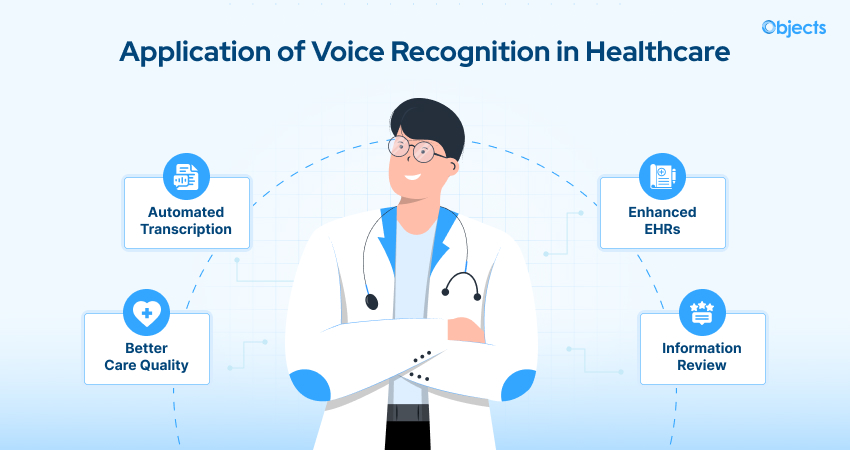
In this modern age, the healthcare industry benefits from speech recognition software to transcribe patient information alongside medical documents. This technology helps healthcare services speak regarding the patient’s condition and care plan into a microphone, and everything they say will be dictated and transcribed into text.
Undoubtedly, healthcare speech recognition facilities have revolutionized how healthcare providers store and use patient information and have enhanced the advantages of electronic health records (EHRs).
When healthcare professionals develop detailed medical records through extensive notes on a patient’s condition, the quality of care improves and, in turn, enhances the patient’s outcomes.
Another use of speech recognition in healthcare is to assess medical information from lectures, meetings, and consultations from audio and video recordings.
This way, healthcare professionals can identify keywords and review the information without having to go through the tapes after transcribing the recordings.
Advantages of Implementing Voice Recognition in Healthcare

Once we analyze what voice recognition technology is and how the healthcare industry uses it, let’s take a look at some of the benefits providers and organizations are experiencing by implementing it.
Improved Efficiency
Speech recognition systems reduce the time healthcare professionals spend on administrative tasks by ensuring the documentation remains up-to-date and correct.
While providers will still need to review the clinical documentation for errors or incorrect information, they can save significant time by using medical speech recognition software to transcribe a bulk of the notes.
This allows the medical professionals to spend more time on patient interactions and research to improve health care plans and outcomes.
Enhanced Patient Care
There is no denying that speech recognition technology helps manage medical documentation, enhancing the care a patient gets since the notes are more detailed than if they were manually entered.
Speech recognition systems can also strengthen patient care by recording or noting conversations between healthcare providers and patients. With a transcription of the conversations, healthcare providers can ensure they document the treatment plan agreed upon during the appointment.
Types of Voice Tools Used Today
You might have heard of voice tools before you understood their primary purpose. Their role is not limited to offering users pre-recorded answers only. They also help listen, interpret, and impact healthcare.
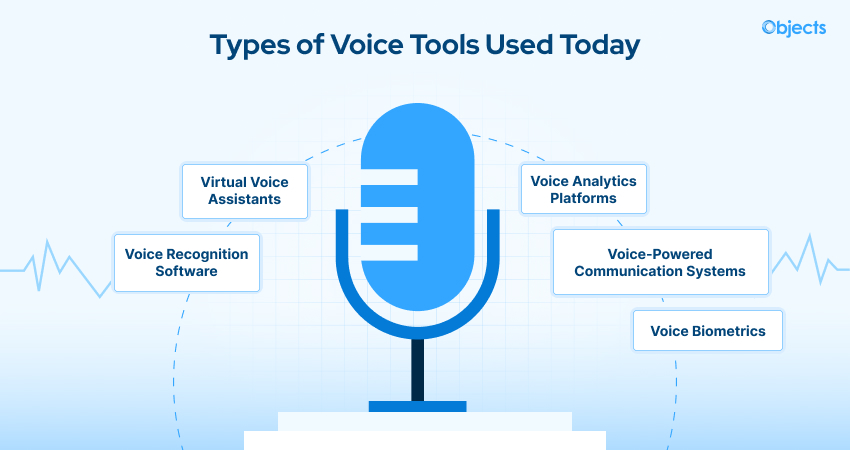
Voice Recognition Software
Voice recognition is a pioneering technology behind healthcare that converts spoken words into text. For instance, you say, and the voice-activated software writes directly into your electronic health record (EHR).
It is pretty user-friendly, as you don’t need to type, and it responds faster as a result. Nuance Dragon Medical is one of the leading examples of software that enables clinicians to dictate notes and reports.
Virtual Voice Assistants
As for virtual voice assistants, they offer healthcare-specific knowledge to users like Siri or Alexa. You can use them to inform patients regarding medication. Furthermore, you can compile lab reports with this impressive tool.
Voice Biometrics
Voice biometrics uses your voice as a password. It relies on your uncommon vocal patterns to authenticate your identity. This means that voice biometrics doesn’t depend on login credentials. With this tool, call center agents can securely access patient records.
Voice Analytics Platforms
Voice analytics platforms are another type of voice identification tool. They assess tone, pace, word choice, and stress levels when providing crucial clinical insights. You can perceive them as second layers of interpretation that sometimes remain unnoticed or unidentified.
Voice-Powered Communication Systems
Voice-powered communication systems have streamlined and transformed communication, a core healthcare point for all the right reasons. They are cloud-connected, HIPAA-compliant, and can be easily integrated with internal routing systems, EHRs, and scheduling tools.
They not only improve communication but also speed up coordination. Regardless of whether a voice is routed and transcribed, a nurse pages a lab, or a call center agent takes follow-ups, they primarily work as a central connecting point.
Leverage Voice Technology in Healthcare
Voice technology is more powerful, advanced, and results-driven, and plays a key role in enhancing the impact of healthcare. Likewise, patients can benefit from the flexibility and convenience that voice technology offers without any discrimination.
With AI and voice-first technology, healthcare teams can work together smoothly and focus on patient care. Moreover, you can easily streamline your front desk so that technology can manage ad hoc tasks, freeing up time to improve your organization’s care delivery.
In the coming years, voice tools will be your most important support system once you begin leading a healthcare team.
It’s not merely about saving time. It relates to providing patients with the love and support they need. And that’s a conversation worth your time and energy.
What Objects Can Do for You?
Objects can help businesses of all sizes by delivering remarkable healthcare software development services under one roof. This way, they can enhance their productivity in different facets like patient engagement, medical imaging solutions, healthcare management, etc.
Keyboards Don’t Save Lives
Various instances have highlighted the importance of ambulance transport, which primarily acts as the patient’s initial encounter with the healthcare system for a particular disease or condition. It allows users to note key patient information and share it with the relevant authority.
FAQs
Q1- What Applications Does Speech Recognition Serve in Healthcare?
Voice recognition enables doctors to handwrite medical notes freely. This way, they can save their precious time and energy, providing care to patients.
Q2- Can Artificial Intelligence Identify Mental Health Issues?
Through artificial intelligence-powered voice analysis, doctors and paramedic staff can detect anxiety, stress, and depression by analyzing word patterns, speech tone, and hesitation.
Q3- Does Voice Technology Support Patients at Home?
Voice assistants can inform patients about taking medications on time. They can help monitor symptoms and make appoinments. Voice assistants can alert attendants if something is suspicious.
Q4- What are the Key Challenges of Following Voice Tech in hospitals?
Various challenges are staff training, integration with current EHR systems, initial implementation costs, and background noise interference.
Q5- Will Voice Technology Replace Healthcare Workers?
Voice technology will not replace healthcare professionals as it has been primarily designed to support them and enhance their productivity overall. It helps them simplify repetitive tasks so that they can concentrate on patient care.