
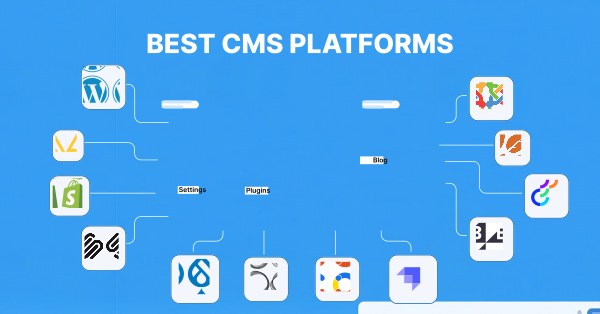
Identifying the best CMS platform to build your website? Put simply, a CMS, or content management system, lets you craft your dream, functional website without having to develop every page from the beginning.
In addition, several CMS platforms offer different sets of features to users, so you’ll want to select the right CMS for your new or established business that meets your budget and distinct needs.
This blog post will describe the best CMS platforms that suit e-commerce stores, blogs, business websites, and more.
What Do You Mean by a CMS?
Before we discuss the best CMS platforms, let’s explain what a CMS is. As you may be aware, CMS enables users to manage their sites’ content efficiently. They can effortlessly use a simple yet effective editor when handling a site’s content.
What to Consider When Choosing a CMS
Before you select one of the best enterprise CMS platforms, you should not overlook a few crucial features:
Pricing
Each CMS has associated costs. A few are open source and cost nothing. However, you must pay to host them. As for the premium ones, you will need to buy the software from the CMS provider.
Support & Customer Experience
A few open-source platforms lack sufficient support options. That said, most paid CMS platforms offer 24/7 customer support.
SEO
Your potential software must enable you to rank your website in leading search engines, including Yahoo and Google.
Personalization
You should select a CMS platform that helps you delight your existing and potential site visitors with unique experiences, enhancing your conversion rates and marketing.
Ease of Use
If you’re not a developer and don’t know about web development and other services, your chosen content management system should be user-centric and not compel you to get prior development knowledge.
Security
The best CMS platforms help you make your site stable and secure at all times. Still, you must keep an eye on security threats and issues that can hamper your site’s productivity at any time.
Best CMS Platforms for Website Creation and Scalability
This section will discuss the best CMS platforms, including:
WordPress
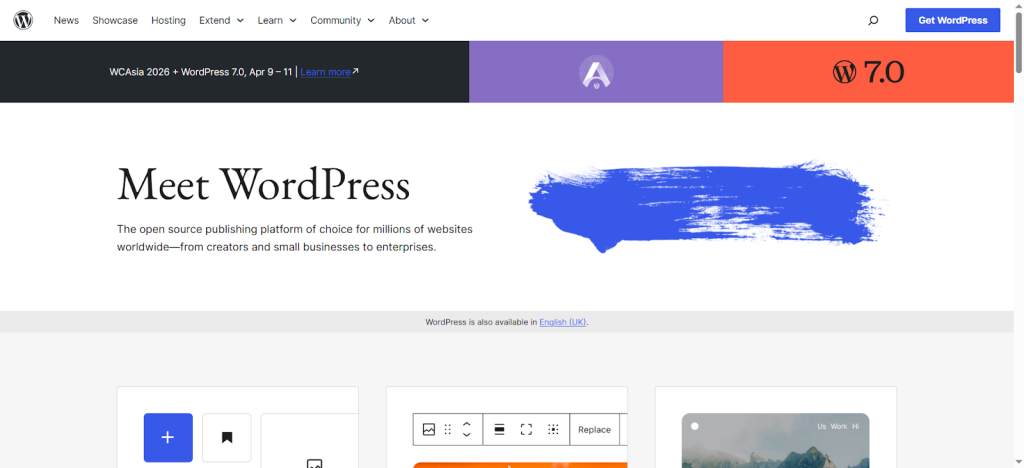
WordPress is arguably the best CMS platform available worldwide. It began as a simple blogging solution but has converted into a comprehensive content management system over time. Luckily enough, it allows users to create any website from scratch.
Salient Features
- Users can benefit from thousands of free and premium themes.
- It provides users with impactful SEO features, such as a clean URL structure and support for SEO plugins.
- Features such as revision history, post scheduling, and media management make content management simple and effective.
Pricing
- WordPress does not charge users for website creation or development fees.
- Users will need to pay for miscellaneous expenses such as web hosting, domain registration, and additional plugins.
Shopify

Shopify is a popular, hosted e-commerce platform that lets users build an impactful e-commerce store. Its unique selling proposition is simplicity: it is a comprehensive hosted solution, so users do not need to worry about hosting, maintaining, or securing their stores.
Salient Features
- It inspires users with a wide range of customizable, mobile-responsive themes to help build a highly optimized, brand-specific store.
- The built-in payment processing, along with various payment gateways, helps improve conversions.
- Users can take advantage of various impressive options, such as automatic inventory updates and cross- location tracking, when managing products and inventory.
Pricing
- The Basic plan costs $19/month (once billed annually). It is available for $1 for the first 3 months.
- The Grow package costs $49/month (billed annually), but it is available for $1 for the first 3 months.
- The Advanced plan costs $299/month (once billed annually), but it is available for $1 for the first 3 months.
- The Plus package is available for $ 2,300/month.
Drupal
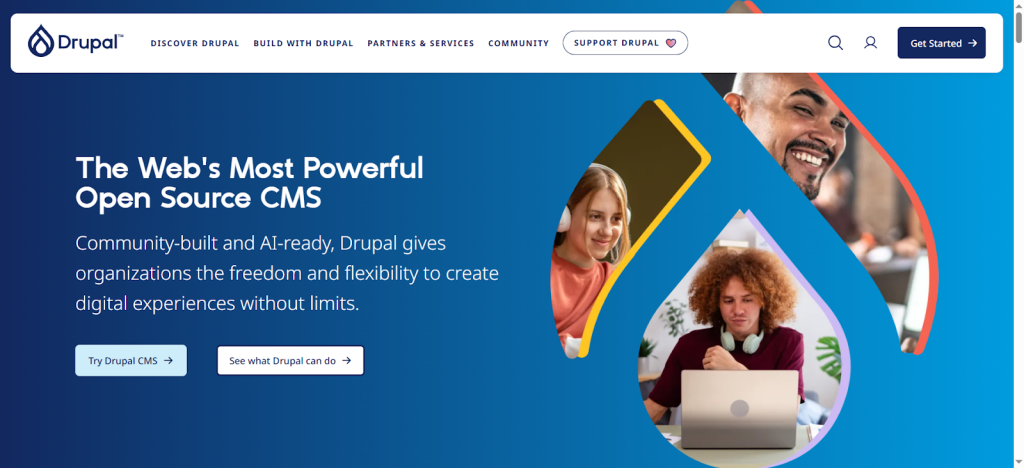
Drupal is an open‑source CMS that primarily serves developers’ needs. Luckily, they can easily decouple the popular CMS through customization. Moreover, developers can smartly craft powerful, results-driven websites.
Salient Features
- Users can benefit from several tools for creating, handling, and organizing structured content through taxonomy, fields, and content types.
- It offers enterprise-grade security features, including encryption, role-based access controls, and protection against common web attacks.
- It has a robust API-first architecture that helps smoothly integrate with external apps.
Pricing
- It is free to use; however, users must pay for paid features, web hosting, and other add-ons.
Strapi
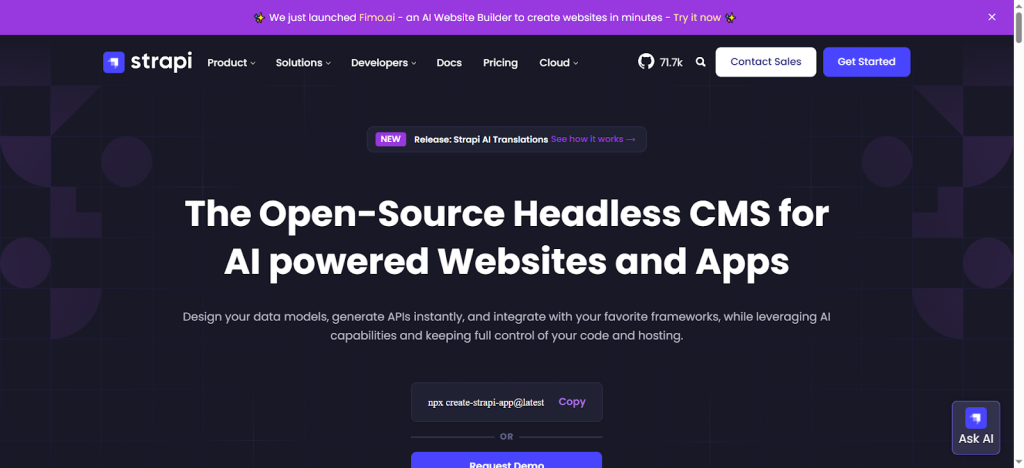
Strapi is a headless, open-source CMS platform designed specifically for developers. The CMS follows an API-first approach and empowers developers to incorporate any functionality they look for.
Salient Features
- Its customizable codebase is available on GitHub, enabling you to customize APIs and features.
- Different deployment options are accessible, including on‑premises, private cloud, or fully managed cloud.
- It supports multiple databases (SQLite, MySQL, Postgres, MariaDB).
Pricing
- Users can avail themselves of all the free plan.
- The Essential plan is available for $18 per month.
- The Pro plan costs $90 per month per project.
- The Scale plan is available for $450 per month per project.
Squarespace

As a notable hosted website builder, Squarespace empowers non-technical users to build websites. Furthermore, they can use it to develop a lightweight e-commerce store tailored to their specific demands.
Salient Features
- Users can benefit from a drag-and-drop editor that lets them create flexible, responsive grid-based layouts, with elements overlapping and moving freely.
- It provides users with top-notch, industry-specific templates that are easy to customize.
- Users can use many visual enhancements, such as image effects, shape dividers, and video backgrounds.
Pricing
- The Basic plan costs $12 per month if users subscribe to a yearly plan.
- The Core plan costs $17 per month if users subscribe to a yearly plan.
- The Advanced plan costs $25 per month if users subscribe to a yearly plan.
BigCommerce
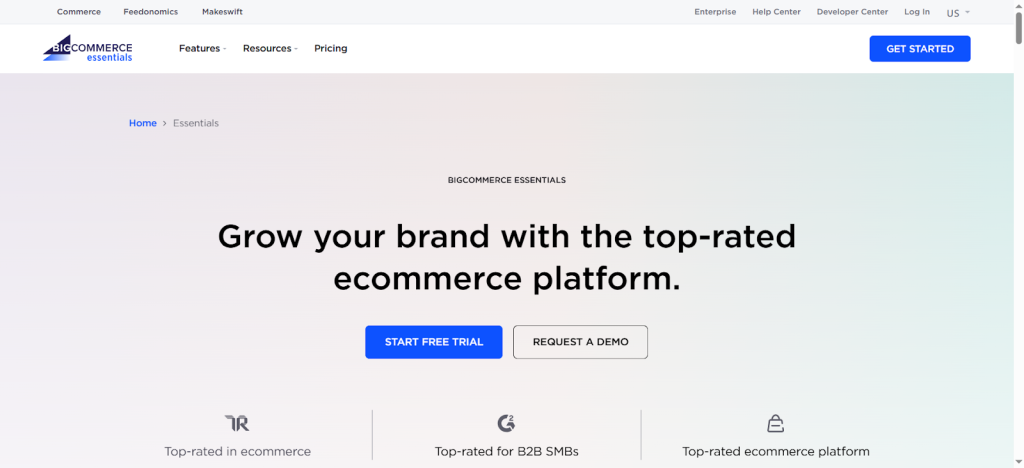
BigCommerce is one of the best CMSs available worldwide. The platform is an open SaaS e-commerce solution that helps small and large businesses scale their brands with a compelling mix of features, including built-in B2B functionality, extensive API flexibility for headless commerce, and more.
Salient Features
- Users can smartly manage multiple brands, domains, and storefronts through a single backend, delivering unique, customized experiences to distinct target audiences.
- A secure, fast, and customizable checkout process helps decrease cart abandonment and improve conversion rates.
- Users can utilize a simple drag-and-drop, no-code visual editor to enhance site layouts, product pages, and the overall design.
Pricing
- The Standard plan costs $29 per month for users on a yearly plan.
- The Plus plan costs $79 per month for users on a yearly plan.
- The Pro plan costs $229 per month for users on a yearly plan.
- The Custom package is available at custom pricing for users.
Optimizely CMS
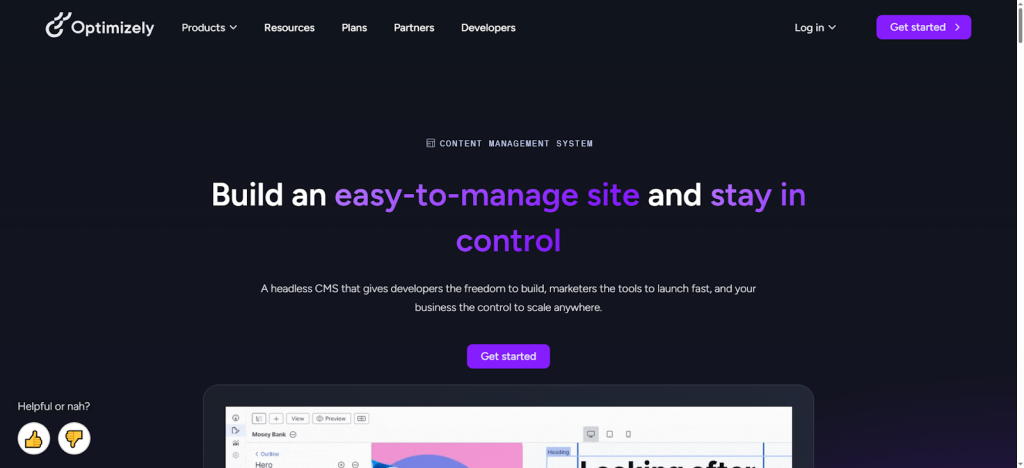
Optimizely CMS primarily operates as a digital experience platform with a key focus on content delivery alongside experimentation driven by optimization. It is a top-notch enterprise-grade content management system (DXP) with a plethora of features.
Salient Features
- The platform offers user roles, structured editing, scheduled publishing, and approval steps for larger teams.
- Users can use a helpful drag-and-drop editing interface to create and preview content across various channels before publishing.
- Site admins can easily handle multiple brands, regions, or languages with multi-site/multi-language support.
Pricing
- Users can consider using different packages, including content marketing platform, content management system, web experimentation, feature experimentation, analytics, and more.
- All these plans apply to the request pricing option.
Agility CMS

Agility CMS is an impressive headless CMS that lets users manage content from a single location and provide it anywhere through GraphQL, JAMstack, and RESTful APIs. Fortunately, this useful CMS platform offers multiple options for users, including features for content modeling, content relationships, scheduling, SEO, etc.
Salient Features
- It enables users to handle URL redirects, sitemaps, and page structures without fuss.
- Users can smartly develop, manage, and deliver content in various languages.
- Comprehensive asset management allows users to store and organize content effortlessly.
Pricing
- The Starter plan costs $1249 per month, paid annually.
- The Pro plan costs $2499 per month, paid annually.
- The Enterprise plan starts at $5998, depending on the business size and requirements.
Ghost

Ghost is a fast, Node.js-powered CMS that prioritises blogging and publishing. Luckily, media publishers and bloggers should use this highly productive platform to ensure their sites remain engaging and value-driven for new and existing visitors.
Salient Features
- Users can create a subscriber base and target unique audiences, allowing them to sell premium content subscriptions with Stripe integration.
- Create can instantly deliver newsletters to subscribers after publishing content.
- Users can set various roles, such as editors, administrators, authors, and contributors.
Pricing
- The Starter plan costs $15 per month, paid annually.
- The Publisher plan costs $29 per month, paid annually.
- The Business plan costs $129 per month, paid annually.
- The Custom plan is available at custom pricing.
Joomla
Joomla is another popular open-source CMS like Drupal and WordPress. Moreover, like WordPress and Drupal, Joomla offers extensive marketplaces for extensions and templates, empowering users to create websites that meet and exceed their specific needs.
Salient Features
- The CMS provides useful options, such as custom fields, nested menus, and categories, to support content organization.
- It offers support for multilingual websites without requiring additional plugins, making it suitable for international sites.
- Users can benefit from thousands of extensions that add specific functionality, such as forums, advanced security, e-commerce, and more.
Pricing
- The platform does not charge its users, but they will need to pay for miscellaneous expenses like domain name registration, website hosting, custom themes and plugins, etc.
October CMS
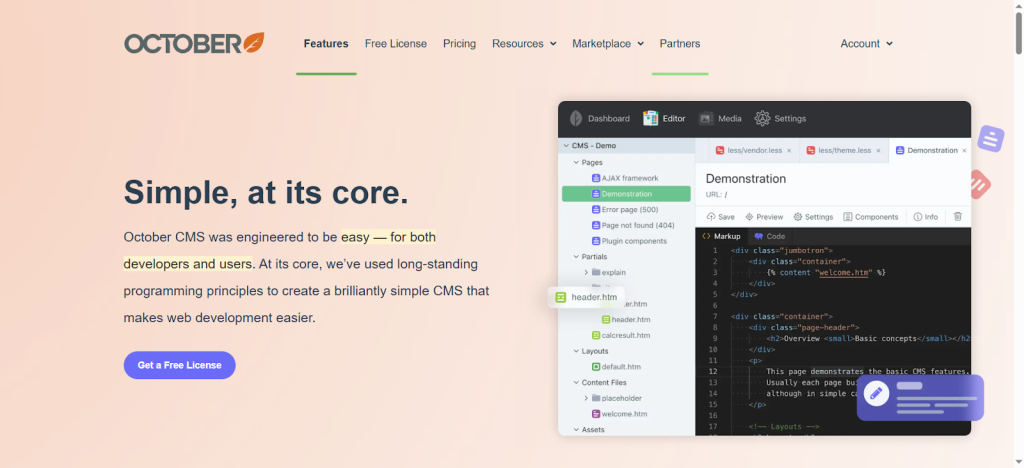
October CMS is a top-notch, results-oriented platform for developers and users alike. This impressive CMS’s main objective is to facilitate users, developers, site managers, and other stakeholders by making web development easier and more engaging.
Salient Features
- Users can benefit from a built-in tool, Tailor, which automatically generates content types and back-end user interfaces from YAML files, known as blueprints.
- The multisite feature allows users to manage and showcase content in various languages and customize their website appearance for specific audiences.
- Non-technical users can use the built-in visual editor to handle images, videos, and other files when managing page content.
Pricing
- Users can get one free license plan, valid for one year.
- The single license plan costs $39 per year.
- The unlimited licenses plan costs $26 per month and $312 per year.
Contentful
Contentful primarily works as a cloud-native, headless content management system (CMS) (or content platform) that detaches front-end design from content creation. It typically serves as a one-stop solution that manages and delivers content via APIs across apps, sites, and smart devices.
Salient Features
- Users need to create content once, as it can be reused across platforms such as mobile apps, websites, and devices.
- It helps integrate with advanced tools such as CRM (e.g., Salesforce) and e-commerce (e.g., Shopify).
- It allows users to update, manage, and edit digital assets from a single dashboard without fuss.
Pricing
- Users can access the platform’s basic functionality using the free plan.
- The Lite plan costs $300 per month.
- The Premium plan is available at custom pricing for users.
FAQs (Best Enterprise CMS Platforms)
Which CMS is the biggest?
WordPress is one of the most famous and impactful CMS platforms, revolutionizing the majority of websites on the internet. Unsurprisingly, WordPress is the mastermind behind 42.4% of all sites.
What is the best database for CMS?
MySQL is one of the leading open-source databases for CMSs. That’s because it offers ease of use, high performance, and compatibility with multiple platforms.
Examples of CMS that rely on MySQL are WordPress, Drupal, and Joomla. Additionally, developers prefer PostgreSQL for its extensibility and flexibility.
Is Canva a CMS?
Canva is basically a visual design platform, so it doesn’t work like WordPress, a full-fledged content management system.
What is a Headless CMS?
A headless CMS primarily operates as a backend-only content management system. It serves as a central repository that helps users create, manage, and deliver content via APIs to various digital channels, including websites, mobile apps, and IoT devices.
Wrapping Up
We hope you liked our blog post that thoroughly explains the best CMS platforms. As we noticed, a CMS lets users manage their content and turn it into websites without having to edit code every time they want to amend it. With these versatile, benefit-driven CMSs, you can launch a site and expertly manage it.
If you are a novice, you should go with WordPress, Drupal, or Squarespace, as you will not need to use a headless CMS. If you want to shift your content to different locations, headless CMS platforms are a good option, provided you have the required technical understanding.