

Over the past ten years, the terrain of digital commerce has changed dramatically. From basic online stores to complex ecosystems driven by artificial intelligence, sophisticated analytics, and flawless integrations.
eCommerce in 2026 will go beyond simply online product sales. It’s about creating experiences, strengthening communities, and using technology to compete in a world going global.
This development has made sites like Shopify more pertinent than they ever were. Businesses need strong, scalable solutions that can adapt to rapidly changing consumer expectations as conventional retail boundaries blur and AI-powered personalization becomes the standard.
While recent events hastened digital adoption, what we are currently seeing transcends emergency pivots. Businesses are redefining their trade strategy, and many find that the right platform can make all the difference between thriving and merely surviving.
What is Shopify?
Now, let me introduce Shopify, a platform that has subtly evolved into the backbone of contemporary e-commerce. But understanding what Shopify is and how it operates requires looking beyond the surface-level justifications you will find in most publications.
Fundamentally, Shopify is a Software as a Service (SaaS) tool allowing companies to build, personalize, and run web stores. That definition, however, hardly captures the scope of what companies today really need.
Consider Shopify as the cornerstone and framework for your whole online buying experience.
Unlike conventional website builders designed primarily for content presentation, Shopify is built for commerce. Every tool, integration, and feature is developed with one eye toward helping companies sell more successfully online.
Popular Features of Shopify
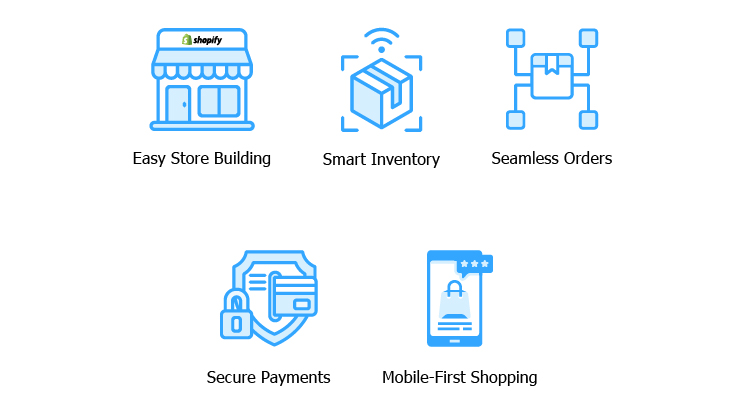
The platform’s main strength is its extensive feature set, which covers almost all facets of online selling. Though it’s the underlying commerce capability that counts most, the drag-and-drop store builder lets even non-technical users design professional-looking stores.
Inventory control transcends basic stock tracking. Shopify’s system handles variations; it also tracks inventory across several sites, creates automatic reorder points, and even handles bundled goods. For companies managing complex product catalogs, this level of sophistication can be revolutionary.
From the first purchase to final delivery, the order processing system handles everything. It manages partial shipments, automatically generates invoices, handles returns and exchanges, and connects with several dozen shipping carriers. What hours of hand labor could be reduced to a few clicks?
Since many e-Commerce systems fall short in payment processing, this area calls particular attention. Their native solution for transactions manages fraud detection, automatically handles currency conversions, and accepts over 100 payment methods worldwide.
For companies that sell abroad, this relieves the burden of handling several payment processors.
The mobile optimization transcends simple responsive design. Built mobile first, Shopify themes acknowledge that over 70% of eCommerce traffic now originates on mobile devices. Features of the mobile shopping experience range from one-click checkout to mobile-optimized product galleries to touch-friendly navigation.
How Shopify Stands Apart from Competitors
From open-source solutions like WooCommerce to enterprise systems like Magento, the eCommerce platform market is crowded with choices. The simplicity and balance of power Shopify offers set it apart from others.
Shopify manages all the backend infrastructure, while WooCommerce calls for technical knowledge to set up and maintain. Forget about server maintenance, security updates, or hosting. Unlike Magento, which can be pretty complicated, Shopify offers an intuitive interface that doesn’t compromise functionality.
Still, Shopify’s ecosystem strategy is the true differentiator. The platform doesn’t aim to do everything itself. Instead, it offers a strong foundation that integrates well with thousands of third-party apps and services. Is sophisticated email marketing what you need? Combine with Klaviyo. Are you looking for advanced inventory prediction? Interact with programs like Cin7 or TradeGecko. This ecosystem approach lets companies start small and add complexity as they expand.
The App Store ecosystem is specifically Shopify’s strength. With more than 13,000 apps at hand, companies can personalize their stores with capabilities that would cost hundreds of thousands of dollars to create from scratch. From sophisticated search engines to AI-powered product recommendations, the app ecosystem greatly expands Shopify’s powers.
eCommerce Market Share and Position
The market situation for Shopify reveals a crucial truth about the platform’s potency. By 2025, Shopify had around 6.8 million active stores globally and a 28.8% market share among the top 1 million websites. Still, the raw figures do not fully depict the situation.
More intriguing is Shopify’s expansion path relative to rivals. Platforms like Magento have seen declining market share, while Shopify has been steadily expanding, especially in the small- to medium-sized business sector.
Not only are new companies launching online, but they are also contributing to this expansion. Citing simplicity of use, reduced total cost of ownership, and improved performance, many established businesses are moving from other systems to Shopify.
With Shopify Plus, the platform has also become rather popular in the corporate category. Major brands like Gymshark, Allbirds, and Heinz now run their eCommerce operations on Shopify, proving the platform can scale from startup to multinational corporation.
How Shopify Earns Revenue

Note: Source. Revenue figures are in millions USD. 2025 is an estimate based on a 25.78% growth rate from 2023 to 2024.
Knowing Shopify’s revenue strategy helps one to better understand why the platform is so oriented on merchant success. Mostly through monthly subscription fees, transaction fees, and payment processing fees, Shopify generates money.
Think of Shopify’s business model as a true partnership with store owners. The company only thrives when its merchants do well. It’s a win-win situation where everyone benefits from increased sales and transaction volume. This shared success story drives Shopify to continuously enhance their platform, rolling out new features and improvements that help business owners boost their sales.
Now, let’s talk money. Transaction fees typically fall between 0.5% and 2%, though the exact rate depends on which subscription tier you choose. Here’s a neat trick: switch to Shopify Payments as your payment processor, and those transaction fees disappear entirely. As for payment processing itself, you’re looking at rates that compete well with industry standards: usually somewhere between 2.4% and 2.9%, plus a flat 30-cent charge per transaction.
While Shopify does generate some income through its App Store by splitting revenue with third-party developers, this represents just a slice of their overall earnings pie.. The focus remains on core platform fees tied directly to merchant success.
Business Models Suited to Shopify Stores
One of Shopify’s greatest strengths is its flexibility in supporting different business models. The platform doesn’t force businesses into a one-size-fits-all approach. Instead, it provides tools to support various online selling methods.
Direct Shipping
Buying stock, warehousing it, and then sending it straight to consumers is the simplest model. By sticking to tried-and-true methods, companies can manage every aspect of their products, from quality to delivery time and customer satisfaction.
When it comes to facilitating this strategy, Shopify’s advanced inventory management features really shine. The system interfaces with major shipping companies to compute rates in real time and print labels. It also monitors supply levels across multiple sites and sends notifications when supplies are running low.
Because it offers the most control over the consumer experience and the highest profit margins, this approach is followed by many successful Shopify stores. When you have complete command over your inventory, you can easily uphold the reputations of brands like Dollar Shave Club and Aloha, which are based on reliable products and lightning-fast shipping.
The capital needs and associated risk make this concept difficult to implement. Buying inventory requires an initial investment from businesses, and there’s always the chance that some of those things won’t sell. This model, however, frequently offers the highest long-term profitability for companies with proven products and reliable demand forecasting.
Dropshipping Model
Dropshipping is all the rage, fueled by social media influencers and entrepreneurs’ claims of massive success. With tariff wars raging between major economies in recent times, is it still a viable business model? Well, Shopify makes the process a breeze. The gist of the business model is that you don’t have to get bogged down in inventory management or manually handle shipping; your suppliers handle it all.
The biggest draw of the dropshipping model lies in its simplicity. You set up your store, add items from vendors, and when orders come in, the supplier ships them directly to the customer. The variance between what consumers pay and what you pay the supplier determines your profit.
Still, success isn’t guaranteed just because the barrier to entry is low. You will need to identify profitable niches, choose trustworthy vendors, and craft compelling product descriptions to drive sales. Since you represent the company even though you are not directly handling the products, customer service becomes absolutely vital.
The secret is approaching dropshipping as any significant commercial endeavor. You will have a far better chance of producing something sustainable if you focus on delivering real value to your clients rather than chasing short-term gains.
Shopify Stores Integration with Business Tools
Modern e-commerce is not isolated. For marketing, bookkeeping, customer support, inventory control, and analytics, successful online companies depend on scores of separate technologies. The strength of Shopify lies in its easy integration with these fundamental business tools.
The platform’s API-first design enables practically any corporate tool to interface with Shopify. This results in a cohesive ecosystem where data flows automatically between systems, reducing human effort and increasing accuracy.
Specifically strong are marketing integrations. Mailchimp, Klaviyo, and Constant Contact email marketing tools easily sync purchase history and customer data. This allows for advanced segmentation and tailored ads grounded in real purchase activity.
By seamlessly syncing sales data across QuickBooks, Xero, and other systems, accounting connectors improve financial accuracy and ease bookkeeping. Advanced forecasting and multi-channel inventory tracking technologies offered by inventory management systems, such as TradeGecko and Cin,7, help
Faster resolution of consumer problems is made possible by customer service solutions as Zendesk, Gorgias, and Help Scout, which instantly enter order data into support tickets. Analytics tools offer deep insights into consumer behavior and conversion optimization opportunities, such as Google Analytics and Hotjar.
These linkages primarily benefit data consistency. You remove disparities and can make more educated decisions when all of your company tools share the same underlying data from Shopify.
Shopify Payments
Payment processing is often an operational headache for eCommerce businesses. Different processors, varying fees, complex integration requirements, and fraud management can consume a considerable chunk of worker hours and resources. Shopify Payments aims to simplify this entire process.
Shopify Payments is the platform’s native payment processing solution, available in over 35 countries. It accepts all major credit cards, digital wallets such as Apple Pay and Google Pay, and region-specific payment methods, such as iDEAL in the Netherlands and Bancontact in Belgium.
The integration is hassle-free because it’s built directly into the platform. No additional setup or third-party integrations are required. Payment information flows automatically into order management, inventory systems, and reporting dashboards.
Fraud protection is built in and constantly improving through machine learning. The system analyzes thousands of data points for each transaction, flagging potentially fraudulent orders while minimizing false positives that could harm legitimate sales.
For businesses shipping internationally, Shopify Payments handles currency conversion automatically, with competitive exchange rates. This eliminates the complexity of managing multiple payment processors for different countries.
The fee structure is transparent and competitive. Rates vary by plan but are generally comparable to other major processors. The key advantage is the elimination of transaction fees that Shopify charges for third-party payment processors.
Shopify Fulfillment
When Shopify started gaining serious traction, the founders realized something important: their merchants kept hitting the same wall when building an online store. Easy. Actually getting orders to customers quickly and affordably? That’s where things got messy.
So Shopify made a gutsy decision. Why not handle the warehousing and shipping too? Enter the Shopify Fulfillment Network – essentially, Shopify decided to become Amazon’s logistics arm for smaller businesses.
The concept is straightforward. Shopify built these massive warehouses in smart locations – places like New Jersey, California, and other spots where they can reach the most customers fast. You ship your stuff there in bulk, and when someone buys from your store, Shopify’s team grabs it, boxes it, and ships it.
What makes this really slick is how everything talks to each other. Your store automatically knows what’s in stock at the warehouse. When something ships, your customer gets notified. Tracking numbers? They just appear. It’s like having a massive fulfillment operation running in the background while you focus on actually running your business.
This setup is a lifesaver for companies that are suddenly doing serious volume. Maybe you started selling phone cases out of your garage, and now you’re moving thousands per month. Instead of leasing warehouse space, hiring packers, and negotiating with UPS, you just route everything through Shopify’s system.
The pricing isn’t cheap, but it’s reasonable compared to other professional fulfillment services. Plus, since everything’s already wired into your Shopify store, you avoid the nightmare of integrating multiple systems.
Of course, it’s not a magic bullet. The service isn’t available in every city yet, and if you’re selling something weird – like custom furniture or live plants – you’ll probably need a specialist. But for most standard products, it eliminates a massive operational headache.
Unsurprisingly, Shopify no longer owns its logistics and warehouse business, Deliverr. In fact, Shopify sold it to Flexport in 2023.
Shopify Plans and Pricing in 2026
| Plan | Monthly Cost | Transaction Fee*(0% with Shopify Payments) | In-Person Rate | Key Features |
| Starter | $5 per month | 5% | 5% | Order management, a mobile POS, basic analytics |
| Retail | $89 per month | Smart inventory syncing, unlimited staff, professional reports, 24/7 retail support | ||
| Basic | $39 | 2.9% + 30¢ | 2.6% + 0¢ | Unlimited products, 24/7 support, abandoned cart recovery, discount codes |
| Shopify | $105 | 2.6% + 30¢ | 2.5% + 0¢ | Professional reports, gift cards, abandoned cart recovery |
| Advanced | $399 | 2.4% + 30¢ | 2.4% + 0¢ | Advanced report builder, third-party shipping rates |
| Plus | $2,300+ | Custom | Custom | Advanced customization, dedicated support, and high API limits |
Note: Source. Consider total cost of ownership (transaction fees, apps, development) when choosing a plan. Higher-tier plans often pay off through lower fees and features that boost sales.
Look, not every business starts with a million-dollar budget, and not every entrepreneur needs enterprise-level features on day one. That’s why their pricing makes actual sense. You pay for what you need now, not what you might need someday.
For its Starter plan, users will pay $5 per month. Likewise, the Retail plan is available at $105 per month.
Their Basic plan costs $39 per month. Don’t let the name fool you, though – “basic” here still gives you serious firepower. You can list as many products as you want (no artificial limits), get help whenever you need it through their 24/7 support, automatically follow up with customers who abandon their carts, and create discount codes to boost sales.
Honestly, that’s more than enough to run a legitimate online business. You can eliminate the 2.9% transaction fee using the built-in payment solution.
Shopify Plan costs $105 per month and adds professional reports, gift cards, and abandoned cart recovery. Transaction fees drop to 2.6%, making this plan cost-effective for businesses processing significant volume.
Advanced Shopify at $399 per month includes an advanced report builder, third-party-calculated shipping rates, and reduced transaction fees to 2.4%. This plan makes sense for established businesses with complex needs.
Now, at the other end of the spectrum sits Shopify Plus. It’s the big guns for companies doing serious volume. We’re talking $2,000+ per month, but you’re not just paying for bragging rights.
You get white-glove treatment with dedicated account managers, the ability to completely customize your checkout process, and API limits that won’t choke when you’re processing thousands of orders daily. This is where the Fortune 500 companies and fast-growing brands play.
Here’s something most people overlook: that monthly fee is just the starting line. Your real expenses come from all the extras – those transaction fees add up quickly, especially when you’re doing volume.
Then there are apps (some free, others definitely not), plus any custom development work you need. Smart business owners look at the total picture, not just that monthly number on the pricing page.
Many businesses find that higher-tier plans pay for themselves through reduced transaction fees and increased functionality that drives sales growth.
How to Launch Your Shopify Store: Checklist
You can read a bunch of resources on what Shopify is, but you also need to start executing your business plan. Launching a successful Shopify store requires more than just setting up the technical platform. The process involves strategic planning, careful execution, and ongoing optimization.
- Start with market research and product validation. Before diving into store setup, ensure there’s demand for your products and understand your target audience. This foundation influences every subsequent decision from design to marketing.
- Choose your Shopify plan based on your immediate needs and growth projections. Most new businesses start with Basic Shopify and upgrade as they scale. Don’t overpay for features you won’t use initially.
- Select a theme that aligns with your brand and product type. Premium themes usually give you more flexibility and someone to call when things break. Most importantly, whatever you choose, make sure it looks fantastic on phones, because that’s where 70% of your customers are shopping.
- Shipping zones, tax rules, payment processors – all that behind-the-scenes stuff that customers never see but will definitely notice if it’s wrong. Do it properly now instead of scrambling to fix it later when you’ve got angry customers and Google rankings to worry about.
- Blurry photos taken with your phone in bad lighting? That’s a hard no. You need images that make people actually want to buy, detailed descriptions that answer questions before customers ask them, and pricing that’s crystal clear. This is your digital salesperson, so make it count.
- Set up essential apps for functionality you need beyond Shopify’s core features. Popular apps include email marketing tools, review systems, and SEO optimization tools. Start with crucial apps and add others as needed.
- Configure Google Analytics and other tracking tools before launching. You want to collect data from day one to understand customer behavior and optimize performance.
- Test your store thoroughly before going live. Place test orders, check mobile experience, and verify that all functionality works correctly. Ask friends or colleagues to test the shopping experience and provide feedback.
- Plan your launch marketing strategy. Having a great store means nothing without traffic. Consider email marketing, social media, paid advertising, and content marketing to drive initial visitors.
- Monitor performance closely after launch and be prepared to make adjustments. eCommerce is iterative, and successful stores continuously optimize based on data and customer feedback.
Conclusion: What is Shopify? The Best Fit for Online Stores
What started as a simple store builder has leveled up into a full-on commerce ecosystem that’s got everything you need to crush it online. Whether you’re a solo hustler or a global giant, Shopify’s got your back with an interface so smooth even a non-technical person can use it, features that pack a punch, and integrations that make your tech stack sing.
Here’s the real magic: Shopify wins when you win. Its whole revenue model is tied to your growth, so they’re constantly evolving the platform to help you sell more. It’s like a feedback loop of awesomeness: your success fuels their innovation, and their innovation fuels your success. Win-win!