
Imagine your team being out sick, on vacation, or overloaded with work. Suddenly, you’re facing a staffing shortage. What can you do? One option is to augment staff. Staff augmentation is the process of hiring contract or temporary workers to fill in the gaps in your workforce. It can be an excellent choice for businesses that need help for a short time or have high staff turnover.
Staff augmentation has many benefits, including cost savings, increased flexibility, and access to top talent. But before you decide if this is the right solution for you, it’s essential to understand what it is and how it works.
This blog post will explore what staff augmentation is and what benefits it can offer your business. We’ll also talk about the different kinds of temporary workers you might find and how to pick the right one for your needs.
What Is Staff Augmentation?

What if you’re the manager of a company? You’ve just been given a new project, but don’t have the resources to take it on yourself. What do you do?
You could hire a new employee, which would involve interviewing candidates, checking references, and onboarding the new employee. It’s a lot of work, and it can be risky.
Also, around 70% of companies still experience issues while hiring candidates for full-time positions.
An easier option is to outsource the project to a staffing company. Staffing companies provide temporary or contract-based employees to businesses in need of extra help. This is known as staff augmentation.
According to the report, the global outsourcing market will reach USD 450 billion by 2026. It will continue to grow at a substantial 5.1% CAGR from the beginning of 2020.
Staffing companies have a pool of pre-screened employees, so you can be sure that you’re getting someone qualified for the job. And since the employees are temporary, you don’t have to worry about them leaving after a few months.
Parsley Energy, an independent oil and gas company operating in the Permian Basin, relies on staff augmentation. Here is how it played out for them:
Saved $1.5 million in consulting fees
Saved $300k in travel costs
Saved $50k in enterprise project management software
Pros and Cons of Staff Augmentation 2026?

Staff augmentation is a great way to expand your workforce without the hassle of hiring and training new employees. With staff augmentation, you get to onboard employees who are already trained and familiar with your company’s policies and procedures.
However, there are many pros and cons to staff augmentation that you should be aware of before you invest in this modality.
– Staff Augmentation Pros
Here are a few perks of investing in staff augmentation to complete a project or serve other business needs.
– Staff Augmentation Cons
Now that you know the benefits of staff augmentation, let us enlighten you with some drawbacks to relying on this strategy:
- Long-Term Dependencies: Continuous reliance on outside sources is unsustainable. If you always use resources from outside your company to reach a goal, you can do better in some ways than your own company.
- Unable to Meet Deadlines: It can be challenging to meet deadlines. It might take some time to introduce new workers to your project. The length of the onboarding and training processes may delay your project.
- Risk of Drop in Quality: Even though outsourced teams often consist of highly skilled experts, there are still risks associated with adding more IT workers, such as the challenge of integrating them into the project. Hiring a dedicated employee might occasionally be more advantageous in this aspect.
Different Types of Staff Augmentation
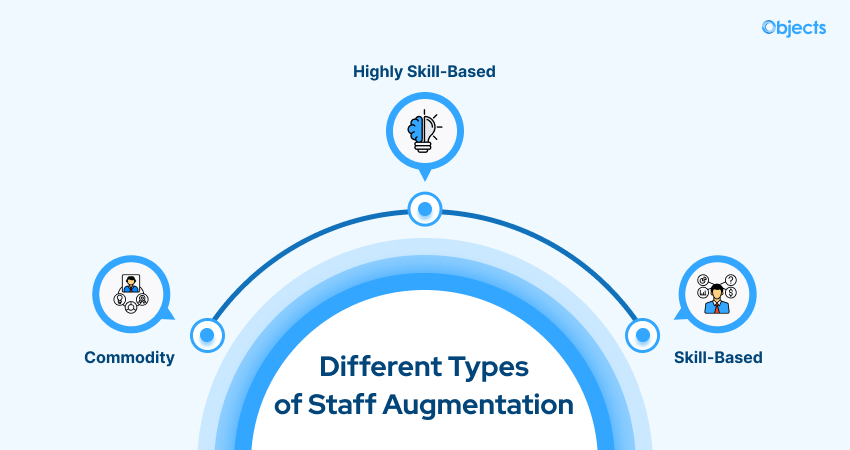
Our staff augmentation model can vary according to your requirements. To be precise, there are three different types of staff augmentation:
This type of staff augmentation focuses on the urgency of a particular task or requirement rather than on specific skills. This type of staff augmentation usually involves factory work, manual labor, retail, and other roles. If you are ever short of staff to perform a variety of tasks, then look for agencies that offer such people to work for you.
If you require more skill, then this type of staff augmentation is for you. However, this is considered hiring people with mediocre skill sets. For example, if you need someone for clerical work or data entry, you can consider this type.
The third type involves highly skilled staff. This could be the staff you need to improve your business operations. IT and software development agencies are usually on the hunt for highly skilled staff augmentation. But you should only work with agencies that ensure their employees are well-trained and have sufficient experience to deliver results.
When Should You Consider Staff Augmentation?
To make the most of this service, ensure this model best suits your project. Here are a few scenarios when you can consider this a reliable option:
Recruiting is usually a long process. You can turn to staff augmentation agencies on short notice and receive help from experts while you continue with the hiring process for future similar projects.
A time may come when you need specific skills for a period. For example, logo designing, tech setup, app development, web development, and more. In these situations, an agency can give you a temporary tool to help you reach your goals.
Are you looking for a competitive addition while launching a new product? Well, you’ll have to increase your team rapidly. Hire an agency to fulfill the temporary spike or increased workload.
What Are the Challenges of Staff Augmentation?

There are some challenges to consider before you decide to go down this road. For one thing, you need to ensure you have the infrastructure to support temporary workers. This includes HR processes, systems, and tools, and communication channels.
Another challenge is finding the right people to fill the roles. It’s essential to understand the skills and experience required for the job and then find someone who meets those expectations.
And finally, you need to ensure you’re budgeting for staff augmentation correctly so you’re not overspending or underutilizing resources.
How Do You Find the Right Staff Augmentation Partner?
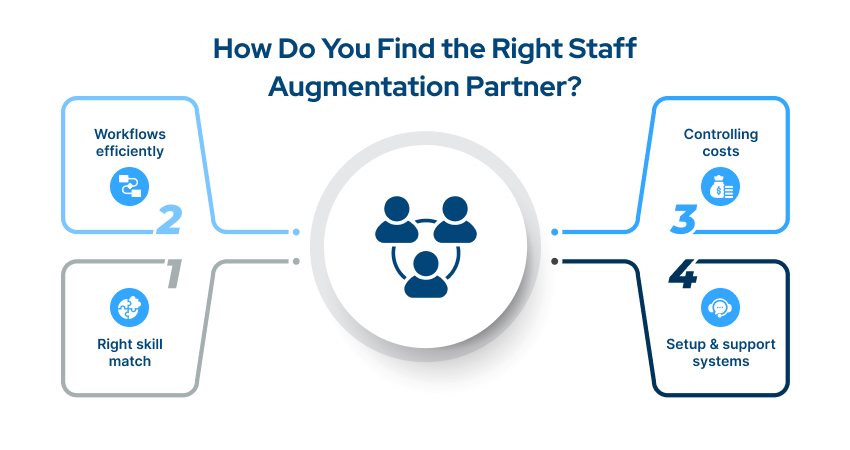
How do you find the right staff augmentation partner? It’s not as easy as just picking a name out of a hat.
First, you need to figure out your specific needs. What kinds of skills do you need to add to your team? What’s the workload like right now? How many hours do you need the person to work?
Once you have a good idea of what you’re looking for, start researching and asking the right questions. Here are a few tips to get you started:
- Ask about the agency’s screening process. How do they ensure that their workers are qualified for the job?
- Ask about the agency’s training process. How do they make sure their employees are ready to follow the rules and policies of your company?
- Ask about the agency’s retention rate. How often do workers leave their jobs after being placed by the agency?
- Ask about the agency’s client base. Are they experienced in working in your industry or sector?
- Ask about the agency’s fees. How much do they charge for their services?
Keep in mind that not all staff augmentation companies are created equal. You want to find someone with a proven track record of success who can provide the quality help you need.
What Roles Can We Fill Through Staff Augmentation?

Businesses should not undermine the importance of staff augmentation, as it allows them to fill different crucial roles. Here is the list that includes various roles staff augmentation can easily fill:
- Cybersecurity specialists
- Design and marketing experts
- Admin professionals
- Project managers
- Business analysts
- IT professionals (network engineers, QA testers, etc.)
- Dedicated remote developers
When Should We Use Staff Augmentation?

You can leverage staff augmentation strategies to boost your business’s overall productivity. In reality, staff augmentation plays a crucial role in several situations, including:
- Short-term projects (If they need immediate expansion)
- Specific tasks and activities ( if they require expertise)
- Increase in demand (it can be seasonal)
- Bridge a skill gap
Staff augmentation is a blessing in disguise for businesses looking to build their reputation and leave a lasting impression on customers. Furthermore, it allows them to expand their current IT teams to meet the dynamic needs of any project, if they are willing to do so.
Comparing Staff Augmentation with Other Outsourcing Models
Staff augmentation is outsourcing the desired talent. That said, it is one of the various outsourcing models one can benefit from.
There are numerous other options, such as independent contractors (freelancers), time-and-material (T&M), offshore development centers, and dedicated teams.
Hence, how do these fare against staff augmentation, and which one suits you best?
Usually, certain facets can be different or be similar across many outsourcing models. Such models comprise who is responsible for what, like: –
- Office facilities (paying for office rentals and equipment)
- Recruiting (hiring a development team or a developer and their accessibility or availability)
- Payroll (salaries and accounting responsibilities)
- Engagement (the amount of time a hired developer typically dedicates)
- Management (deciding if it’s client-side or vendor-side)
- Overhead expenses (purchasing equipment, furniture, licenses, and bill payments)
- Salary reviews (bonuses and increments)
- Employee perks (advantages such as training, workshops, health insurance, 401 (k), and more).
- Communication (collaborating and discussing with the developer or team)
- Rate review (deciding the costs for services)
Staff Augmentation vs Independent Contractors
Adding a freelancer to your team would require you (or a client) to be responsible for most, if not all, of the points mentioned above.
You will need to address different attributes, such as payroll, communication, and management, which the vendor would handle if you chose staff augmentation.
On the other hand, recruiting independent contractors indicates that you will not need to pay a commission to a vendor. Alternatively, you will have to hire the contractor.
However, a crucial consideration is that specific limitations apply to the position an independent contractor has within the company or the firm.
For instance, you do not have to offer employee perks or cover overhead costs when working with an independent contractor.
In addition, their role could involve limited access to your company data or to the information you usually communicate and exchange with your augmented workforce.
Staff Augmentation vs Managed Services
The most apparent difference between IT staff augmentation and managed services is the level of control a client grants to a vendor.
While the former assigns only staff provisioning to the vendor, and the rest are typically client controls or monitors, the latter normally operates as a one-in-all service.
Vendors offering manager services take external control of a client’s non-core systems. They oversee all the aspects of the client’s functioning when recommending talent.
Thus, managed services imply greater delegation. At times, it can be an excellent solution for organizations or businesses looking to optimize resource allocation and prioritize their in-house teams for strategic priorities.
Moreover, a managed service company comprises a developer/development team “benched.” This means you can start project-related activities after contract signing, rather than waiting for the vendor to hire employees.
Staff Augmentation vs Dedicated Teams
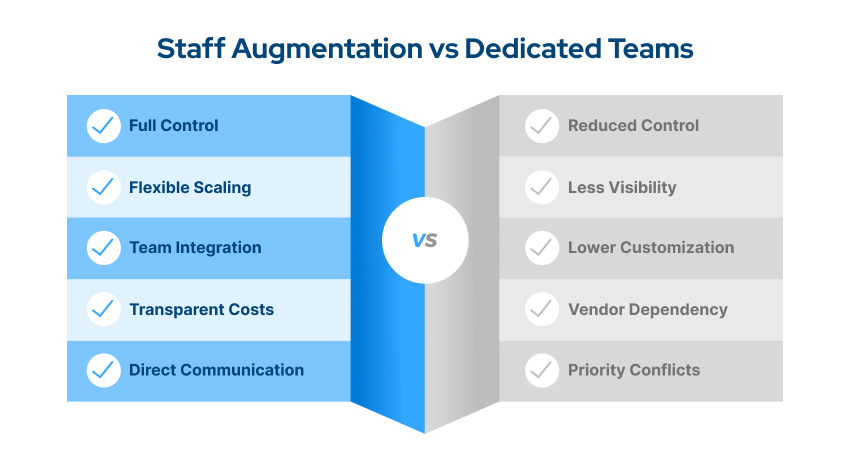
There is a key difference between staff augmentation and a dedicated team you should be aware of: the outsourcing vendor takes more responsibility, or they are more responsible when a client needs a dedicated team.
You can smartly control or monitor your outsourced developers, including augmenting resources and staff, directly. That said, a dedicated team works under the vendor’s supervision and follows them accordingly.
The former usually involves full-time engagement; the latter involves many clients on any given day. The vendor reviews or examines dedicated teams’ salaries. On the contrary, the client or customer does it when they are willing to augment staff.
Staff augmentation vs Offshore Development Centers
The difference between staff augmentation and offshore development centers (ODC) is surprisingly similar to the difference between getting an apartment for rental purposes and building your own house.
An ODC represents an office that your vendor will set up on your behalf. They will hire a workforce or employees, secure office space, and communicate with other service providers for supplies, furniture, internet connections, and more.
The vendor will charge for all of this, and once everything is fine, you can effortlessly manage the team and the office yourself, as this will be a crucial function of your company or firm.
Staff Augmentation vs Time and Material (T&M)
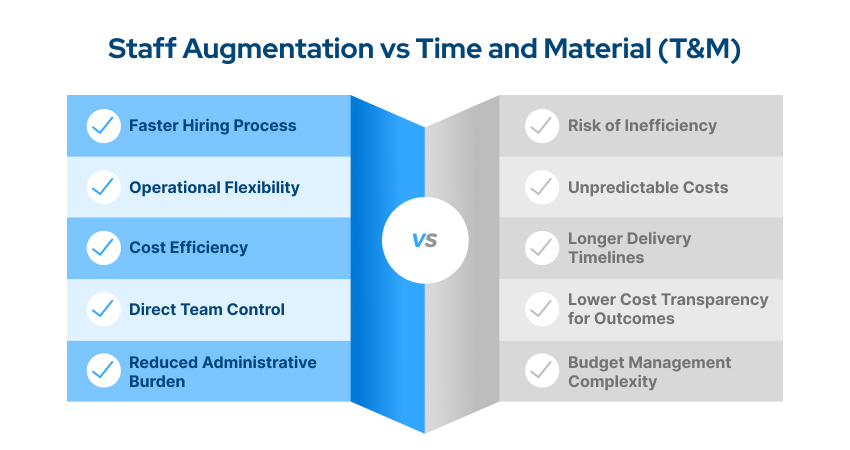
Under the time-and-materials outsourcing model, a client pays for the time a development team or a single developer allocates and spends while working under the client’s guidance.
Staff augmentation is significantly different from this, as it comprises temporary staffing by augmentation companies that manage all documentation, taxation, and administrative expenses.
Here, a client can take on payroll responsibility if they want to. Generally, salary reviews and perks fall under the client’s purview, but sometimes vendors may also expertly manage them.
What is Staff Augmentation Reddit?
According to one Reddit user, when an organization brings in consultants, there are two different reasons they perform this activity:
Expertise: They may want to create an AWS microservice architecture, but don’t have any engineers with any experience in that. They will likely bring in consultants with that experience who can empower businesses to design the system and show their engineers how to do it.
Staff Augmentation: They just need temporary help. Because it’s just temporary, they don’t want to hire full-time employees. Hence, they bring in consultants who will just become temporary members of the team. Typically, they will give you the work nobody else on their team wants to do.
Another Redditor commented, ” Experience varies, but in my experience, you just get stuck with work nobody wants to do, and that is not very beneficial to your growth. It is hard to find something better when you are stuck doing non-critical, routine tasks.
You can get sent to work in roles that do not fit your skills, background, or interests. I thought they hired me for a particular role, but once I started, they told me I was going to a completely different role that I knew I would hate before I started the project.”
Overall, staff augmentation is beneficial for companies or organizations seeking to maximize productivity and achieve short-term goals effectively.
Final Words on What is Staff Augmentation
If you are still wondering what staff augmentation is, well, it can help you save money and time, and it’s a great way to find qualified candidates quickly and easily. Staff augmentation is the best option if you’re looking for a reliable, affordable way to fill in the gaps in your workforce.
Objects is the right place to look if you are seeking highly skilled IT staff augmentation. Objects is an established organization with IT professionals who have the potential to help you achieve your goals.
If you want your organization to partner with the best, contact us today, and we’ll provide you with the best resources to work on your next project.