
So, you have planned to create a website to help you achieve your lifelong mission, but you cannot decide which content management system (CMS) to use for your business.
If you have conducted any research, you should have come across the same three names that keep popping up: WordPress, Joomla, and Drupal.
This is why you would want to pick anyone, as they all look like useful options. But the thing is, you must compare WordPress vs Joomla vs Drupal before you select the right CMS.
This blog post will analyze WordPress vs Joomla vs Drupal and help you make an informed decision.
What is WordPress?

WordPress is arguably the world’s leading content management system. In fact, it is one of the best CMS platforms, helping users create ideal sites, regardless of niches, from scratch. As an open-source platform, it is preferred by millions of site owners, managers, and developers globally.
The story doesn’t end here, as it allows you to choose from a multitude of impressive themes and plugins. As a result, you can easily customize your site to make it more productive and impactful, improving scalability and profitability.
If we say WordPress is handy for developing a blog or e-commerce website, we are correct. In short, this engaging content management system has all the right tools to help you successfully manage your small or large business online from anywhere.
Currently, WordPress has planned to launch its latest version, WordPress 7.0, in the near future.
Benefits of WordPress
Before differentiating WordPress vs Joomla, understanding the main benefits of WordPress is crucial. Here are some key benefits:
- Popularity: The platform is extremely popular and is beginner-friendly.
- Themes, Plugins, and Support: Thousands of plugins and themes are available, along with support.
- Hosting Integration: Various hosting services offer customized packages to customers.
What is Joomla?
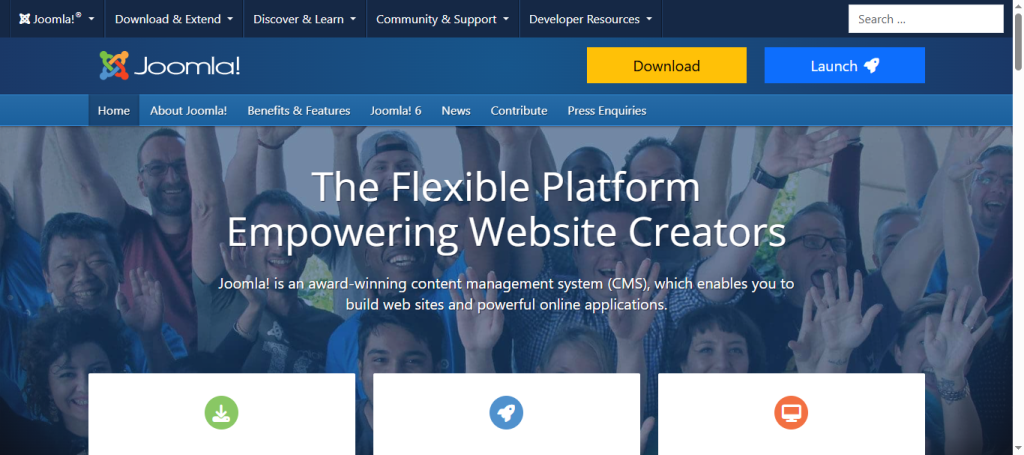
When we compare Joomla with WordPress, we realize that they differ. Firstly, Joomla suits large websites. Secondly, users don’t experience performance problems when they try to expand their sites due to its architecture. Moreover, they can make full use of the codebase and interface to handle a multitude of pages and posts.
The platform primarily operates through a two-part system, including design and content. This helps users handle both these parts separately. As a result, website managers can manage content and other priority tasks without influencing the design.
From the designers’ perspective, they can manage design-specific tasks without affecting content-related features and options. Joomla is a suitable option for multifaceted sites that heavily rely on flexibility.
This shows that you can benefit from all the tools you need to handle and scale a large business site smartly. Otherwise, go with Drupal if you plan to launch an extensive corporate site.
Benefits of Joomla
Before we compare Joomla vs WordPress, it’s important to understand the key benefits of Joomla. These benefits are:
- Scalability: The CMS favors large sites with multiple pages.
- Two-Part System: Users can smartly build sites and manage content without affecting both.
What is Drupal?

Drupal is another impactful open-source content management system (CMS). The platform serves users who want to develop, maintain, and scale sites tailored to their specific needs.
Dries Buytaert was the mastermind behind Joomla, who created the platform in 2001. Drupal largely depends on PHP and is built on databases such as MySQL or PostgreSQL.
Drupal offers a huge module library and themes that allow users to improve their sites’ functionality and overall performance. It is definitely capable of effortlessly handling massive, complex websites.
However, there is a caveat: technical skills. You need some technical knowledge to use Drupal effectively. Doing so will help you make the most of this incredible CMS in the right direction.
Benefits of Drupal
Drupal has some significant benefits for its users, including:
- Customization: The platform offers a range of options to support content optimization.
- Scalability: It supports large businesses with massive websites
Why Does WordPress Lead the CMS Race?
There are various reasons. That said, they ultimately refer to one single factor. WordPress has offered users peace of mind by retaining its ease of use. As for Joomla, it also needs to enhance the “ease of use” factor.
Moreover, Drupal has not focused on improving the “ease of use” aspect to serve its target audience better.
Before highlighting why WordPress leads the CMS race, it is better to describe Joomla and Drupal.
Joomla – An Evenly-Poised CMS for Beginners and Specialists
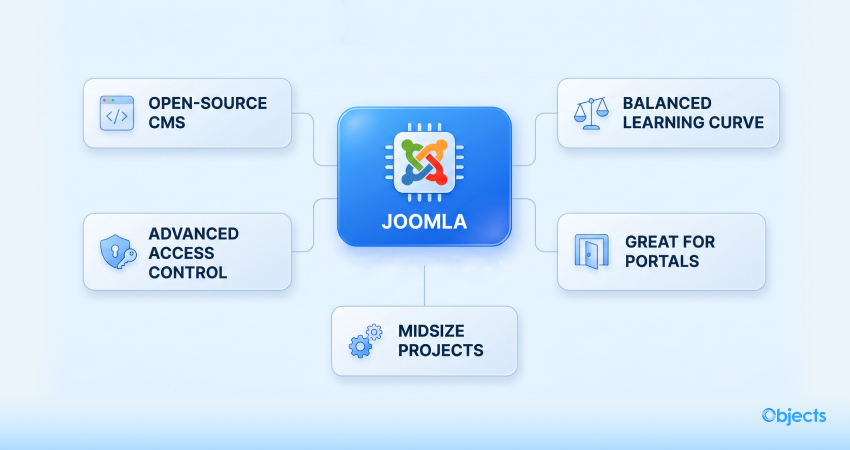
Joomla is an open-source, PHP-based content management system that sits between WordPress’s simplicity and Drupal’s complexity, balancing user-friendliness with developer features. 1.8% of all sites whose content management system is known rely on Joomla. It becomes 1.3% of all sites.
The tool has substantial content management capabilities and advanced access control. Joomla suits small to midsize organizations and websites that need portals or detailed community features.
In addition, if users want to set up Joomla for their existing or potential site, they should not overlook that the platform has a moderate learning curve. It is less customizable than WordPress and more user-centric than Drupal. Likewise, Joomla requires fewer resources and delivers better performance, making it well-suited for midsize projects.
Drupal – Another Crucial CMS that Favors Developers
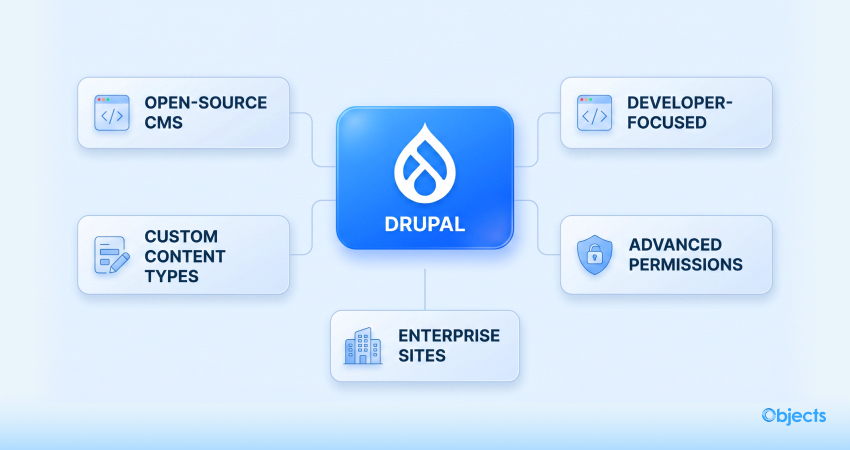
Drupal is another open-source CMS that leverages the PHP scripting language. The platform has software components that help improve functionality for adding custom content types and complex functionality. Interestingly, 1.0% of all the websites whose content management system we know use Drupal. It becomes 0.7% of all websites.
Furthermore, its extensive content taxonomy and user permissions help support complex, large-scale websites. Drupal is a good choice for educational and enterprise-level sites, but doesn’t seem to be a great alternative for small, simple sites.
That said, if you want to use Drupal, you must have some prior knowledge of coding and other technical concepts. Similarly, the flexibility part is massively dependent on PHP-compatible servers. For optimal performance, Drupal needs substantial resources.
WordPress – A Versatile CMS for Most Websites

WordPress is the world’s leading open-source CMS, with over 42% of all websites using it. Besides, it relies on PHP and plugins that help transform its functionality to new heights. Hence, new users and experienced professionals, such as coders, developers, and bloggers, can easily use WordPress to create their preferred sites.
Moreover, users can smartly customize sites across different niches and industries using plugins and themes. They don’t need technical expertise to use WordPress for managing websites. Additionally, the platform is lightweight and favors scalable options, including dedicated hosting, cloud, and more.
The above explanation highlights that WordPress is a more dominant content management system (CMS) than Joomla and Drupal.
WordPress vs Joomla vs Drupal (Crucial CMS Features)
| CMS Features | WordPress | Joomla | Drupal |
| Data Handling | WordPress is an ideal platform for content-based websites. This shows that it can effortlessly streamline data handling activities. | Joomla is compatible with medium-sized sites. It also assists users in data handling activities. | Drupal helps users efficiently handle large volumes of data. It works well with enterprise-level sites. |
| Access Controls | WordPress has a variety of access control options. | Joomla offers a range of innovative access control options. | Drupal also provides users with several access control features. |
| Multilingual Websites | It favors multilingual sites that comprise plugins. | It helps users create and handle multilingual sites. | It supports the creation, maintenance, and expansion of multilingual sites. |
| Content types | WordPress enables bloggers, entrepreneurs, and other users to create content in multiple formats. | Joomla has various content types. | Drupal encourages users to create custom content types. |
| SEO | Users can use various SEO plugins for keyword optimization, readability, and other purposes. | Extensions (such as EFSEO) support on-page SEO. | The taxonomy system enables robust content categorization. |
WordPress Use Cases
WordPress suits a variety of target audiences, like experts, beginners, small businesses, big companies, and large enterprises. We can easily recommend WordPress to bloggers, entrepreneurs, small and large business owners, enterprises, companies, etc.
The platform supports blogging sites, educational sites, e-commerce sites (through WooCommerce), membership and subscription sites, online learning platforms, and more.
From a personal e-commerce site to a blog, WordPress is an ideal solution for any niche. Our WordPress development services help bloggers, entrepreneurs, companies, and enterprises build responsive, customized websites that scale over time.
Joomla Use Cases
Joomla suits large, enterprise-level sites, including corporate sites and portals. In addition, the CMS supports community and membership sites, e-commerce sites, and news sites.
Drupal Use Cases
Drupal favors niche industries, which is why it supports large businesses willing to attract diverse target audiences through large corporate websites. Furthermore, it favors healthcare, educational, media, enterprise-level, and other sites.
Wrapping Up
We expect you to appreciate our exclusive WordPress vs Joomla vs Drupal comparison guide. There is no denying that every CMS has its own strengths and weaknesses, and the right option depends on what you need for your website. A few platforms prioritize ease of use, while others emphasize security, scalability, or flexibility.
At the end of the day, regardless of the content management system (CMS) you choose, performance in installation and setup, ease of use, results, and scalability matter. That’s because a well-crafted, well-directed, and well-managed site has the potential to fulfill and even exceed your expectations.
Therefore, you should invest your time when selecting the right CMS for your current or potential website. In this case, experimenting with various platforms is highly recommended. Eventually, success comes down to how well you use it to develop a website that fulfills your needs.
FAQs
Is Drupal harder than WordPress?
Yes, Drupal is harder than WordPress because it’s built specifically for technical users. WordPress, on the other hand, favors non-technical users.
Is Joomla easier than WordPress?
If you want a fast, easily manageable platform, WordPress is a better option. If you need a platform that offers technical control and complex customization, Joomla is a better fit.
What is the difference between WordPress, Joomla, and Drupal?
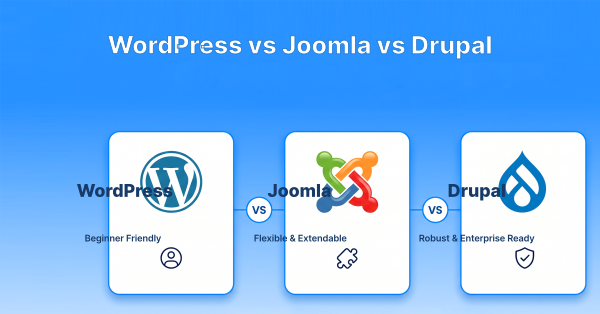
WordPress, Joomla, and Drupal are all notable open-source content management systems (CMS). These platforms offer different levels of flexibility and ease of use. Besides, their target audiences are dissimilar.
WordPress serves bloggers and beginners well. Joomla strikes a delicate balance between ease of use and flexibility. Drupal attracts users with its impressive scalability and security for large, enterprise-level sites.
Is Drupal a CMS or CRM?
Drupal is the world’s most powerful open-source content management system (CMS) that empowers you to build ambitious, flexible, and scalable content.
Does Tesla use Drupal?
The popular electric car company Tesla Motors prioritizes Drupal for its corporate website. The platform enables Tesla to deliver a fluid, dynamic user experience, providing detailed information about its vehicles, flexible, easy-to-use options, and associated services.
![Web Crawlers List – Famous Bots [2026]](https://objects.ws/wp-content/uploads/2026/05/2-Web-Crawlers-List-–-Famous-Bots.jpg)